










Archives

Recent Assets

  • ITAF_QRA.jpg
  • Hawk KSA 560.jpg
  • 7117003209_0a89e5b7fa_h.jpg
  • 7176702010_df702a73fc_b.jpg
  • Voyager.jpg
  • Voyager 560.jpg
  • Grizzly 560.jpg
  • MSN2 560.jpg
  • 111207-F-AQ406-219WICf22.jpg
  • 120510-F-AD344-089t6vance.jpg

October 2010 Archives


Photo by Lockheed Martin
So far, the F-22 and F-35 have been developed along parallel paths. Except for one of the F-35's engines, the direct links between Lockheed's two "fifth-generation fighters" are surprisingly thin. It seems both Lockheed Martin and the US Air Force like it that way. If an official -- or even unofficial -- photo exists showing both aircraft together in flight, I've never seen it.

The disconnect extends deep beneath the titanium and steel skin. Major subsystems for both aircraft are based on different computing architectures. So improving hardware or software on the F-35 yields no benefit for the F-22, and vice versa.

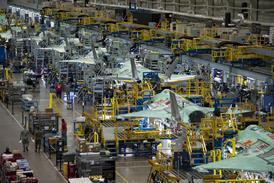
No decisions have been made, but Lockheed officials at the F-22 factory are asking if that should change, only 16 months before the production line is shut.

The concept involves installing the F-35 computing architecture and certain hardware in the F-22. Even Lockheed acknowledges the idea would require "significant initial investment", but could yield "some cost savings" in the long-term. Discussions with the US Air Force are underway.

"Say, if we want to add something to [the F-22] CNI suite, F-35 could take that wholesale with minimal modifications," says Jeff Babione, vice-president and deputy general manager of the F-22 programme. "So you'll see this bouncing back and forth where F-22 develops something for F-35, and F-35 develops something for F-22."

Although less powerful and slower than the F-22, the F-35 has more sensors. Installing the electro-optical targeting system, infrared search and track and distributed aperture system "as is" on the F-22 is impossible, the company says, but the proposed "common architecture and common modules provides the opportunity for synergy ... at a potentially lower cost across both platforms".

Another potential example is the integration of the multifunction airborne data link (MADL), a narrowband channel designed to pass data between stealth aircraft such as the F-35, F-22 and the Northrop Grumman B-2A bomber.

The US Congress has criticised the US Air Force over the high cost of integrating MADL on the F-22, even after making a similar heavy investment for the F-35. The USAF has recently withdrawn MADL from the Increment 3.2 upgrade programme for F-22, delaying the start of integration until fiscal year 2014, Babione says.

But adopting a common architecture with the F-35 could "dramatically reduce" MADL implementation costs on the F-22, Babione says.


A host of aircraft have been pitched for counter-insurgency. Revive the OV-10? Check. Convert the AirTractor cropduster into the AT-802U? Yep. Remake the T-6A into the AT-6? That too. Here's a new one:


ATK has teamed up with Mohawk Technologies and Broadbay to revive the OV-1D Mohawk for the counter-insurgency market.

The new version adds the ATK 30mm chain gun from the Boeing AH-64 Apache, plus a glass cockpit and integrated targeting system with electro-optical/infrared sensor turret.

Mohawk owns six decommissioned OV-1Ds that are available for conversion, with dozens more of the aircraft available on the used market, says JT Young, of Broadbay, which supplies the crews to operate the OV-1Ds.

The second-generation OV-1D is being pitched as a live-fire training aid for the US military's schools for joint terminal attack controllers, says ATK's Clay Bringhurst. The schools could operate the OV-1Ds on a fee-for-service basis, or buy the aircraft outright. If someone decides to push the armed reconnaissance trainers into a combat zone, so much the better. "Why not?" says Bringhurst.
 
But the ultimate goal is to sell the aircraft on the foreign market. The US State Department last week approved ATK's license application to market the aircraft to approved foreign customers. The OV-1D team is targeting potential military and government buyers in the Middle East and South America.


After surviving two attempts to field a replacement scout helicopter, the Bell Helicopter OH-58D Kiowa Warrior is only getting stronger as the US Army considers a wide range of options for its future.
The Kiowa Warrior assumed a starring role on the service's biggest stage -- the annual convention of the Association of the US Army.
Army officials revealed a new "Fox" model called the OH-58F, featuring long-awaited cockpit and sensor upgrades for the 26-year-old scout helicopter fleet. The army also announced that Bell is resuming a production line for Kiowa Warrior conversions that has lain dormant for about 15 years. The goal is to replace 43 OH-58Ds lost in accidents and combat since 2003 with remanufactured aircraft.
Both steps are strong endorsements in the future of an aircraft that could again be recommended for retirement within six months. An ongoing analysis of alternatives, commissioned in the wake of the 2007 cancellation of the Bell ARH-70 Arapaho, is setting the course for the future of the army's scout helicopter fleet.
Army officials declined to release any new preliminary findings, although officials confirmed that a solely unmanned solution has been ruled out.
When the study is complete in the second quarter of next year, army planners could still point in any of several directions.
One option is to launch a new development program for a high-speed aircraft, with the newly-unveiled Sikorsky S-97 Raider as a top candidate. Another option is to park the Kiowa Warrior fleet for an off-the-shelf aircraft that can meet the army's most demanding new requirement for so-called "high-hot" capability.
In mountainous Afghanistan, the OH-58D lacks enough power fly missions when hovering out of ground effect at 6,000ft on a 35ºC (95ºF) day is required. EADS North America and Lockheed Martin have teamed up to adapt the UH-72 Lakota utility helicopter into an armed scout. Three of the AAS-72X demonstrators are now in development. AgustaWestland, meanwhile, would offer a militarised variant of the AW-119.
But the army may decide to capitalize on its current investments in the OH-58D, which include integrated a digitally-based glass cockpit and a nose-mounted Raytheon common sensor payload (CSP).
But the OH-58D still fails to meet the new standard for high-hot performance. Bell is proposing to replace the Rolls-Royce Model 250-CR30 with the Honeywell HTS900-2, a 50% more powerful alternative leveraged from the cancelled ARH-70. Rolls-Royce, however, has countered with an offer to increase the 250's thrust by up to 12%.
If preserving the OH-58D is the army's preferred approach, the army also can look at the AVX Corp., a Texas-based start-up founded by mostly former Bell engineers. AVX is proposing to transform the OH-58D into a compound helicopter with about 25% greater speed and, according to AVX officials, at a fraction of the cost of the Bell reengining programme.


While I was covering the NBAA convention in Atlanta last week -- amongst other travels -- my colleague Craig Hoyle in London covered the results of the UK strategic defence and security review, which you can read here.

In case you've been living on another planet (or, ahem, at NBAA), the big news is UK government's decision to exchange the short-takeoff-and-vertical-landing (STOVL) F-35Bs for F-35Cs.

Some may consider this a devastating blow to the US Marine Corps.

I consider it a very belated payback for Skybolt.

In December 1962, Secretary of Defense Robert McNamara decided to unilaterally cancel the Douglas GAM-87A Skybolt, the first air-launched ballistic missile. The news was not well-received in Whitehall.

Only two years before, then-Minister of Defence Peter Thorneycroft had committed to Skybolt after canceling the British Blue Streak missile, resting the UK's nuclear deterrent capability entirely in the hands of an unproven, developmental missile paid for almost completely by the Americans.

By canceling Skybolt -- and, not least, for failing to adequately consult Thorneycroft about the decision -- McNamara nearly destroyed the burgeoning UK-US alliance. A contemporary account of the diplomatic pickle is available here in the online archives of Flight International.

In both cases -- F-35B and Skybolt cancellation decisions -- good diplomacy was restored by a face-saving gesture from the offending party. Last week, the UK government exchanged F-35Cs for F-35Bs. In December 1962, the Kennedy Administration may have saved the Macmillan government by giving them the Polaris missile. Compared to Skybolt, that was indeed a bargain.

In the wake of the SDSR decision, I'm not sure the US Marine Corps made off so well.


The launch of an all-new airlifter development for the US Air Force could start in 2014. The new aircraft could become operational 10 years later. The aircraft would replace the 450-aircraft C-130 fleet, but the USAF may buy no more than 250. Even after at least five years of discussion, the USAF still does not know whether it wants a fixed-wing, tiltrotor, rotorcraft or airship.

These are possible implications inside a capabilities request for information document posted earlier today by the USAF's Aeronautical Systems Center about the Joint Future Theater Lift (JFTL) program .

It is, of course, dangerous to read too much into a CRFI. No requirements for the JFTL are established, and basic assumptions can change dramatically over the next 12 months. In fact, the CRFI is released precisely to help the USAF make a series of fundamental decisions about the program. But the CRFI is useful for gleaning the USAF's analytical framework as the service considers its options.

According to the CRFI, the next C-130 may have to carry up to 190% more payload and assume a new mission -- mounted vertical maneuver. Taking on the MVM mission means dropping off medium-weight armored vehicles -- think Bradleys, not Abrams -- in places the enemy does not expect. Long, concrete runways? Not any more. Fifteen hundred feet of level, hard-packed surface? That might work. Perhaps better: a clearing big enough to land a really big tiltrotor or helicopter. 

At this point, the USAF has a lot of options. Lockheed Martin's Skunk Works is sponsoring Predator and Hummingbird inventor Abe Karem to design an optimum-speed tiltrotor for precisely such a mission. At the same time, Lockheed also has revealed a glimpse of a wider version of the C-130. Boeing has proposed an entire suite of options ranging from helicopters to tiltrotors to new variants of the C-17. EADS North America wants the USAF to consider the Airbus A400M. More exotic concepts also exist with stealth characteristics and embedded propulsion (see Boeing Speed Agile concept pictured above).

What the CRFI shows is that the time for making some very basic decisions is getting even closer. If the USAF wants to launch a new program by 2014, service officials need to define the requirement and ask a future Secretary of Defense for a lot of money at the dawn of a new era of fiscal austerity.

Here's a summary -- copied and pasted from the CRFI -- of what the USAF wants to figure out.    


Photo by Stephen Trimble

Rolling up to Sikorsky's flight test center on the edge for the Everglades before dawn this morning, I told the guard I was here for the "X2 media event". The guard looked confused, and replied: "But that's tomorrow." The dude left me hanging in shock and primal dread for several seconds before he broke into a grin. "Nah, I'm just kidding with you," he said. Just my luck to find the only corporate security guard in the aersospace industry with a mischievous sense of humor.

My return flight to Atlanta was already booked for 11am, and this was an event I did not want to miss.

Having completed a record-breaking, 250kt flight with the X2 last month, Sikorsky finally showed the aircraft in flight to the media, then revealed plans to develop two flying prototypes called the S-97 light tactical helicopter. Read my news story on S-97 here. Or watch Sikorsky president Jeff Pino briefing the press below.


I filmed as much of the event as I could on my Sony flip-cam. It's a little shaky during parts of the X2 flight demonstration, as I was filming with my left hand while snapping photos with my right. After the X2 makes a 160kt pass in a race with a Bell 407 (which actually was simulating the 90kt top speed of the OH-58 Kiowa), fast forward to the 20-minute mark. Then you'll see the X2 flying past the reviewing stand at 210kts.

This contract award awarded by the US Navy last January is so screwed up I don't know where to start. If even half of it is true, it would reveal both an all-new fighter and the resurrection of the F-117 Nighthawk. My guess is we're dealing with freakish typo issues here. See link for contract award announcement, or read excerpt below: 

                Universal Propulsion Co., Fairfield, Calif., is being awarded a $16,015,378 firm-fixed-price, definite-delivery/definite-quantity contract for the manufacture of digital recovery sequencer kits, power modules and electronic modules in support of the F-15, F-16 F-17 and F-117 aircraft. Work will be performed in Fairfield, Calif., and work is expected to be completed by July 2011. Contract funds will not expire before the end of the current fiscal year. This announcement includes foreign military sales to the governments of Taiwan (11 percent); the Netherlands (10 percent); Saudi Arabia (4 percent); Singapore (3 percent); Korea (3 percent); Thailand (2 percent); Norway (2 percent); Egypt (2 percent); Israel (1 percent); Denmark (1 percent); Oman (1 percent); and Pakistan, Jordan, Italy, Poland, Chile and United Arab Emirates (less than one percent). This contract was not competitively awarded. The Naval Inventory Control Point is the contracting activity (N00104-10-C-K026).
Let's count the problems:

  1. The Navy doesn't own any F-15s and only a handful of F-16s for aggressor training.
  2. The "F-17" doesn't exist. The YF-17 prototype, which became the F/A-18A, flew in the mid-1970s.
  3. The USAF allegedly retired the F-117stealth fighter in March 2008, although there have been recent sightings as reported on this blog last week.
  4. Foreign Military Sales customers probably aren't in the market for propulsion components for the F-117.
I've asked the Navy's press office to explain this contract. In the meantime, any theories?


Russia's fifth-generation fighter -- the PAK-FA -- staged an air show for Russian President Prime Minister Vladimir Putin back in May. Russian TV showed a few clips of what was then the 16th flight of the prototype called the T-50.

A new video posted on YouTube on 13 October reveals nearly 2 minutes of new footage allegedly from the same demonstration flight. It doesn't tell us anything remarkably new about the aircraft's capabilities, but the footage is stunning. Whatever its combat capabilities, Sukhoi definitely has a new star on the air show circuit. I hope we'll see the T-50 make its debut at the MAKS air show in Moscow next Aug 16-19, although the Paris Air Show in June would be even better since I'll probably be there.


I suppose it's only fitting that a historical briefing on the CIA A-12 Oxcart project gets wrapped up in intrigue. The Smithsonian Air & Space museum has resposted an audio-only version of the 24 September briefing on YouTube about one week after taking down a link showing the panel discussion in video. Since a couple of former spooks participated, it's possible they didn't want their faces on YouTube even in retirement. Or maybe the museum felt insecure about the production qualities of video presentation, although I thought they were fine for YouTube. Anyway, I encourage everyone to listen to the briefing, as it's a fascinating retelling of one of -- if not simply the -- most technically ambitious projects in aerospace history.

I will note that the audio-only presentation is three seconds shorter than the version posted last week. I don't have a transcript of the first briefing, so I have no idea if any content was deleted.

The US Air Force retired the F-117 in dramatic fashion in March 2008, ceremonially sending off the final four of the gawky stealth fighters to storage at the Tonopah Test Range, then releasing images of one poor airframe getting crushed into little pieces by a Caterpillar excavator. USAF message: See? No more F-117s here!

But, like Elvis, some folks believe the F-117 still lives and even prowls the skies above us -- especially if you happen to live in the Nevada desert. In fact, the forums at abovetopsecret.com are buzzing this week about an alleged sighting of the Skunk Works product on October 5, with both photos and video (caution: requires special video player) of the purported encounter. Unfortunately, there's no way to definitively prove the images were not taken years earlier, and the camera operator neglected to pan over to a newspaper with the morning's date.
Josh Rogin of Foreign Policy magazine's blog, The Cable, solves the mystery of the White House letter sent to Congress last week that seemed to open the door for C-130 sales to China. Rogan writes:

"The president's waiver allows for the temporary export to China of C-130 aircraft only for the purposes of refueling and/or resupplying with oil spill chemical dispersants in China as necessary for oil spill response operations in the Southeast Asia region," said National Security Council spokesman Mike Hammer. "No C-130 has gone to China or is being sold to China; this is just a waiver for a contingency plan."

Administration officials told The Cable that the State Department will still need to review and issue licenses for any C-130s that travel to China, and that this waiver was granted at the behest of allied countries.

"A European company that has C-130s wanted to be able to use them in a disaster response in that region and needed the waiver just in case they needed to land in China," a senior administration official told The Cable.

This, of course, raises a new mystery: What European company owns C-130s? I'm aware one American (Lyndon Air Cargo), one Canadian (First Air) and two African companies (Libyan Air Cargo and Transafrik) operating the L-100 commercial version of the C-130. If there's a European operator, they must have a decommissioned militarized C-130. Any guesses?


Appearing at the National Press Club today, Gen Norton Schwartz had a message for the General Electric/Rolls-Royce team building the controversial F136 alternate engine for the F-35 fighter:

"I don't deny that competition might well result in some savings over the long-run. The question is whether we can afford it in the short-term. And I have to be candid that if Rolls and GE are so confident that their product will succeed and bring value to the taxpayer, it would be nice if they put a little bit more against that $1.9 billion bill that they want the taxpayer to undertake."
In the arcana of US government acquisition terms, "indefinite delivery/indefinite quantity" is a big one. But you don't want to mix your words up, or you might make an inadvertently hilarious, Freudian-like slip, which Lockheed Martin managed to do in a press release issued this morning. To wit:

ORLANDO, Fla., Oct. 12 /PRNewswire/ -- Lockheed Martin (NYSE: LMT) has named Howard Yellen Vice President of Special Operations Support Contractor Logistics Support Services (SOF CLSS). His primary responsibility is executing a 10-year indefinite delivery, indefinite quality contract, potentially worth $5 billion, providing logistics support to U.S. Special Operations Forces (SOF) around the globe.
[UPDATE: I owe Lockheed an apology. For horrendous typos, nothing beats this unfortunate error (see caption) last week on the US Marine Corps' official Flickr page. See URL: http://www.flickr.com/photos/marine_corps/5057190082/]

Since becoming US Air Force chief of staff in July 2008, Gen Norton Schwartz has presided over the cancellation of the F-22 and the Next Generation Bomber, the retirement of hundreds of tactical fighters, the revitalization of the nuclear enterprise, a politicized process to select a tanker supplier and a surge of intelligence, surveillance and reconnaissance support to Afghanistan. Schwartz's tenure may be remembered in history as a pivotal period in airpower, or perhaps an aberrant blip from convention.

The talk around Washington DC suggests Schwartz will soon depart his current post for a higher-profile role on the Joint Chiefs of Staff. Perhaps as a dress rehearsal, Schwartz will stage a rare appearance for a service chief of staff on Tuesday at the "Newsmaker Luncheon" hosted by the National Press Club. It will be an opportunity for ourselves in the press to gauge Schwartz's legacy as chief of the world's largest air force. And, yes, I expect there to be at least a few questions about the tanker contract.

Photo courtesy US Air Force

China may be the next export customer for the Lockheed Martin C-130.

Really.

The White House on Friday posted this letter from President Barack Obama to Rep Nancy Pelosi, speaker of the House of Representatives:

"I hereby report to the Congress that it is in the national interest of the United States to terminate the suspensions under section 902(a)(3) of the Act with respect to the issuance of temporary munitions export licenses for exports to the People's Republic of China insofar as such restrictions pertain to the C-130 cargo aircraft to be used in oil spill response operations at sea."

This is quite an interesting development. There does seem to be a legitimate pretext. C-130s helped spray oil dispersal in the Gulf of Mexico after the Deepwater Horizon oil spill in April. China also has been dealing with a much smaller oil spill in the Yellow Sea since July. Meanwhile, the Congressional notification comes a few days before US Secretary of Defense Robert Gates meets his Chinese counterpart in Hanoi.

But it's still surprising to see the US lift a strict embargo on arms sales to China for a C-130. Why? China already owns a fleet of C-130-like Shaanxi Y-8s, a copy of the Antonov An-12. Moreover, China is already building a C-130 look-alike called the Y-9. China also has a long history of re-engineering military and commercial aircraft.

Monday is a bank holiday for the US government, but I hope to start getting answers this week.


One of the Gripen NG's key sales points is range. Saab says the fighter can fly 1,300km with six air to air missiles, loiter 30min and return to base. It's hard to make a direct comparison to the F-35 since performance specifications with external stores are not publicly listed. Using only internal fuel and weapons, the F-35A is designed to fly 1,093km with up to four air-to-air missiles and return to base.

Massive fuel tanks allow Saab to achieve the range goal for the Gripen NG. Saab has now tested the 50% larger, 450gal fuel tanks in flight, as the video above clearly shows. 
Wasn't it weird enough that US Aerospace, a company nobody previously knew, joined the nearly 10-year-old KC-X competition one week before the bids were due, proposing two non-existent and one actual aircraft -- and all three designed in post-Soviet Ukraine -- and dispatching a bonded messenger with apparently vague instructions to deliver a $29 billion proposal to the main gate at Wright-Patterson AFB, then protesting the US Air Force's decision to reject the whole idea because it was allegedly submitted five minutes too late?

When you think about it, that was pretty darn strange.

So when they issue a press release that confirms the protest has failed, but misidentifies the name of their own aircraft as the "An-122KC" instead of the "An-112KC", it all sort of fits, doesn't it?

(Background: An-122KC was one of three options US Aerospace originally proposed when they joined the competition in early July. It is a concept for a twin-engined version of the An-124. The company actually proposed the An-112KC, which was a twin-jet, tanker version of the An-70 airlifter. But somebody at US Aerospace apparently got confused.)


Could the modern US aerospace industry build an aircraft today that is as ambitious as the A-12 Oxcart/SR-71 was for its time? Could the industry build an aircraft today that could beat the performance of the CIA's Oxcart and the Air Force's Blackbird?

If you ask the people who built it, I think they would probably say no.

The Air & Space Museum held such a discussion on 24 September, which was unfortunately sold-out before I could buy a ticket. But the museum kindly posted a nearly 90-minute video of the panel yesterday. The panel includes original members of the Oxcart development teams from Lockheed's Skunk Works and Pratt & Whitney. Kelly Johnson and Ben Rich are no longer alive, but their subordinates tell some good stories.

Former Skunk Works manufacturing director Bob Murphy says 100 engineers were assigned to the SR-71 program. Rockwell hired 5,000 engineers to design the B-1 bomber. "I don't know how you coordinate 5,000 engineers," Murphy grumbles. Pratt & Whitney J58 engineer Dennis Nordquist Bob Abernathy also remembers:

"Today there are layers and layers of oversight committees. In those days I could walk into Bill Brown's office and he'd pick up the phone and call Kelly. And there wasn't any of this -- more or less, the Air Force let Kelly Johnson and Bill Brown build the U-2, which they did, and then they built the Blackbird together as partners without the oversight that we have today."
The US Air Force summarily rejected the US Aerospace/Antonov proposal in July for allegedly being turned in five minutes late, but head of the Ukrainian manufacturer says they're still in the race.

"We have not managed to officially register our participation, but the terms were prolonged following our request, and we will take part in the tender," Antonov president and general designer Dmitry Kiva told reporters yesterday in Kiev.

I'm not exactly sure what "prolonged terms" he's talking about, but "we will take part in the tender" is clear enough!

Antonov's interest in KC-X almost overshadows the news that the company has resurrected the An-70. During the same meeting with reporters, Kiva said that Russia will take delivery of 13 An-70s before 2015. The An-70 is a turboprop airlifter in the same class as the A400M, but with even more powerful engines. For the purposes of KC-X, US Aerospace has proposed modifying the An-70 with two jet engines -- most likely General Electric GE90s.
About six months ago, intrepid mil-blogger Michael Yon posted a comment on this blog below an item showing a new photo of an Northrop Grumman X-47B. Yon wrote:

"I saw something like that land at Kandahar Airfield, Afghanistan. (Maybe was something else, but looked very similar.)"

Close, Michael, but not quite. The X-47B still hasn't flown yet. You must have seen the RQ-170 Sentinel, a stealthy unmanned air vehicle (UAV) confirmed by the US Air Force last December but still only glimpsed in a series of grainy or awkwardly-framed images.

Last week, a photo surfaced on a random Flickr page showing the RQ-170 in Kandahar. The image is attributed and copyrighted by Michael Yon, but the Flickr site appears to belong to someone else. It's not clear how the image turned up there, but it's a good thing it somehow came to light. Obviously snapped while Yon was taxiing in a passenger aircraft, the image reveals the best angle of the RQ-170 published so far in the unclassified world.

Thanks, Mr. Yon!