














Although the Trump Administration in Washington, DC has not yet made the decision to do so, it now has enough military assets in place to launch an air campaign against Venezuela.

The Pentagon, under the direction of Trump, has been slowly building up naval and air forces in the Caribbean region over the past several months, including the USS Iwo Jima amphibious ready group, equipped with Boeing AV-8B Harrier II jump jets, and land-based Lockheed Martin F-35B stealth fighters stationed in Puerto Rico.

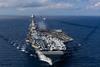
Most recently, the White House ordered the USS Gerald R Ford aircraft carrier strike group to the Caribbean, complete with the flattop’s full carrier air wing of four Boeing F/A-18E/F strike fighter squadrons and a single EA-18G electronic attack squadron.

Complementing all that air power are multiple US Navy vessels equipped with long-range Tomahawk cruise missiles.

Multiple flights by US-based bombers, including Boeing B-52H and B-1Bs, have also passed aggressively close to the Venezuelan coast.

USS Gerald R Ford c US Navy

Source: US Navy

Washington has ordered the USS Gerald R Ford carrier strike group to redeploy from the Mediterranean Sea to the Caribbean in support of a historic regional build-up of firepower

Thus far, Washington has not directly struck any targets on the South American continent, but American authorities have ordered lethal strikes on 13 small boats in the Caribbean and seven in the Eastern Pacific, according to the DC-based Center for Strategic and International Studies (CSIS).

“The United States and Venezuela teeter on the brink of war,” the think tank writes in a 10 November analysis authored by retired US Marine Corps Colonel Mark Cancian and research associate Chris Park.

At least 75 people are believed to have been killed in the ongoing American boat strikes, with the undeclared war having already turned quite hot.

By all indications, that heat is likely going to be turned up even further.

When the Ford carrier strike group arrives on station, the US armada will have at least 186 ship-launched Tomahawk cruise missiles within striking distance of all Venezuelan territory, according to the CSIS.

That marks a total greater than the number of Tomahawks expended during the recent Red Sea air campaign against Yemen’s Houthi militant group (135) or at the start of the 2011 intervention in Libya that ousted former dictator Muammar Gadaffi (150).

The 1999 NATO bombing campaign in the former Yugoslavia saw 218 Tomahawks fired, according to the CSIS analysis.

In addition to that long-range strike capacity, the Pentagon will enjoy a strong advantage in manned tactical aircraft, once the Ford’s carrier air wing arrives on station.

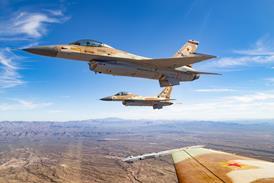
Against more than 60 forward deployed strike fighters and long-range heavy bombers able to reach Venezuela from bases in the continental USA, Caracas has a modest force of four legacy Lockheed F-16A/Bs and 21 Sukhoi Su-30MK jets.

These are in an unknown condition, although Venezuela did manage to sortie two of the F-16s in a show of force against the US build-up in early September.

In a reversal of the problem Washington faces in the Indo-Pacific, those Venezuelan jets would likely be knocked out, or at least rendered unable to launch, in the opening hours of a US campaign.

“Venezuelan air assets and facilities – such as runways – will likely be among the first targets struck in a US missile attack, making them inoperable,” the CSIS report notes.

China is expected to employ similar tactics against US air bases in the Western Pacific in the event of a conflict with Washington over Taiwan.

F-35s escort B-52

Source: US Air Force

Two F-35Bs from the US Marine Corps escorted a US Air Force B-52H long-range bomber during a 15 October “bomber attack demonstration” off the coast of Venezuela

Caracas does have ground-based air defence systems, which the CSIS notes could hold American aircraft at risk, particularly non-stealthy platforms like the F/A-18.

“Venezuelan capabilities pose enough risk that the United States will probably rely on long-range strike and not overfly Venezuelan territory,” the analysis concludes.

Notably, the Pentagon has only deployed a modest ground combat capability of some 2,200 US Marines embarked aboard the Iwo Jima amphibious readiness group – meaning any kind of large scale invasion remains unlikely.

However, Washington has the ability to deploy paratroopers from the US Army’s 82nd Airborne Division, several thousand of whom remain on global quick reaction status at all times.

Any serious ground incursion would require many times that number of troops, with such an operation remaining unlikely for now.

By contrast, the military requirements of an air-only war are both “straightforward and achievable”, the CSIS report says, noting that the intended political objectives and outcomes are another matter.

Such a campaign could involve direct strikes against the Venezuelan government’s internal security forces and command and control infrastructure or be limited to targets associated with the drug cartels identified by the Trump Administration as a national security threat.

Or Washington may back down on its pressure campaign without further escalation.

“War is not inevitable,” the CSIS report notes.