
Norwegian’s renaissance continues apace, with another set of strong earnings figures capping a year in which its pre-Covid struggles vanished from the rear-view mirror.
Notably, its latest earnings call on 13 February saw chief executive Geir Karlsen describe an airline that is very comfortable in its own skin.
Its product offering is exactly where ultra-low-cost carriers are aspiring to get to – and where customers want it to be – he argues, while big rival SAS’s move to focus on its Copenhagen base differentiates Norwegian’s point-to-point offering to its advantage, he adds.
At the same time, Norwegian is seeing strong gains from owning more of its fleet, is talking to long-haul operators about potential interlining, and is even able to tease the possibility that it will growth more “aggressively” than currently planned, should market conditions make that logical.
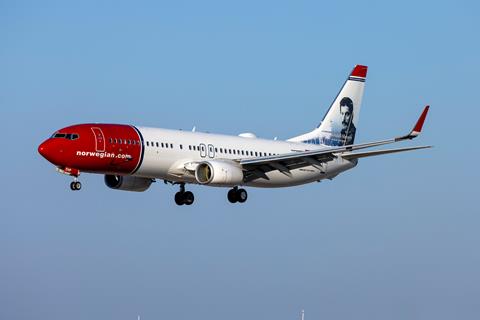
It has also upgraded the profitability boost it believes it can achieve from its slightly mysterious sounding ‘Program X’ initiative, continues to confidently adjust its capacity to help the business better deal with seasonality, is enjoying a boost to its earnings from the performance of acquisition Wideroe, and is paying dividends to its shareholders.
All told, Norwegian is quietly getting on with being one of Europe’s post-Covid success stories – a status that was unimaginable when its pre-Covid expansion into long-haul flying threatened its very survival.
Karlsen addressed many of the airline’s key initiatives on the latest earnings call, alongside talking points in the wider industry.
On product, Karlsen is clear that Norwegian will not be copying Wizz Air’s recent decision to roll-out a ‘premium’ seating option across its network (involving the blocking of the middle seat in the front row of aircraft).
He argues that Norwegian’s product offering already meets the standards that ultra-low-cost carriers are seeking to achieve with recent product upgrades, citing the airline’s 86% load factor in the fourth quarter of 2025 as evidence that its products are well-liked by customers.
“What you are seeing in the ultra-low-cost market, or the low-cost market if you include the US, is carriers are actually moving towards the legacy players, offering a more premium product; not all the way, but partially moving in that direction.
“That is actually the position that we have today in Norwegian,” he contends.
Among the initiatives that position Norwegian in that space, it has been courting the corporate travel market in recent years via agreements with more than 2,000 companies, while it has also upgraded its distribution capabilities and offers a frequent flyer programme.
“So we are very happy with the position that we are currently have, where we think we have a better product than the ultra-low-cost guys,” Karlsen says.
Regarding SAS, he acknowledges that there is a “constant fight between the two airlines”, but notes that the latter’s focus on a single hub differentiates the two business’s offerings – potentially to Norwegian’s benefit.
“That’s why we have come up with the slogan ‘why connect when you can fly direct’,” Karlsen says in reference to Norwegian’s point-to-point offering. “It’s a slogan but it’s an opportunity, big time.”
He adds that in Copenhagen, Norwegian must also “make sure we are treated fair in SAS’s main hub”.
On interlining, meanwhile, Karlsen says: “We would like to come into a position where we can do interlining; we are very close to that position.”
Interlining with Wideroe is the first priority, but Norwegian is also “in dialogue” with a number of airlines that fly into Scandinavia, he says.
“It depends on a few things, not at least a commercial agreement and whether that makes sense for us,” Karlsen explains. “It brings complexity into our operation and we need to get paid for that complexity.”
On fleet, Karlsen cites the options Norwegian has to grow by more than current projections in the coming years amid a positive demand outlook.
“That’s an optionality we like,” he says.
Those options exist around Norwegian’s leased Boeing 737-800s, Karlsen explains, which are gradually leaving the fleet as more 737 Max 8s arrive.
“We still have quite a few 737NGs – most of them are leased,” Karlsen says.
“Looking at the growth for the coming years… we have the flexibility of potentially extending the leased aircraft, if we should wish, so we could grow more aggressively.”
Norwegian expects to operate 95 aircraft his summer, including 36 737 Max 8s and 59 737-800s, and the fleet is projected to grow to 104 jets in summer 2028, featuring 65 Max 8s and 39 737-800s.
Karlsen further notes that having purchased 13 of its leased Boeing 737-800s in 2025, Norwegian remains in the market for similar deals.
“If opportunities come up on a similar basis we are more than welcoming that,” Karlsen states while reiterating the economic advantages Norwegian sees in owning more of its fleet.
Norwegian’s current fleet includes its first 737 Max 8 delivered from a direct order for 80 examples from Boeing, which was handed over to the carrier in October last year. That example is Norwegian’s first to feature its refreshed logo.
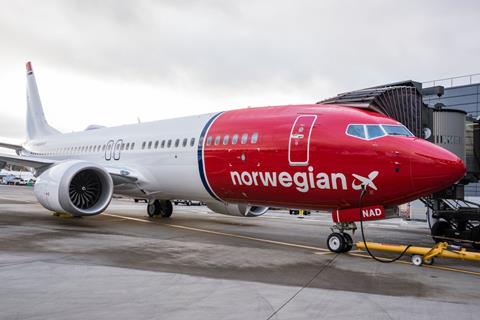
Norwegian achieved its best-ever operating profit of NKr3.73 billion ($389 million) in 2025, having swung to a NKr21 million profit in the fourth quarter. Its full-year net profit of NKr2.81 billion was around double that achieved in 2024, amid a “focus on cost control and robust operational performance”.
While Karlsen is firm that Norwegian is a structurally stronger business today, he also acknowledges that its earnings were helped by the recent weakness of the US dollar.
It plans to grow its capacity by around 3% in 2026, with Karlsen sounding optimistic about Norwegian’s earnings potential for the year.