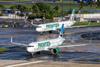
As a major competitor’s struggles cause it to enact sweeping fleet and network cuts, a pair of ultra-low-cost carriers – Frontier Airlines and Allegiant Air – are capitalising on the opportunity.
Barry Biffle, Frontier’s chief executive, said during the airline’s earnings call this week that the “competitive landscape is shifting in our favour, with our largest low-fare competitor significantly reducing capacity”.
Spirit Airlines has been cutting cities from its network and reducing capacity by more than 20%, compared with the equivalent period of last year, as it works through its second Chapter 11 financial restructuring in less than 12 months.
With so many discount seats coming off the market, that creates a “more balanced supply-demand environment”, Biffle says.
”This positions us to accelerate key commercial initiatives aimed at driving growth and reinforcing our competitive advantage,” he says. ”Our strategy remains clear: to be the leading low-fare carrier in the top 20 US metros.”
Frontier also expects tailwinds in the form of a strengthened loyalty programme and more premium-oriented products, including the roll-out of first-class seating early in 2026.
For the moment, Frontier has not been exempt from the sector-wide capacity cuts. It reports a year-on-year decline in third-quarter revenue of 4% to $886 million, driven by a 4% decline in capacity.

Looking ahead to the fourth quarter, Frontier expects capacity to be roughly flat with the October-December period of last year.
“Importantly, competitive seat capacity is projected to decline by two percentage points, including significant reductions by Spirit Airlines, which is exiting 36 overlapping routes and reducing frequencies by 30% across 41 others in December,” says James Dempsey, Frontier’s president.
As a result of Spirit’s widespread withdrawal, Frontier expects to enter a new growth phase in 2026.
”To capitalise on emerging opportunities, we announced 42 new routes launching through early 2026, expanding our presence in major metro areas such as Atlanta, Baltimore, Charlotte, Chicago, Dallas/Fort Worth, Detroit, Fort Lauderdale and Houston,” Dempsey says.
The carrier is also boosting international operations to sun destinations such as Guatemala, Honduras, Mexico, Turks and Caicos and the Bahamas.
Biffle cautions that a return to growth in the first half of 2026 is no guarantee, as it remains to be seen how competitors react to Spirit’s pull-back and Frontier’s bullish moves.
“We’re watching the competitive situation, and based on how that plays out, we have the ability to flex up or down,” he says. ”We believe there will be opportunities for us in our cost structure to kind of replace that capacity in several places – and, if so, that will dictate growth.”
ALLEGIANT EXPECTS ‘FLATTISH’ 2026 CAPACITY
Allegiant CEO Greg Anderson told Airline Business in September that the industry-wide capacity cuts being enacted in the USA are enabling new opportunities for the Las Vegas-based ULCC, as well.
“We have seen capacity reductions in the Vegas market from low-fare carriers, such as Spirit and Frontier, and we are seeing improvement from a margin perspective over the summer of 2024,” Anderson said. “It does have an impact as capacity adjusts and changes.”
But Allegiant is not as aggressive as Frontier in pushing into newly and soon-to-be-vacated markets. Looking ahead to 2026, Anderson envisions a modest approach to capacity, but nothing approaching the cuts underway at Spirit.
“From an industry perspective, carriers are moderating their domestic capacity plans, and we are planning on flattish capacity next year as we drive a higher percentage of peak-day flying,” he said during the company’s 5 November earnings call.
While not anticipating notable capacity growth in 2026, the carrier expects a year-on-year increase in traffic “driven by limited growth, industry supply moderation and revenue initiatives”, says Robert Neal, Allegiant’s chief financial officer who was recently named as the airline’s president.
Like other US carriers with heavy domestic exposure, Allegiant notes a “steady improvement in the demand environment” during the third quarter, with encouraging trends continuing into the final three months of the year.
Anderson says Allegiant recorded a “modest operating loss in what is typically our weakest period of the year”, but at the more-optimistic end of its previously issued guidance range.
Allegiant’s year-on-year revenue growth was roughly flat in the third quarter, at $562 million, with the company posting a net loss of $77 million during the July-October period.
That compares with a $24 million net loss during the same period of last year.
Allegiant expects to operate 16 new Boeing 737 Max 8-200 aircraft by year-end, and for that narrowbody type to produce about 20% of the airline’s passenger capacity for the full year of 2026.