
Having stepped up to lead Air Baltic on an interim basis following Martin Gauss’s sudden departure, the chief operating officer is clear-minded on where the business is heading
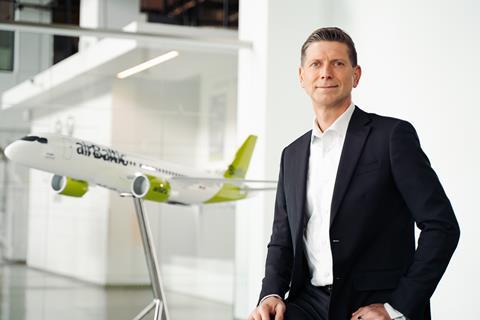
For Air Baltic’s Pauls Calitis, running the airline on an interim basis is the latest step on a career path that began with the airline’s formation in 1995.
Part of the first group of pilots recruited by the Latvian carrier, Calitis has since made his way from first officer to part of the leadership team, on that journey experiencing the impact of outside factors including 9/11, the financial crisis and the Russia-Ukraine war, and the transformation of the airline itself from a small carrier with a handful of jets and turboprops through the world’s largest operator of Airbus A220-300s.
Notably, Calitis was central to the introduction of that aircraft to Air Baltic’s fleet.
“One of the most emotional days of my professional career was bringing the first [Bombardier] CS300 – at that point in time – to Latvia, doing the ferry flight from Canada,” he tells Airline Business during a late-April interview.
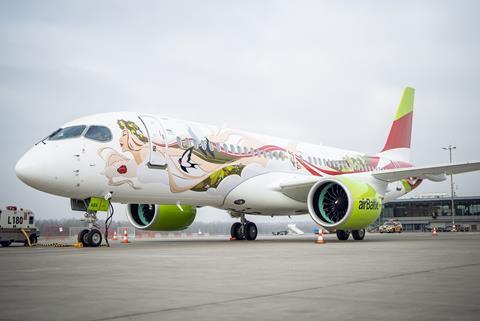
“To go from that first aircraft and then now to be an airline operating 50 of those aircraft and then having the next growth phase ahead of us [with another 40 on order]… The experiences, the changes, the processes that I’ve been had the pleasure to be involved in is really tremendous.”
But as interim leader of Air Baltic, his new challenge is a significant one, even if it is on a temporary basis.
Calitis stepped up in to the top job on April, after Air Baltic’s supervisory board made the decision to end the contract of long-serving Martin Gauss.
IN THE COCKPIT
Acknowledging that Gauss’s departure was unexpected, Calitis cites his own piloting experience as important in adapting to his new role.
“One of my leadership qualities… coming back to the piloting side of things… is a very pragmatic, calm and thorough look at things,” he states. “I know how to make decisions. I can do decision-making when it’s needed quickly, but I can also make sure I see the full picture and integrate things.”
So, what has the supervisory board tasked Calitis with as it searches for Gauss’s permanent replacement?
He is keen to stress that Air Baltic’s fundamental strategy is unchanged, but that there are important tasks ahead.
Crucially, he has already played a central role in preparing the business for a much-discussed IPO, having been part of the management board for around five years, working as the airline’s operations chief.
That IPO remains the business’s and Calitis’s key goal.
“Bringing the airline to the point of being ready to execute an IPO has been a tremendous experience and the process to go through,” he states.
Calitis observes, however, that the current market is not a good one for IPOs, with the business needing to wait for its moment.
Still, with the IPO ambition front and centre of Air Baltic’s strategy, Calitis outlines two key strategic pillars – including one urgent priority in his role as interim chief – with the ultimate aim of ensuring Air Baltic delivers at a commercial and operational level.
“The one immediate task was to make sure that we have the proper information flow and contact with stakeholders… be it commercial, be it financial, be it operational,” he says.
“There obviously are a lot of different stakeholders that wanted, needed, expected information.
“It’s still an ongoing process to make sure that we have clear communication and clear understandings of where we stand and what’s happening,” he states.
ALL IN THE EXECUTION
Within that context, Calitis notes that with Air Baltic in the busy summer season, “I need to have the organisation focused on execution”.
That has not always been easy. The carrier was forced to announce in January, for example, that it was cancelling almost 5,000 flights in the summer season due to aircraft groundings relating to their Pratt & Whitney PW1500G engines.
“We have to be focused on this and making sure that we are [delivering] in terms of our fundamental core values and our core mission,” he adds.
The second key priority, he says, is taking the opportunity to enact changes in the business within the confines of its overall strategy – an ambition made easier by the IPO implementation being paused as Air Baltic waits for markets to improve.
“We’ve had a very high organisational focus on the IPO,” he says. “There’s a pause button is activated and that can also free up a bit of internal capacity to refocus in other areas in another way.”
That means Air Baltic is working on what Calitis calls a “business improvement programme”
“There are deep dives in each area [of the business]… all the findings and ideas come out and get validated – and we figure out which ones make sense in terms of going forward.”
With that work under way, Calitis reiterates that Air Baltic’s fundamental strategy is unchanged by Gauss’s departure.
SAME FUNDAMENTALS
“The key thing to remember is that our fundamental strategy… is not being challenged,” he states.
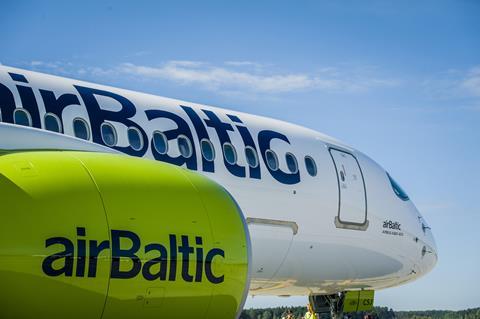
That fundamental strategy, developed under Gauss’s leadership, includes Air Baltic being a single-type airline, with a fleet of A220-300 twinjets, operating as “a network carrier with our hub in Riga”, he explains.
“Our core market is the Baltic area including Tallin and Vilnius, and also the flying that we do through Tampere [in Finland].”
Another key pillar is Air Baltic’s ACMI work, which became central to its strategy during the Covid-19 crisis.
“We currently have the three-year framework agreement with Lufthansa Group and each year we are doing more and more in this regard.
“So again, as of April, we have 19 aircraft that are deployed for Lufthansa Group, [across] four different airlines and four different bases in Europe.”
With that deal in place, Lufthansa Group is in the process of taking a minority take in Air Baltic, which Calitis says gives the airline ”comfort that this is a long-term partnership”.
Underpinning its priorities, Air Baltic is also focused on improving its financial performance, Calitis says.
The airline achieved an operating profit in 2024, but swung back to a full-year net loss after being in the black in 2023.
Air Baltic annual net profit trend
Helpfully, Calitis points out an there is an “expectation” that some headwinds faced in 2024 will moderate and “be less of an influence in 2025”.
One of those is the grounding of aircraft amid work on their Pratt & Whitney PW1500G powerplants, which is causing a lack of spare-engine availability. In April, Calitis says, Air Baltic had nine aircraft grounded by the issue and continues to wet-lease-in some jets to compensate.
“We plan to be less impacted this year than we were last year,” he says of the engine issues. “Next year we plan to be even less impacted than this year.”
And in 2027, he suggests the situation should be “normalised”.
“We still have issues ahead of us,” he states. “But we obviously have a lot of history and operational experience behind us. So we know how to deal with this issue.”
An end to the war between neighbouring Russia and Ukraine would also be a boon to Air Baltic, but Calitis is cautious about making any predictions in that regard.
For now, his focus is on Air Baltic’s key pillars and working towards an IPO.
“The business is in solid shape, it’s in good hands and we now move forward to find the right timing and the right possibility to execute,” he says.