
Commercial chief Arved von zur Muehlen outlines moves to transform the legacy carrier in tandem with the opening up of the kingdom to tourists
Amid the huge effort under way among Saudi Arabia’s airlines – old and new – to play their part in the projected growth of air travel to and from the country, eye-watering numbers tend to generate the headlines.
Hundreds of new aircraft are on order among its growing list of carriers, aimed at delivering on the government’s Vision 2030 ambition of reaching 150 million tourists, having passed the 100 million mark in 2024.
But at legacy flag carrier Saudia, capacity growth is just one strand of the story; the other is a wholesale transformation of the airline.
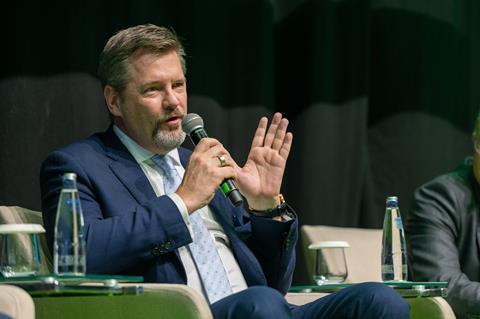
“As the country is transforming itself, so is the airline,” Saudi chief commercial officer Arved von zur Muehlen tells Airline Business during an interview at London’s World Travel Market event in November.
“It’s not only building the bridges and bringing guests into the kingdom, it is also to transform a legacy airline into a very modern airline.
“It’s a bold growth plan and a bold transformation plan at the same time. It’s also a mindset transformation.”
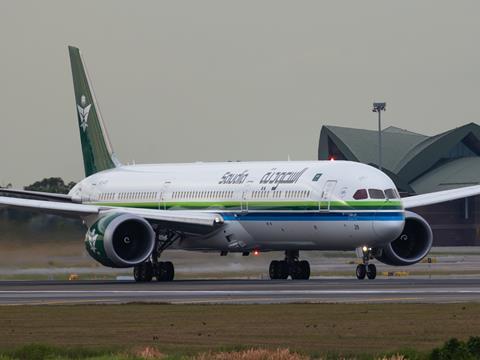
Von zur Muehlen says the state-owned operator’s “holistic” transformation is touching all parts of the business – “people, process, technology and product” – as it readies to receive 116 more aircraft through to 2030, bringing its fleet from around 160 jets today to about 230.
“In [20]26 we get a plane per month; in [20]27 we get a plane per week,” he states. “So you see we are ramping up quite significantly.”
Those incoming aircraft include dozens of Airbus A320neo-family jets, including A321XLRs – “we will use them to build up new destinations” – A330neos and Boeing 787-9s and -10s.
“I think we are the only airline maybe in the world that has to go through a very deep transformation while it is growing,” he says.
A broad aim of that transformation effort in a country where more than two-thirds of the population are under 30 years of age is to turn 80-year-old Saudia into a “digital” airline, von zur Muehlen states, bringing the business into line with developments elsewhere in the kingdom.
“Even me as an expat in the country, I’ve never visited a government building because everything is online,” he says.
Much of the work is behind the scenes, involving an overhaul of the systems that underpin the airline’s operations, but in terms of customer-facing measures, Saudia is already using AI to “empower our guests to make the decisions”, von zur Muehlen says, rather than requiring them to contact call centres or queue at airport counters.
It also began rolling out WiFi across its fleet in early November.
Beyond digital initiatives, Saudia is introducing a new business-class suite across its fleet, alongside “a lot of investment in lounges… in food on board… and we have the latest entertainment system too”.
And when it comes to the customer experience, there is also a focus on getting the basics right. “The most basic is punctuality,” von zur Muehlen says.
ON-TIME SHIFT
Saudia was ranked 60th in the world for punctuality three years ago, he explains. “And we said, if you want to have a hub, that’s not a good number.”
Last year it ranked second, according to aviation analytics firm Cirium.
“And that was a huge proof point for the whole organisation that if you come together and you break down silos and you use technology and accountability, you can make it,” von zur Muehlen says.
His mention of Saudia’s hub function raises the question of where the airline is seeking to grow in the coming years. Here, von zur Muehlen is keen to stress that unlike peers such as Emirates and Qatar Airways – he is a former executive at the latter, as well as at WestJet, Malaysia Airlines and Lufthansa Group – Saudia’s main growth mission is helping to deliver the huge rise in tourism traffic that is a key pillar of Vision 2030.
“Our focus in terms of customer… I would say 75%, 80% is point to point,” he says. “So, Saudis flying out, guests coming in, pilgrims coming in, tourists coming in, and then we fill up the rest with transfer.”
Helped by working “hand in glove” with local tourism authorities, Saudia has a wide range of options when it comes to adding connectivity.
“We have some white spots,” von zur Muehlen says. “A lot of focus is on Europe, on the US. There’s still Africa also, because if you look at the positioning of Jeddah, we are close to Africa.
“We are very strong on the Indian subcontinent, but honestly, we can grow anywhere.
“It’s really getting the planes in and make it work.”
Expansion of the hub function is also on the cards.
“We have already a three-wave hub,” he says. “We are looking at, over time, building maybe a fourth one.”
In a country with 28 airports, Saudia also has a large domestic market to work with.
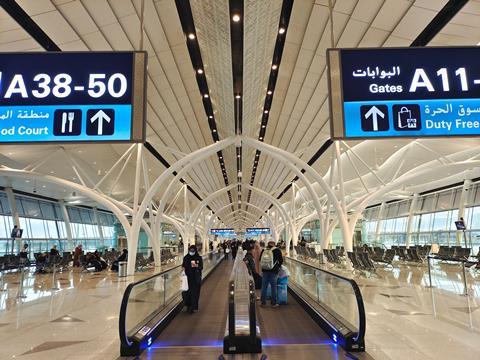
At the same time, its expansion could not happen without the significant investment under way at its King Abdulaziz International airport home and at the home of new national carrier Riyadh Air, King Khalid International airport.
“We are growing the whole ecosystem,” von zur Muehlen states.
On Riyadh Air, which is set to begin flights this year, he notes that the two airlines will work in partnership.
“Saudia [carries] the name of the country and Riyadh Air carries the name of the capital, so we have it covered,” von zur Muehlen says.
“We both operate basically to fulfill the Vision 2030, so it’s very much in cooperation with Riyadh Air.”
At the same time, a byproduct of Saudi Arabia’s aggressive push for visitors is more interest in serving the country among international carriers. Citing flights into the kingdom, including those by Saudia’s SkyTeam partners Air France, Delta Air Lines, KLM and Virgin Atlantic, von zur Muehlen says such developments reflect healthy demand, rather than a competitive threat.
“We are embracing competition, but they’re also helping us in building partnerships, more sustainable bridges, into the kingdom,” von zur Muehlen states, while citing Saudia’s ability to fly customers on to other destinations in its home country.
Within the Saudia Group, von zur Muehlen further talks up the importance of low-cost carrier Flyadeal.
“We have conversations with them about the long-term development, especially on route planning,” he says of an airline that is also on an aggressive growth path.
Amid such a busy period for Saudia, von zur Muehlen acknowledges that even once Saudia achieves the main aims of its current transformation effort, it can never stand still.
“It’s an ongoing task… you need to establish the mindset to be agile and adapt to the changes,” he states.
But it is a task that von zur Muehlen ultimately believes will deliver results.
“I’m confident that we will hit the targets and make the country proud of the national airline,” he concludes.