
London Gatwick airport has a special place in Emirates’ history.
Back in 1987, it became the fresh-faced carrier’s first UK destination, using brand-new Airbus A310s.
Almost 40 years later, Gatwick is set to play an even larger role in the Dubai carrier’s UK presence, which today stretches to eight airports.
On 8 February, Emirates will begin operating a fourth daily flight to Gatwick, bringing its Rolls-Royce Trent XWB-powered Airbus A350-900 jets to the West Sussex facility for the first time. Notably, that type debuted in Emirates colours in early 2025 on flights to another UK destination: Scottish capital Edinburgh.
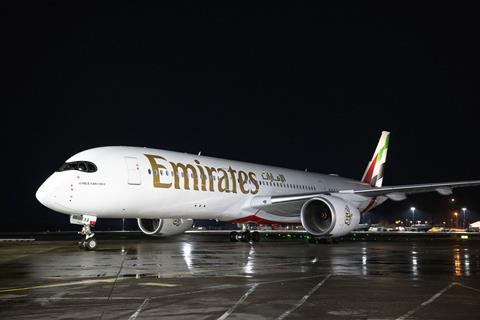
But aside from the fuel savings that come from operating the new-generation widebody, what does the A350 mean for Emirates’ operations and its customers?
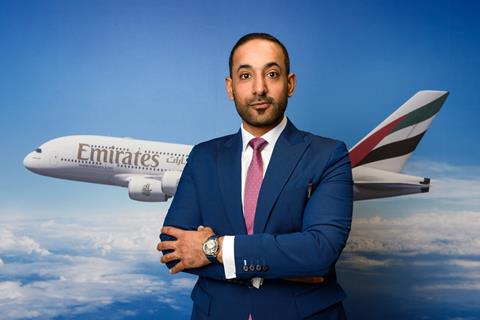
Notably, explains Emirates’ UK divisional vice-president, Jabr Al-Azeeby, during a late January interview with Airline Business, passengers at Gatwick will be able to experience the carrier’s Premium Economy cabin for the first time – a product that is concurrently being rolled out across Emirates’ wider fleet as part of a $5 billion retrofit programme.
He also cites the A350’s ”high-end entertainment systems with 4K screens”, features such as wireless charging, and a generally better passenger experience.
But in a wider strategic sense, the A350 is opening up new network opportunities for the carrier.
“It gives us the ability to penetrate smaller markets, which we couldn’t do when we only had the 777 and A380 in our fleet,” says Al-Azeeby.
Crucially, as a relatively efficient widebody with at least 42 fewer seats than Emirates’ Boeing 777-300ERs and at least 177 fewer than its Airbus A380s, the A350 gives Emirates new network options, not least in a UK market where the global connector already has a strong presence.
“The A350 gives us a lot of options to do so,” Al-Azeeby says of the potential for more growth in the UK market. “It helps us to test the water, put that flight in, see how it works, if it does upgrade that aircraft to a 777 – we’re going to get the 777X very soon – or the [A]380.
“It all depends on the demand and supply at that time,” he adds, noting that “every airline has limited supply” to feed the currently strong demand for passenger travel.
Those opportunities with the A350 align with Emirates’ strategy of focusing on regional airports in the UK, Al-Azeeby says, giving it plenty of options should it wish to deploy extra capacity in the country on routes that might have been too thin for its older, larger aircraft.
“We are into eight points in the UK; we fly to two points in Scotland, we fly to Newcastle, Manchester, Birmingham, and the [three] airports in London,” he says.
“This is our strength – you don’t need to fly to hubs in the UK, you can fly to your home airport.”
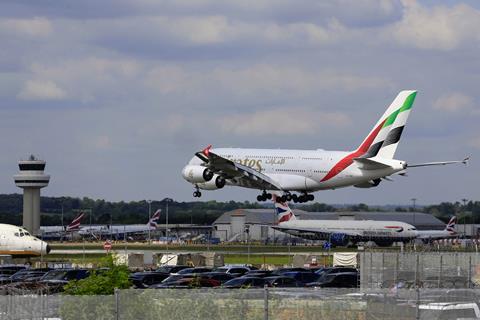
Indeed, Gatwick is one of three London airports Emirates serves alongside Heathrow (at which it has seven daily flights on most days during the current winter season) and Stansted (two daily flights). From 8 February Emirates will use the A350 for a late-night flight from Gatwick on top of the three daily services currently operated using 777s and A380s, reflecting the airport’s importance to the airline’s network.
“The timings split perfectly – so you have a morning flight, an afternoon flight, an evening flight and a late-night flight,” explains Al-Azeeby of Emirates’ Gatwick presence.
“It’s great for people who have long drives from far away,” he says of the new late-night service. “They can easily finish work, go home, change, head to the airport and they still have time to fly.
“And by the time they reach Dubai, it is 11am, which is the check-in time, for example, for hotels. So it’s perfect, especially for people who are going to Dubai and of course for connecting flights if they are going beyond Dubai.”
The appetite for travel among those passengers in Gatwick’s catchment area is well-established, Al-Azeeby notes.
“We believe Gatwick has its own territory,” he says of demand for Emirates’ services to and from the airport. “It’s centralised in the south and it covers a big territory not only in London but all of the south uses Gatwick for us.
“So the demand has always been there.”
That demand is for services to a host of destinations – all of which are popular across Emirates’ three London airports, Al-Azeeby says, even if inbound tourists are often more attracted to Heathrow thanks to its proximity to central London.
“There would be a mix of Dubai, there would be a mix of the Far East, there would be the sub-continent, there would be Australia, there would be New Zealand, there would be Japan, so it’s all over,” he says of choice of destinations among those flying to and from Gatwick via Emirates’ UAE hub.
“We don’t have specific destinations for specific airports,” he adds of Emirates’ trio of London airports. “Just a difference of percentage wise when it comes to one destination or another.”
On Gatwick airport itself, Al-Azeeby says Emirates sees further opportunities for growth once a second runway is in operation, based on plans that were approved by the UK government in September last year.
“We are looking forward to that being implemented and we will definitely be part of that growth, there is no doubt,” he says.
Al-Azeeby is also positive about Gatwick’s status today, thanks partly to its investment in technology that is improving the passenger journey through the airport.
“Gatwick as an airport has enhanced a lot of their services, so that is helping to attract passengers,” he says. “I’m very impressed with what they have done.
“The fast track, the screenings they have done, it’s way smoother now out of Gatwick and I think that helps also, putting some confidence on our side to grow operations to Gatwick.”
His only concern about airport expansion and improvements in the UK – which might also see Heathrow eventually add a third runway – is that airlines are not required to foot the whole bill.
“We need to understand what the charges are and what is the return,” he says of the airport charging regime in the UK. “Because these charges are eventually going to fall on the passengers.
“The last thing you want is to put an increase on to the passengers and they don’t understand why or what the return is for them.”
But that concern aside, Al-Azeeby is confident that Emirates has a long-term future in the UK.
“Whether for business or leisure, the UK has been a success story post-Covid,” he says. “Flights are full, businesses are doing well, inbound and outbound are still working very well…. The forecast is also looking positive.
“The UK is a big market for us and we are looking for growth wherever we can.”
Emirates’ fleet today features around 261 aircraft, including 129 777s, 116 A380s and 16 A350s. It has dozens more A350s on order alongside 270 much-delayed 777Xs and 25 787s from Boeing.