
Airlines might have a lot to gain by offering elevated but attainable products to a willing customer base, argues Conran Design Group’s Ludwig Duran
The so-called ‘third space’ of the aviation sector has arrived – and it’s something brand leaders should take note of. Neither low cost nor legacy, it occupies a territory that blends the best of both worlds: experiences that are elevated yet attainable, refined yet democratic.

Roughly one in four travellers are consistently willing to spend a little more for an upgraded experience, says David Neeleman, founder of JetBlue Airways. That airline has strengthened its positioning in recent years around the idea of ‘affordable premium’, offering elevated comfort, service and experience at accessible price points.
This trend indicates more than just a shift in passenger behavior. It signals the emergence of a new profit engine rooted in both emotional and economic value, where customers choose airlines that deliver an elevated experience without the exclusivity or high cost traditionally associated with premium travel.
It also redefines what brand differentiation means in aviation. Airlines are shifting not only how they position and communicate their offerings, but how they define themselves, too.
Competing in this space calls for a reimagining of how airline brands connect with their customers across every touchpoint - not by outspending rivals on cabin fit-outs or introducing more add-ons for the sake of it, but by breaking the traditional branding structures that have historically kept premium and low-cost worlds apart.
IN THE DELIVERY
The airline brands capturing the third space most effectively understand that success is no longer about what you offer, but how you deliver it.
To build credibility in this middle market, brands must borrow intelligently from both ends of the spectrum: the calm confidence and design coherence typical of premium carriers, combined with the openness, transparency and flexibility of low-cost carriers. The goal is to blend the best of both - creating an elevated experience that feels inclusive rather than exclusive.
JetBlue is a good example of an airline firmly rooted in this third space – appealing to a cost-conscious traveller looking for more than just barebones service. This airline doesn’t position itself as either low-cost or legacy, but something in between. It achieves this by fostering a unified, customer-centric masterbrand strategy which leverages consistency and prioritises customer experience.
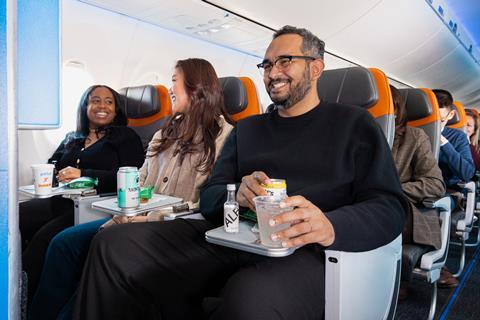
At the start of 2025, the airline announced it was launching its ‘EvenMore’ service with exclusive perks, including extra legroom, dedicated overhead space, complimentary alcoholic beverages, and premium snacks. This reflects an evolution of their brand promise to go beyond budget price and offer increased comfort too.
Another example of an airline shifting its branding to better capture middle-market travellers is Avianca. Like JetBlue, they’ve recognised the need to reposition themselves by providing more choice to customers at different price points.
The carrier was ahead of the curve in 2021, when it introduced Premium Economy seats, designed to cater to passengers in this middle space who seek an elevated experience without paying for business class. In Avianca’s premium economy, the middle seat is removed and replaced with a console that includes charging ports, allowing for an upgraded experience and additional space when compared to traditional economy seats. Through providing this middle option to passengers, they position themselves as a brand focused on delivering a high-quality experience no matter the price point.
Scoot, owned by Singapore Airlines, also demonstrates successful expansion into the third space by continuously enhancing its premium economy-style offering, ScootPlus. ScootPlus delivers premium comfort and service through added extras like wide leather seats with double legroom and a complimentary meal and beverage. Scoot also provides a uniquely branded, targeted offering with its ‘Scoot in Silence’ cabin, which is situated in the forward section of the Boeing 787 aircraft. This exclusive space provides a quieter cabin for passengers aged 12 or over, as well as increased legroom and adjustable headrests.
Collectively, this portfolio strengthens Scoot’s brand as a carrier that delivers choice, flexibility, and elevated comfort at competitive price points.
GROWING ROOTS
How should brands go about building roots in this third space? Taking into account the lessons from JetBlue, Avianca and Scoot, there are many options for building a brand identity within this space.
First, an airline might move beyond traditional branding structures. Instead of fragmenting the brand across service tiers or subsidiaries, consider fostering a unified, customer-centric masterbrand strategy across all products and platforms. This will help create a more cohesive experience for customers and ensure that every touchpoint with the brand reinforces its core identity.
Second, an airline might recalibrate brand identity to redefine value. To truly capture this space, carriers need to redefine their brand’s value proposition for the middle-market traveler. This means focusing on their unique needs by offering high-value experiences at every price point.
Third, an airline might invest in emotion. Understand that the rising third space is being driven by a balance of financial and emotional motivations. Investing in customer experience is key to building brand loyalty. When customers feel genuinely seen and cared for, they will not only opt for the higher price point, but they’re also more likely to choose the airline again.
The rise of the third space is completely redefining what brand differentiation means in aviation. As JetBlue, Scoot, and Avianca show, truly owning the third space means successfully blending premium experiences with accessible pricing.
By changing how they define themselves to the middle-market traveler, airline brands are meeting customers where they truly are, offering elevated yet attainable experiences for all and laying the groundwork for long-term customer loyalty and continued growth.
Ludwig Duran is chief strategy and growth officer at Conran Design Group