
While countries in the Middle East region are well-versed in handling regional conflicts, the latest escalation of hostilities is on a scale that has not been seen for some time.
The US and Israeli attacks on Iran have prompted the latter to launch its own attacks on targets in countries such as Bahrain, Israel, Jordan, Kuwait, Qatar, Saudi Arabia and the UAE.
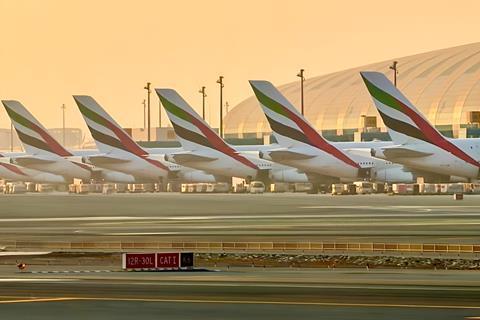
This has essentially grounded commercial aviation in much of the region amid airspace closures and security concerns.
So, what might this mean for the airline industry?
Just a few months ago, the Middle East’s importance to the global airline sector was on show at the latest iteration of the Dubai air show.
At a busy event, the region’s airlines – old and new – were out in force, showing off their metal and, in some cases, placing fresh orders for aircraft.
This reflected a Middle East region that has become a growth engine for the global airline sector, perhaps rivalling India for the title of the world’s airline hotspot (India, of course, has had its own challenges recently in vying for that accolade).
Alongside the established global connectors in the shape of Emirates and Qatar Airways – and, to a lesser extent, Etihad Airways – Saudi Arabia has emerged with huge ambitions to grow its airline sector in support of a push for more tourism, including through the establishment of Riyadh Air as the country’s second flag carrier.
The Saudi moves also herald a new era for low-cost carriers in the region, as several new operators join established players in eying opportunities in the kingdom. Moreover, AirAsia’s recent decision to open its first Middle Eastern hub in Bahrain underscored the geographical advantages conferred on those flying from its airports as they seek connect east with west.
There had been some significant challenges in 2025 in terms of regional security, not least the US attacks on Iran that had caused disruption earlier in the year. But with that incident having proven short-lived (and with the US leadership claiming it had achieved its objective in destroying Iran’s nuclear capabilities), and Israel’s conflict in Gaza having reached a ceasefire of sorts, the mood regarding geopolitical developments in the region was as positive at Dubai air show as it had been for some time.
The events beginning 28 February 2026 have, however, brought the region’s vulnerability to conflict into sharp focus again, while having an immediate and significant impact on a number of airlines, both local and international.
Some of those impacts are logistical: airports are closed, airspace is tighter.
And some will ripple through the global industry, including a possible end to a run of favourable oil prices, and therefore jet fuel prices, which have supported positive airline earnings in recent months.
Near-term oil price predictions are rarely worthwhile, but it is possible to quantify how important the Middle East is to the global airline sector and therefore build a sense of how significant it would be if widespread airport closures and aircraft groundings endure.
The biggest headline is that Dubai International airport is the busiest in the world for international passenger traffic and the second-busiest overall, according to Airline Business data, sitting behind Atlanta Hartsfield (unlike US carriers, Dubai’s two big operators, Emirates and Flydubai, do not a have a big domestic market to drive further passenger traffic).
Dubai, and other Middle Eastern hubs, connect the West with markets across Asia-Pacific and vice versa, often providing passenger and cargo services that are inaccessible through direct flights (and sometimes because the competition from the Middle Eastern carriers has made direct services uneconomical).
As a result, some 92 million passengers made their way through Dubai International in 2024, many of them flying on the world’s largest fleet of Airbus A380s, which account for 116 of Emirates’ 261 widebody jets (which makes it the biggest widebody fleet in the world).
Underlining the seriousness of developments in the Middle East in recent days, Dubai International has suffered some damage from drone strikes amid a complete shutdown of activities.
As the world’s most profitable airline – with a $5.6 billion net profit in its last full fiscal year – and backed by Dubai’s wealthy ruling Al Maktoum family, Emirates is better positioned than most to survive a period of significant disruption, but the impact of a few days’ grounding alone would be huge in financial and operational terms.
| Top 10 airline groups by net profit (2024) | ||||
| 2024 ($m) | 2023 ($m) | 2019 ($m) | ||
| Emirates Group | 5,573 | 5,080 | 456 | |
| Delta Air Lines | 3,457 | 4,609 | 4,767 | |
| Turkish Airlines | 3,425 | 2,915 | 788 | |
| United Airlines Holdings | 3,149 | 2,618 | 3,009 | |
| IAG | 2,956 | 2,871 | 1,920 | |
| Qatar Airways Group | 2,181 | 1,679 | -1,925 | |
| Singapore Airlines Group | 2,076 | 1,989 | -155 | |
| Ryanair | 1,730 | 2,080 | 721 | |
| Lufthansa Group | 1,493 | 1,809 | 1,358 | |
| Cathay Pacific Group | 1,267 | 1,251 | 216 | |
| Source: Airline Business Rankings (based on top 100 in 2024 across all years) | ||||
Similarly, Flydubai – which works closely with Emirates, using its narrowbody fleet to connect travellers on shorter, thinner routes throughout the region, and is also ultimately owned by the emirate of Dubai – recently announced a full-year profit of more than $500 million, reflecting its success and financial strength in the face of a possible prolonged grounding.
Meanwhile, Hamad International airport in Doha, Qatar, is also a significant global hub, handling 52 million passengers in 2024, which ranks it 33rd globally.
Qatar Airways itself has a widebody fleet of around 200 jets, positioning it in third place globally by that metric. The airline recorded a net profit of more than $2 billion in 2024, meaning that, like Emirates, it is a big contributor to global airline profits.
The other Middle Eastern carriers among the top 100 airlines ranked by Airline Business include Etihad Airways (which has launched a new growth push after years of financial challenges), Saudia, El Al (which was just beginning to see some negative earnings impact from international carriers returning to Tel Aviv, having dropped it during earlier regional instability), Flynas and Air Arabia. Just outside the top 100 sit carriers such as Royal Jordanian Airlines and Gulf Air.
All told, Airline Business data shows that Middle Eastern carriers accounted for 25% of global airline net profits among the top 100 airline groups in 2024, on around 9% of revenue and 10% of passenger traffic.
At the end of 2025, IATA forecast that Middle Eastern carriers would contribute $6.8 billion of the predicted $41 billion global airline industry profit in 2026.
All of this means that disruption on the scale currently being seen in the Middle East is significant to the health of the global airline sector and to passengers’ ability to fly within and through the region, before even considering the dozens of airlines from outside the region that have cancelled services in recent days.
As ever in the post-Covid era, tight capacity means most international carriers will be able to point aircraft elsewhere, and some – including Europe’s Wizz Air, for example, which recently dropped its Abu Dhabi operation – had already become more cautious about flying to and within the region in the light of previous geopolitical incidents and other challenges.
But for all carriers flying in or near the Middle East region, another concern will be what further escalation of the conflict might mean for airspace that is already constrained by the Russia-Ukraine conflict. That had already forced much airline traffic further south towards what is a growing regional conflict in and around Iran. There therefore exists a scenario where international carriers are stymied in trying to replace some of the capacity lost among the grounded Middle Eastern carriers, should airspace restrictions grow beyond those in place today.
There is also the impact on passenger appetite for air travel that inevitably follows conflict situations.
For now, uncertainty reigns.
The only certainty is that with aviation safety, global connectivity, fuel prices and airspace constraints all factors in the new conflict, the potential impact on the global airline industry of a prolonged conflict is huge.