















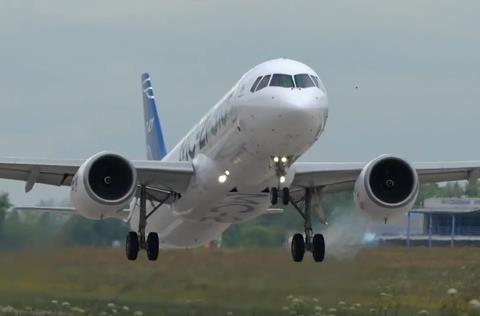
United Aircraft has completed ground-vibration testing of the import-substituted Yakovlev MC-21 prototype, moving the twinjet closer to its maiden flight.
The aircraft has undergone extensive modification to replace foreign-supplied systems with domestically-built alternatives in order to offset the effects of international sanctions on Russia’s aerospace industry.
United Aircraft says the vibration testing has been conducted in the final assembly plant at Irkutsk.
“Frequency testing is an important stage of the certification program,” says MC-21 chief designer Vitaly Naryshkin. “[It] guarantees the reliability of the aircraft and brings the fully import-substituted airliner closer to its first flight.”
These tests checked the responses and operation of the hydraulics, the power supply and integrated control system, undercarriage and electronic equipment, when subjected to various frequencies of oscillation.
“An aircraft that has passed frequency tests is protected from the occurrence of dangerous resonant oscillations of the structure in flight,” says United Aircraft.
Yakovlev has already flown partially-substituted MC-21s – around 70h of flight testing has been conducted – but the latest prototype is set to be the baseline model for serial production.
Russian state technology firm Rostec recently indicated that the fully-substituted aircraft would carry out its maiden flight in August.
United Aircraft says the aircraft will need to perform around 220-230 test flights for its certification programme.
It states that preparations are continuing for serial production, including an update to equipment on the Irkutsk final assembly line, while training of maintenance specialists for the MC-21 and its Aviadvigatel PD-14 engines has started.