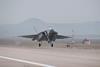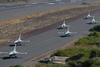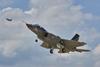














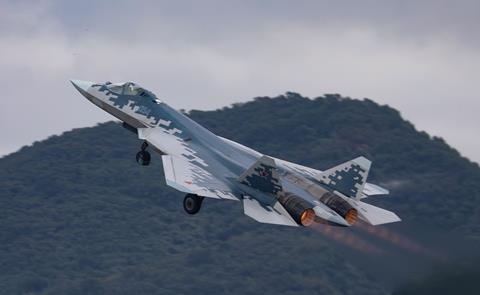
Russia’s state-owned technology corporation Rostec has begun flight testing a new powerplant for the Sukhoi Su-57 fighter, which the conglomerate describes as a “fifth-generation” engine.
The new turbofan has been termed “Product 177” by Rostec and its subsidiary United Engine Corporation (UEC), which is collaborating with Su-57 manufacturer United Aircraft Corporation to integrate and test the new engine.
“The new Product 177 engine, with its increased thrust, will further enhance flight performance and provide significant room for further development of the aircraft,” Rostec says.
The defence manufacturer does not provide details about the initial test sortie, saying only that it proceeded as scheduled “in accordance with the flight mission requirements”.
“During the flight, the new engine performed as expected and demonstrated reliable operation in the Su-57 aircraft,” says Evgeny Marchukov, general designer and director of the A Lyulka Design Bureau at UEC.
Su-57s are currently powered by twin NPO Lyulka-Saturn Izdeliye 117 turbofans, which are operationally designated AL-41Fs.
The now-flying Product 177 engine is likely the Izdeliye 177S powerplant on display at the Russian pavilion during the Dubai air show in November. There, the 177S was also touted as a fifth-generation engine.

Also present at Dubai was a sub-scale model of the Su-57 featuring updated exhaust nozzles with thrust vectoring and a smaller aperture.
The Su-57 has long been the subject of criticism for lacking those characteristics, along with other manufacturing shortcomings observed during public appearances.
Unlike the twin Pratt & Whitney F119 engines that power Lockheed Martin F-22s, which the Russian jet was meant to best, the Su-57’s lacks thrust vectoring and has exhaust nozzles that are not recessed inside the aircraft fuselage – increasing the fighter’s thermal signature.
The Su-57 also lacks the well-defined S-duct air intakes featured on the Lockheed’s F-22 and F-35, which obscure the rotating turbine blades from radar, significantly reducing observability.
Despite such limitations, director of the Sukhoi design bureau Mikhail Strelets describes the Su-57 as the world’s “most advanced fifth-generation fighter”.
“We are not resting on our laurels, and the Su-57 platform is undergoing evolutionary development to enhance its combat capabilities and incorporate the most-advanced technologies,” Strelets says.
At the Dubai air show, Strelets’ boss – Rostec chief executive Sergey Chemezov – told FlightGlobal that UAC is using battlefield learnings from Moscow’s war in Ukraine to drive upgrade plans for the Su-57.
“We get feedback from our pilots in the war zone,” Chemezov said in November. “We are tweaking and adjusting our equipment accordingly.”
Marchukov notes the new 177 engine offers “significantly improved technical characteristics” when compared to previous-generation powerplants.
According to UEC, the 177 turbofan boasts 35,274lb-thrust (157kN) while on afterburner. That is slightly more than the 35,000lb-thrust provided by the F119 – a design now more than 30 years old.
The Rostec subsidiary also says the 177 engine will provide improved fuel efficiency in all operating modes and longer service life than the current AL-41s.
The engine upgrade is part of a UAC programme to expand production capacity and increase fighter aircraft deliveries to the Russian armed forces. The aircraft manufacturer also says it is actively marketing an export variant of the Su-57 to overseas customers.
The only nation outside Russia to order the type is Algeria, with a commitment for 14 examples.