













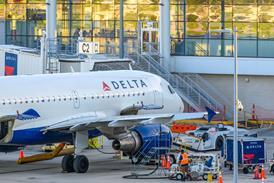
After playing catch-up to the Boeing 737 for nearly four decades, Airbus’s A320 family finally overtook its rival last year and, by the close of 2025, had opened up a triple-figure delivery lead.
Analysis of delivery figures for the two single-aisle models indicate that the crossover occurred in September – with the A320 family ending the month on 12,257 total deliveries, two more than the 12,255 claimed by Boeing for all 737 variants.
Airbus’s lead had stretched to precisely 100 aircraft when the airframer’s full year wrapped, and might have been more but for an A320neo fuselage panel quality issue which forced the manufacturer to lower its overall delivery ambitions for the year.
The company had been aiming to hand over 820 commercial aircraft, a target which had looked precarious around mid-year when a shortage of engines forced Airbus to park otherwise-complete A320neo airframes – wryly termed ‘gliders’.
But while this left the delivery profile heavily backloaded, commercial aircraft chief executive Christian Scherer insists that the engine volume was not the “limiting factor” by the end of the year.
He says “quality deviation” on a number of A320neo forward fuselage panels forced the revision of the delivery target down to 790.
ANNUAL IMPROVEMENT
Airbus managed 793, higher than the 766 achieved in 2024. “Had we not had [the A320neo panel problem] we’d have delivered about 820 aircraft,” Scherer says.
Back in 2019 the company had delivered 863 aircraft in a single year – and expected to reach 880 in 2020 – just before the Covid-19 pandemic caused havoc in the air transport sector.
While it has strived to rebuild its supply chains and ramp up production, Airbus has yet to return to the level of 800 deliveries, and has fallen short of initial targets in three of the last four years.
But Scherer defends the airframer’s aggressive forecasts. “I’d rather be on the ambitious side,” he says. “It’s better to be ambitious than not pursue demand for products, in my opinion.”
Airbus’s ramp-up trajectory “continues to move in the right direction”, he adds. It delivered 607 A320neo-family jets during the full year, of which 64% were A321neos. The largest variant of the family has become the most popular member, and Airbus has adapted all its final assembly lines to handle A321neo production.
Scherer says commercial aviation continues to show “remarkable resilience”, and he remains confident that, despite persistent supply-chain setbacks, Airbus will reach its planned A320neo-family production rate of 75 aircraft monthly.
“We’ll achieve this rate,” he says. “It’s achievable. Supply-chain issues are there to be resolved.”
Boeing had been delivering 737s for a little more than 20 years – having handed the first to Lufthansa in late 1967 – before Airbus delivered its initial A320 to Air France in 1988, sparking a fierce single-aisle contest that has endured since.
Although Boeing had a substantial head start in terms of time, it was still producing the popular 727, and the 737’s lead amounted only to about 1,500 aircraft when the A320 emerged. With both manufacturers hiking production rates to meet increasing demand, the delivery gap between the A320 and 737 still stood at more than 2,100 aircraft in 2010.
SAFETY CONCERNS
Airbus chipped away at Boeing’s lead by around 30-50 aircraft annually for much of the following decade, until the US airframer suffered a setback in 2019 when the 737 Max – in service for less than two years – was grounded over safety concerns in the aftermath of two fatal accidents.
Annual deliveries of 737s slumped from nearly 600 to fewer than 130 in 2019. The situation worsened the following year when Boeing suspended Max production for five months, as the grounding dragged on, while the broader commercial aviation market was reeling from the pandemic.
This disruption tore into the 737’s lead over the A320 – halving it in the space of two years to 921 aircraft by the end of 2020 – and Airbus continued to hack away, substantially gaining on its rival even as supply-chain pressures dogged production ramp-up efforts during the post-pandemic recovery.
Boeing ran into further problems in 2024, facing intense Federal Aviation Administration scrutiny of its production quality after the in-flight separation of a 737 Max door-plug.
The regulator capped monthly Max output at 38 aircraft – although it was academic, as Boeing rates were still considerably below this.
While Airbus had struggled to restore its pre-pandemic production level, it was still delivering sufficient A320neos to slash the 737’s lead to fewer than 40 airframes by mid-2025. And even as the stockpiling of ‘gliders’ temporarily held up A320neo deliveries, Airbus’s capturing the lead from the 737 last year appeared inevitable.
Boeing has whittled down and cleared its own inventory of undelivered 737 Max jets, and production has started to accelerate. The US airframer handed over 447 of the twinjets during 2025, a near-70% rise on the previous year – with deliveries more than trebling in the fourth quarter.
The company was recently granted authorisation to lift the monthly production cap, increasing it to 42, and Boeing is seeking to raise this figure further in five-per-month hikes – although each will be implemented only after six-month stabilisation periods.
Such rate advances will be a relief to Boeing, which has a 737 backlog close to 4,900 aircraft to carve through. Deliveries will generate cash while the company awaits certification for the Max 10 and Max 7.
Among Boeing’s – and Airbus’s – priorities this year will be the smooth integration of the manufacturing work previously undertaken by Spirit AeroSystems, following the break-up and divestment of Spirit’s operations to the two airframers.
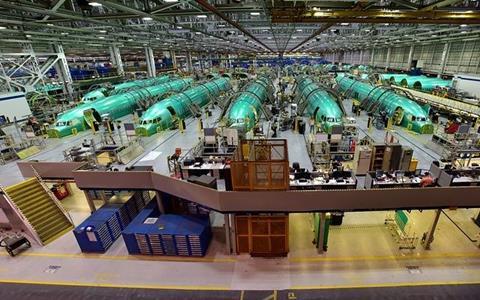
Boeing is taking over 737 Max fuselage production, following efforts to improve quality and reduce the level of rectification work, while Airbus has acquired Spirit’s A350 centre-section assembly as well as wing and fuselage manufacture for the A220.
Airbus believes its absorption of the Spirit A350 package will enable it to unjam a bottleneck and jump-start higher output for the widebody twinjet.
The airframer delivered 57 A350s last year, just half of the 112 it managed in pre-pandemic 2019.
It wants to increase A350 monthly production to 12 aircraft in 2028, a timeframe which aligns with the planned introduction of its A350 freighter.
“Now that we have regained control of that particular centre fuselage piece, you’ll see the A350 continue its ramp-up,” says Scherer.
Airbus is encouraged by the strong presence of the A350-1000 in the full-year round-up. The manufacturer secured net orders for 165 passenger A350s, split almost equally between the -900 and -1000 variants.
Riyadh Air, China Airlines, British Airways and Lufthansa were among last year’s -1000 customers.
| Airbus and Boeing 2025 gross orders and deliveries* | ||
|---|---|---|
| Airbus | Orders | Deliveries |
| A220 | 49 | 93 |
| A320neo | 656 | 607 |
| A330neo | 102 | 36 |
| A350 | 193 | 57 |
| Total | 1,000 | 793 |
| Boeing | Orders | Deliveries |
| 737 Max | 601 | 447 |
| 767 | 15 | 30 |
| 777F | 15 | 35 |
| 777X | 163 | 0 |
| 787 | 381 | 88 |
| Total | 1,175 | 600 |
| Source: Airframers | ||
| Note: *Includes aircraft for military and VIP conversion | ||
While the A350-1000 was designed to challenge the Boeing 777-300ER, the speed of sales has been comparatively slow.
Airbus secured its first orders for the -1000 in 2007 – but in several of the subsequent years the larger variant of the twinjet failed to add to its backlog.
Initial A350-1000 deliveries began in early 2018 but the in-service fleet entered triple figures only in August last year – a situation doubtless affected by the pandemic’s impact on long-haul markets and the disruption caused to supply chains.
Airbus executive vice-president for commercial aircraft sales Benoit de Saint-Exupery highlights the 50:50 order share between the -900 and -1000 in 2025, adding that the “acceleration” of the -1000 is a “real story”.
The market, he says, is “upgauging” to the aircraft’s “optimum capacity and unmatched long range economics”.
Airbus also took 100 net orders for the A330neo family.
But Boeing has established a reputation for widebody appeal, and last year underscored it with gross orders for 381 787s, almost entirely for the -9 and -10 variants. This performance meant the US airframer ended 2025 with the second-highest net order figure for the 787 family – a total of 368 aircraft – only surpassed by the level achieved in 2007 when the new twinjet was initially rolled out.
While 787 production has been dawdling, with only 88 delivered last year, Boeing is beginning to lift the monthly build rate back towards the pre-pandemic level of 14.
Boeing secured gross orders for 1,175 aircraft overall, among them 163 777Xs and 15 777 freighters – a strong showing considering the continuing delays to the 777X programme. Boeing’s widebody sales included 15 767 military tankers.
It also landed gross orders for 601 737s, all but 10 of them the 737 Max, although Airbus retained its narrowbody edge.
POLITICAL INFLUENCE
The US manufacturer, of course, has been able to capitalise on the influence of the Trump administration, with multiple orders for Boeing aircraft coinciding with high-level political and trade meetings and, notably, threats of tariffs.
Middle East carriers flexed their financial power during these meetings. Qatar Airways’ signing for up to 210 widebodies – a mix of 777-9s and 787s – was the most prominent demonstration of the apparent ‘Trump effect’ and allowed Boeing chief executive Kelly Ortberg to claim a significant success for the company following a long period of being humbled by regulatory and public brickbats.
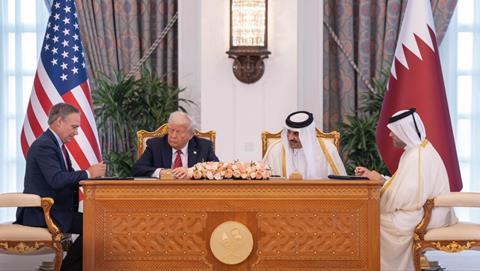
Emirates also handed Boeing a substantial vote of confidence in the beleaguered 777X with orders for another 65 777-9s during the Dubai air show, while throwing down a challenge for the airframer to develop a larger version of the 777X.
Orders and commitments for Boeing also came in from a variety of countries during trade negotiations, primarily in the Middle East and Asia-Pacific regions: Saudi Arabia, Bahrain, Japan, Vietnam, South Korea and elsewhere.
Boeing’s performance – Trump-assisted or not – meant its gross order total of 1,175 aircraft was its fifth-highest total, and a four-figure achievement which allowed a jab at Airbus for the first time in several years.
Airbus might have been forced to sit back and watch while its rival basked in the political halo – chief executive Guillaume Faury acknowledged last year that Boeing had a “powerful sales guy” – but it managed to score a few counterstrikes.
One of the last Airbus deals to be signed in 2025 was the order from Spanish leisure carrier Air Europa, for 20 A350-900s – part of an agreement for up to 40 – which marked a defection from the incumbent 787.
EXPANDED COMMITMENT
Airbus has yet to convince the mighty Emirates to take its A350-1000, but the Dubai-based carrier has expanded its -900 commitment, while fellow United Arab Emirates operator Etihad Airways also signed for the A330neo.
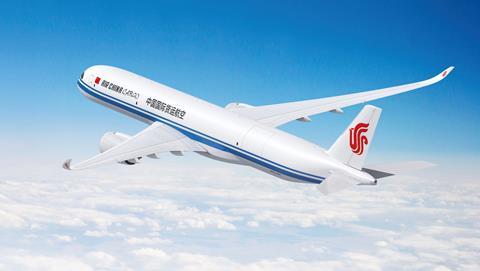
The airframer’s latest assault on Boeing’s widebody domination – the A350 freighter – is due to commence flight-testing this year. With 20 net orders last year taking overall firm commitments to more than 80, the freighter is Airbus’s best chance to establish itself in the new-build cargo aircraft market, after several false starts.
Although Airbus had to concede short-term numerical defeat in terms of orders, it will undoubtedly look back on 2025 as the year in which, with the A320 and A320neo families, it achieved a more momentous supremacy over Boeing. Despite this, Scherer – who is signing off as Airbus’s commercial aircraft chief – appeared to be nonchalant about the landmark.
“I don’t think about it,” he told FlightGlobal during the Dubai air show, even as he asserted his conviction that the single-aisle jet is the “most capable” aircraft – and that its position as the new narrowbody market leader simply “seems natural”.