












The Federal Aviation Administration has issued an immediately effective order to address risks posed by a problem with the 737 Max’s environmental control system that can cause the jets’ cabins to become dangerously hot.
Boeing says the issue stems from a “ground wire fault”. It is developing an “engineering solution”.
The FAA issued an airworthiness directive (AD) on 24 February in response to two events involving “excessive cabin and flight deck temperatures that could not be controlled by the flight crew using existing procedures”, the document says.
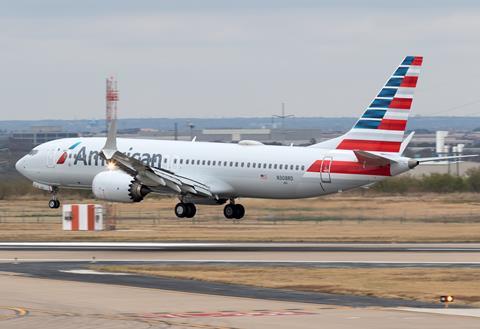
The agency is giving operators of all in-service 737 Max – Max 8s, Max 8-200s and Max 9s – 30 days to update aircraft flight manuals to include procedures pilots should follow to address the issue.
The order takes effect immediately, bypassing the FAA’s typical process of proposing rules and accepting comments prior to making them final. The FAA is, however, accepting public comments through 10 April.
“The risk to the flying public justifies forgoing notice and comment prior to adoption of this rule,” it says.
“We support the FAA’s airworthiness directive, which mandates guidance provided by Boeing in January 2026. We are advancing an engineering solution to eliminate the possibility of this electrical fault,” Boeing says.
The “engineering solution will be incorporated into the 737 Max 8 and 737 Max 9 and [be] ready for the 737 Max 7 and 737 Max 10 prior to certification,” Boeing adds. “We do not anticipate this issue to affect the certification timeline.”
The company has said it expects the long-delayed Max 7 and Max 10 to be certificated this year.
An investigation into the two events traced the problem to a tripped circuit breaker in the jets’ standby power control unit. That circuit provides power to air conditioning and cabin pressure functions, the FAA’s order says.
The tripped circuit “causes an unintended erroneous electrical ground signal” that commands actuators to close both the 737 Max’s “ram air deflectors doors”. Those doors cover inlets that funnel cooling air to the jets’ air conditioning heat exchangers.
When the doors close, the 737’s air system can “supply excessively hot air to the cabin and flight deck”, possibly leading to “uncontrollable, excessively high temperature”, says the FAA.
“This condition, if not addressed, could lead to injury or incapacitation of flight crew and passengers,” it adds.
Boeing tells FlightGlobal it has determined “the root cause to be a ground wire fault in the air conditioning system”. It says previous-generation 737s are unaffected.
The FAA’s order requires operates to revise aircraft flight manuals to include new “non-normal” checklists that specify how pilots should respond to tripped breakers and “excessively hot” temperatures.