












The fatal airline accident level in 2025 was below the annual average for the last 10 years, but the number of individual fatalities was well above average.

The principal reason for the relatively high casualty numbers – a total of 420 for the year – was that more than half of them died in a single, catastrophic crash involving an Air India Boeing 787-8 after departing Ahmedabad International airport on 12 June (see accident listings download at foot of article).

Apart from that disaster, 2025 was an unremarkable year – statistically – for fatal accidents. There were a total of 11: slightly fewer than the average figure of 13 across the 10-year period from 2016-2025.

World airline fatal accidents and fatalities, 2016-2025*       
  2016 2017 2018 2019 2020 2021 2022 2023 2024 2025
Fatal accidents 13 12 14 22 12 15 12 6 16 11
Fatalities 306 56 543 297 332 134 229 115 333 420
Source: FlightGlobal and Cirium *Including fatal events known to be caused by deliberate action      

Most of the fatal accidents in 2025 involved turboprop-powered types, which is true every year, but this time three were jets, of which two were widebodies. Two of the jet disasters happened in the USA, which is very unusual these days.

AVOIDABLE RISKS

Apart from the Air India loss, almost all the ­accidents can be considered to have been “traditional” in nature. That is, they were caused by exposure to ordinary threats such as bad weather, pilots taking avoidable risks, or errors of omission or commission, bird-strikes, turbulence encounters and maintenance shortcomings.

Air transport management shortcomings are certainly classifiable as a traditional risk. Indeed, the fatal mid-air collision on 29 January 2025 between a regional jet and a military helicopter while the airliner was on short final approach – at night – to runway 33 at Washington Reagan National airport was the result of appallingly risky airspace design.

The US Federal Aviation Administration (FAA), bending to pressure from the denizens of the Washington, DC political hothouse, had knowingly permitted busy helicopter corridors directly adjacent to – or overlapping with – the final approaches to the runways of a major national airport, Washington Reagan.

CRJ700 wreckage in Potomac River

Source: US Coast Guard

The January 2025 loss of a CRJ700 regional jet on final approach to Washington Reagan led to airspace revisions

According to the US National Transportation Safety Board (NTSB), a plethora of near-miss incident reports over the past few years illustrating the high level of collision risk had been ignored. As a result, all 64 people aboard a PSA Airlines-operated MHIRJ CRJ700ER died in the collision, along with the three crew members on a US Army Sikorsky UH-60L Black Hawk helicopter, with both aircraft plunging out of control into the dark, icy Potomac River.

The way airspace usage around Reagan National airport had been designed left no room for error or inaccuracy, nor for potential misidentification stemming from the common use of visual flight rules by military helicopter crews in a dense traffic area.

Since the collision the helicopter routes and ­permissions to use them have been revised by the FAA, and a rule permitting military traffic not to ­activate their ADS-B Out (automatic dependent ­surveillance broadcast – out) has been revoked. Not in use by the helicopter at the time of the accident, that system continuously transmits an aircraft’s ­position and ­altitude information for air traffic control and ­anti-collision purposes.

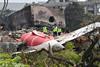
The most disastrous accident of 2025 was the crash of the Air India 787-8 (VT-ANB) immediately after take-off at Ahmedabad. Some 229 passengers and 12 crew were killed, along with 19 people on the ground.

The Indian Air Accident Investigation Bureau’s (IAAIB’s) initial factual report is also the most disturbing. It describes a simple sequence of events during the widebody’s mere 32s of airborne time, during which its engines lost power, the aircraft could not maintain altitude, and it fatally impacted buildings and the ground.

BRUTAL REALITY

The facts presented are so brutal, however, that the brain’s initial reaction is to reject them and to look for an alternative explanation.

The IAAIB’s report says the aircraft’s two fuel-control switches (FCS) were selected from Run to Cut Off just 3s after lift-off. When selected to Run, these supply fuel to the engines, and when they are selected to Cut Off, they stop the fuel flow. The switches are guarded by a spring-loaded locking mechanism that requires each switch lever to be pulled outward before it can be selected in either direction.

The IAAIB report states: “In the cockpit voice recording, one of the pilots is heard asking the other why did he cutoff [sic]. The other pilot responded that he did not do so.” Each pilot is recorded on a separate channel, so the IAAIB knows which pilot made each statement, but decided not to release the information at this preliminary stage. Its report confirms that the co-pilot was the pilot flying, with the captain as the pilot monitoring.

Air India 787 wreckage

Source: Hindustan Times/Shutterstock

The most disastrous accident of 2025 was the crash of an Air India 787-8 on 12 June

It seems that one of the pilots moved both FCS from Run to Cut Off, and the other noticed him doing it. Then, 10s later, one of the pilots attempted to restart the engines by restoring both FCSs to Run.The best way to picture what happened during this very brief period of flight is to look at the precise timeline, as extracted from the AAIB’s report.

08:07:37 VT-ANB begins take-off roll. 08:08:39 Lift-off at 155kt (286km/h). 08:08:42 Max airspeed achieved 180kt, also No 1 FCS switch was moved from Run to Cut Off, followed by the FCS for engine No 2. 08:08:47 The Ram Air Turbine deployed and began supplying hydraulic power. 08:08:52 No 1 engine FCS moved from Cut Off to Run. 08:08:56 No 2 engine FCS moved from Cut Off to Run. 08:09:05 Mayday call transmitted. 08:09:11 Enhanced Airborne Flight Recorder recording stopped.

The FCS were switched off for only 10s before one of the pilots selected them back to Run, and this could have saved the flight had there been sufficient airborne time left. The IAAIB records that this action successfully initiated the engine re-start procedure, which is then managed automatically by the full authority digital engine control computer for each engine.

In this doomed aircraft, according to the IAAIB report, the engines were in the process of restarting when the fatal impact with buildings began.

The initial report does not question that the FCS were manipulated by the pilots. But the full inquiry will want to establish whether this was deliberate, or a ghastly error made during the stress of the take-off.

JOINT TASK

Take-off and early climb is a period of intense concentration by both pilots, the joint task being to ensure that the aircraft maintains a steady climb after take-off while allowing the airspeed to increase gradually in a controlled way. Under normal circumstances, after unstick there is only one actionable task for the pilots to carry out quickly: check that a positive rate of climb is confirmed by the flight instruments, then select the undercarriage up.

This task is normally carried out by the pilot monitoring on orders from the pilot flying, and it would entail moving the undercarriage control lever – located on the forward instrument panel – manually upward. In the case of the Ahmedabad flight, however, according to the report, no-one called for the gear to be retracted, and no-one selected it up.

Instead, at about the time the gear would normally have been retracted, the FCS were moved downward from Run to Cut Off, the left switch first, the right switch 1s later.

Pilots have occasionally carried out incorrect actions that almost defy credibility. On 15 January 2023, a Yeti Airlines ATR 72 scheduled passenger flight was inadvertently set up for disaster during a visual circling approach to land at Pokhara airport, Nepal.

When the final report was published by the Nepal authorities, it gave the following verdict: “The most probable cause of the accident is determined to be the inadvertent movement of both condition levers to the feathered position in flight, which resulted in feathering of both propellers and loss of thrust, leading to an aerodynamic stall and collision with terrain.”

During that incident, the pilot monitoring, who made the selection, had been asked by the pilot flying to increase the flap setting from 15° to 30°, but instead of moving the flap lever, he moved the pair of engine condition levers to the position that causes the propellers to feather and stop turning. That error led to the deaths of all 72 people aboard.

Hopefully, the final IAAIB report on the Ahmedabad crash will be able to deliver a verdict on why this otherwise inexplicable selection of the FCSs happened.

The other particularly shocking widebody jet accident in 2025 killed far fewer people, but only because it was a freighter: a Boeing MD-11F operated by UPS.

The NTSB’s preliminary factual report on the 4 November accident describes how the trijet began an uneventful take-off roll on runway 17R at Louisville, Kentucky, bound for Honolulu, Hawaii. But just after rotation the left engine and its pylon detached from the wing, pitching upward and passing over the top of the aircraft and falling to the right of its flightpath. A fire began on the wing where the pylon had been attached, and this continued burning until the aircraft crashed.

UPS MD-11 engine separation

Source: NTSB/UPS

Fatal accident sequence involving UPS-operated MD-11 freighter began with separation of trijet’s left-hand engine on take-off

Radio altimeter readings from the flight-data recorder show the aircraft’s height never exceeded 30ft above ground level. Its left main landing gear hit the roof of a UPS warehouse at the southern edge of the airport before it impacted the ground and hit two other buildings, one of which was a petroleum recycling plant. It caught fire and the aircraft burned out.

The three-person crew lost their lives, along with at least 11 people on the ground.

The NTSB found that the structural failure started in fatigue and overstress cracks in the aft attachment lugs that bound the aft end of the engine pylon to the wing.

The aircraft appears to have been incapable of climbing, despite having only lost one engine. But initial suspicions that the tail (No 2) engine could have been damaged by debris were not borne out by flight-data recorder information, which showed only very slight variations in its low- and high-pressure spool revolutions per minute, which remained high.

In its report, the NTSB cited details from the disturbingly similar American Airlines McDonnell Douglas DC-10 crash at Chicago O’Hare on 15 May 1979. That also occurred just after take-off and involved complete detachment of the left engine from the wing, but in that crash all 271 people on board lost their lives, and it remains the worst airline accident in US history.

The 1979 loss was blamed on incorrect maintenance practices by the airline which caused damage to the pylon attachments when the engine was being re-mounted on the wing following overhaul.

ACCIDENT REPORTING

Separately, the International Civil Aviation ­Organisation (ICAO), which sets agreed standards including the requirements for accident investigation and reporting (Annex 13), published a report in ­February 2025 expressing its distress that many member nations are failing in their obligation to oversee the publication of final accident reports.

“As of 30 June 2024, IATA data indicates that, between 2018 and 2023, out of 268 accidents recorded in the IATA Annual Safety Report, only 140 (52%) investigations were completed, while 128 (48%) remain without final reports,” it states.

“Furthermore, data gathered by FSF [the Flight Safety Foundation] between 2018 and 2022 for all aircraft over 5,700kg [12,600lb], both scheduled and unscheduled, as reflected in the Aviation Safety Network database, shows 448 accidents and serious incidents requiring reporting in accordance with Annex 13, of which only 160 (36%) were completed.”

Although airline safety is very good by historic standards – far better than it was in the 1990s – this year’s accidents show there is room for improvement. And the ICAO/IATA revelation that many states fail to ensure accident investigations are completed and the reports filed indicates an unacceptable level of complacency in national departments of transport.

Meanwhile, one of the main safety preoccupations voiced by the International Federation of Airline Pilots’ Associations (IFALPA) last year is the need to manage the introduction of artificial intelligence (AI) into aircraft management and control systems.

In a thoughtful paper entitled Artificial Intelligence in Aviation, IFALPA warns the industry to be ready to use AI with care to support the piloting task.

“The role of AI in the operation of a flight should always be to support the humans in the system,” it says.

“For this to be effective, whatever the intended capability of an AI system, it should only present options to a pilot, never a fixed outcome. There should also be transparency to the pilot as to how these options have been selected, and the level of confidence associated with them.”

Our annual accident listing uses data from Flight International’s research, in association with Ascend by Cirium.

Supporting documents

Click link to download and view these files