
















Autonomous aviation developer Near Earth Autonomy is continuing work on a conversion kit that would allow the Sikorsky UH-60 Black Hawk to fly in an unmanned configuration.
The Pittsburgh-based firm is under contract from the US Army to develop a retrofit package for the older “Lima” model Black Hawks that would allow the utility helicopters to fly without a pilot onboard.
The army provided Near Earth with $15 million to support the effort as part of a deal announced in April 2025.
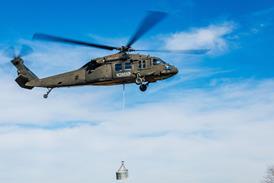
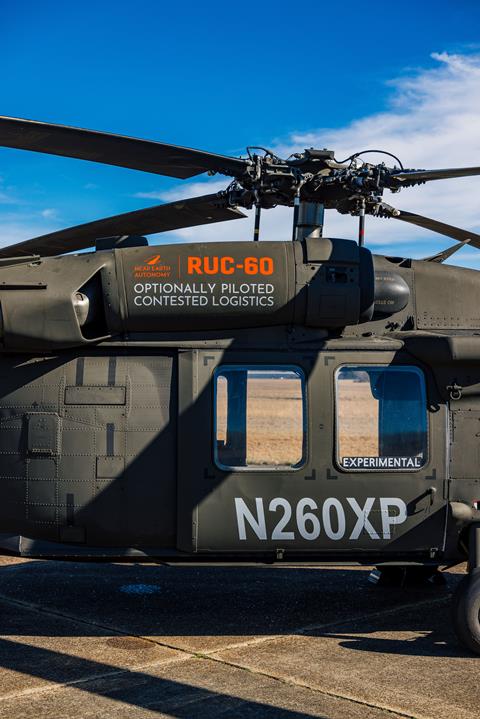
Near Earth says it has spent the ensuing months conducting systems integration and basic flight tests of its unmanned-capable Black Hawk design, which the company has dubbed the RUC-60 or Responsive Uncrewed Capability.
That privately owned demonstrator is powered by Near Earth’s Captain autonomy architecture, which the company says is designed to meet certification standards under existing aviation safety regulations.
“The RUC-60 is a fully integrated logistics aircraft, converted from the army’s inventory of surplus UH-60L Black Hawks,” Near Earth says.
Honeywell Aerospace, Moog and XP Services are all partners on the RUC-60 project.
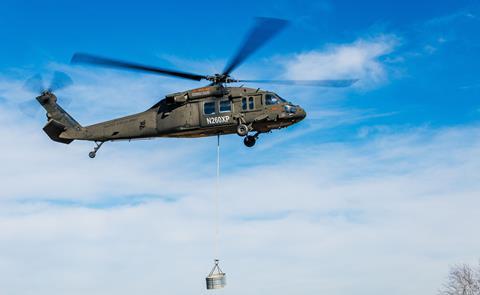
During the summer of 2025, the company says it demonstrated key systems, including flight computing, perception sensors and flight control systems. The effort culminated with a fully automated flight of the RUC-60, including take-off and landing.
That sortie took place in Tullahoma, Tennessee at a facility owned by XP Services. The aircraft was equipped Moog’s Genesys GRC 4000 four-axis autopilot that enabled deterministic control without pilot stick input.
Since then, Near Earth says it was worked with its partners to finalise the aircraft configuration and functions that will be used in mission capability testing throughout 2026.
Those evaluations will focus on the potential for RUC-60 to perform a medium-lift battlefield logistics role without pilot input.
“We are working together to tightly define the exact capabilities needed for Near Earth’s Captain autonomy to take on the full responsibilities of a human pilot,” says Samuel Dinnar, chief strategy officer at Near Earth. “This includes every operational procedure, from coming up cold on a flight line to finishing the mission and shutting down.”
UH-60 manufacturer Sikorsky has taken a similar approach to developing its own option for converting legacy rotorcraft into unmanned aircraft.
The Lockheed Martin subsidiary has been flying an autonomous capable UH-60A called the Optionally Piloted Vehicle (OPV) since 2021.
That aircraft completed its first fully autonomous flight in 2022.
That configuration pairs Sikorsky’s Matrix autonomy software with a series of hardware changes, including fly-by-wire flight controls and an additional flight computer, to offer options for reduced crew or no crew flight operations.
Sikorsky is under contract from the US Defense Advanced Research Projects Agency to deploy the OPV technology on an army-owned UH-60M, which has been dubbed the UH-60MX.
The Lockheed Martin subsidiary says its OPV technology is compatible with all Black Hawk models and could be adapted for other airframes.
The goal of the projects is to add capability to the Pentagon’s vast fleets of legacy rotorcraft, which face significant operational challenges in a modern battlefield saturated with precision guided weapons.
An optionally manned helicopter would give frontline commanders the ability to send in a resupply or casualty evacuation flight into conditions that would be considered too dangerous for crewed rotorcraft.
“Once you remove the pilot, you have to re-evaluate the entire operation,” says Lyle Chamberlain, chief technology officer at Near Earth. “Autonomy isn’t just about flight control; it has to take on the full role of the crew, including responsibilities we often take for granted.”
One such example could be communicating with ground troops. During a combat situation, two-way communication between ground forces and the flight crew if often needed to make sense of a chaotic scene and safely land the aircraft where it is needed.
That typically includes verbal communication over the radio, but also visual communication using coloured smoke, infrared strobes or hand signals.
Addressing that problem with an autonomous aircraft is one of the challenges Near Earth and Sikorsky will face in proving the optionally manned concept can function effectively on the battlefield.
The US Army plans to divest hundreds of UH-60Ls over the coming years as part of a fleet modernisation initiative.
Finding a way to put those aircraft to use represents a significant business opportunity for any company that can deliver a low-cost option for unmanned conversions.
Near Earth is competing in a separate US Marine Corps initiative to convert conventional rotorcraft into unmanned logistics platforms.
The company has teamed with Honeywell to modify a Leonardo AW139 medium-twin for autonomous operations as part of the Aerial Logistics Connector (ALC) programme.
Sikorsky is also competing with its UH-60A OPV, while Airbus Helicopters is adapting its H145-based UH-72 light-twin, which is in service with the US Army as a trainer and utility platform.
Airbus calls its unmanned UH-72 derivative the MQ-72C.