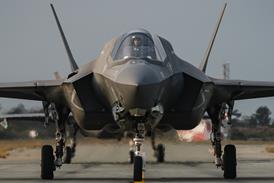















The United States is accelerating its military campaign against Iran, sending more combat aircraft to the Middle East as senior leaders in Washington vow to keep pressing the offensive.
Despite that posture, top defence officials in the Trump Administration say there is little risk of depleting the US military’s stores of critical munitions – a concern that has been publicly raised as the scale of the war becomes more clear.
Of particular concern are long-range precision guided weapons like the Lockheed Martin Joint Air-to-Surface Standoff Missile (JASSM), which can only be produced at a rate of around 1,000 per year, and the complex interceptor missiles used in ground-based air defence systems like Raytheon’s Patriot.
“We used more exquisite stand-off munitions at the start but no longer need to,” said US defence chief Pete Hegseth, who the Trump Administration has styled the Secretary of War.
“Our stockpiles of those as well as Patriot’s remains extremely strong,” Hegseth added during a 4 March press conference in Washington, DC.
Earlier in the week, Bloomberg had reported that Washington’s Persian Gulf allies, including the UAE, were rapidly depleting their stores of Patriot interceptors defending against waves of Iranian missiles and low-cost attack drones.
The UAE’s top diplomat pushed back against those claims, describing them as “false and misleading.”
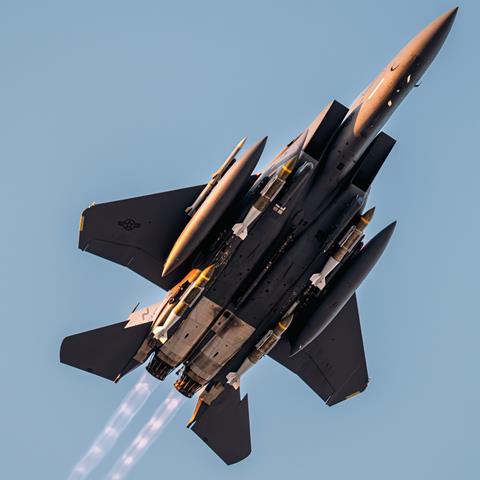
However, it is certain that the Pentagon has made heavy use of its scarce offensive missile systems, as Hegseth admitted. Photos released by US Central Command show fighter jets heavily laden with precision munitions.
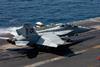
The US Navy posted a video of Boeing F/A-18E/F Super Hornets launching from the USS Abraham Lincoln, each with a full loadout of four AGM-154 Joint Stand-off Weapons.
Another photo from Central Command shows a US Air Force Lockheed Martin F-16 configured for a suppression of enemy air defences mission. The fighter is loaded with multiple precision weapons, including anti-radiation air-to-ground missiles and multiple types of air-to-air missiles.
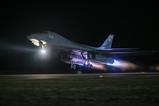
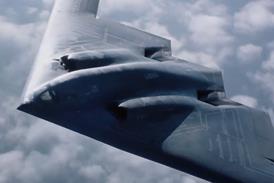
All three US Air Force bomber types – the Boeing B-1B, Northrop Grumman B-2 and Boeing B-52 – have also been deployed as part of Operation Epic Fury, as the campaign has been branded by Washington.
More bombers and fighters arrived in the region on 4 March, according to Hegseth
US Navy warships are also launching Tomahawk cruise missiles at targets in Iran, video of which has been shared by Central Command.
The Pentagon says its forces, and those of ally Israel, have collectively struck more than 2,000 targets as the war grinds through its fifth day.
To avoid burning through stocks of their most-capable weapon systems, Hegseth says US forces will be switching to older and less-complex options for precision strikes.
“We will be using 500lb, 1,000lb and 2,000lb GPS and laser-guided precision gravity bombs of which we have a nearly unlimited stockpile,” he says.
Those “dumb” bombs can be converted into smart munitions with the bolt-on Joint Direct Attack Munition kit made by Boeing, which is cheaper and easier to produce than guided missiles.
Employing JDAMs requires fighters and bombers to get closer to their target than when using long-range missiles, but Hegseth says that is no longer a concern, describing the US and Israel as having “complete control of the skies” over Iran.
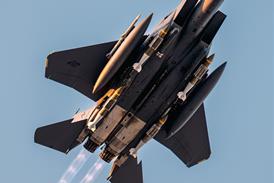
Evidence of that change is already available. A photo of a Boeing F-15E strike fighter released by Central Command on 4 March shows a loadout featuring four JDAM bombs – the olive green shell casings supplemented by the white-grey steering fins of the guidance kit.
Appearing alongside Hegseth, the top US military officer, General Dan Caine, confirmed the secretary’s assessment, describing the US as having established “localised air superiority across the southern flank of the Iranian coast”.
“CENTCOM is now shifting… from large deliberate strike packages using stand-off munitions at range outside an enemy’s ability to shoot at us, now into stand-in precision strikes overhead Iran,” says Caine, who as chairman of the joint chiefs of staff is the top military advisor to the president.
Other stand-in air-to-ground weapons are also being employed, according to Caine, including the AGM-114 Hellfire missile, which can be fired by the General Atomics MQ-9 unmanned aerial vehicle.
“This will allow the joint force to deliver significantly increased precision effects on the target,” Caine adds. “The throttle is coming up… as opposed to ramping down.”
The four-star general declined to provide specific quantities of munitions, saying only that US forces had sufficient stores on hand.
As for throttling up the campaign, that will include more airstrikes deeper inside Iran, targeting military and industrial assets that allow the Iranian military to project power outside its own territory.
The Pentagon says Tehran’s forces have launched more than 500 ballistic missiles and more than 2,000 drones at targets across the region, including Kuwait, Bahrain, Qatar, Saudi Arabia and Jordan.
However, US officials claim their strategy of degrading that capability is working. On day five of the war, the number of theatre ballistic missile shots fired by Iran was down 86% as compared to the the first day of fighting, according to Caine.
Use of one-way attack drones like the infamous Shahed-136 are down 73% compared to day one of the war, the Pentagon says.
If maintained, that trend will reduce materiel pressure on regional allies relying on ground-based interceptors for air defence.
US officials, including Caine and CENTCOM commander Admiral Brad Cooper, have provided additional tactical updates.
Cooper says the first 24h of Epic Fury were “double the scale” of the 2003 “shock and awe” air campaign that preceded the US-led invasion of Iraq to topple the government of Saddam Hussein.
The force arrayed against Iran include more than 200 fighter aircraft, two aircraft carrier strike groups and an unspecified number of the USAF’s ground-based bomber fleet.
“In simple terms, we’re focused on shooting all the things that can shoot at us,” Cooper said in a 3 March video update.
He noted that B-1, B-2 and B-52 sorties have operated unopposed over Iranian territory hunting mobile ballistic missile launchers and command assets.
At least 20 Iranian naval vessels have also been destroyed, with Cooper saying the US will sink Tehran’s “entire navy”. That has included the US Navy’s first sinking of an enemy ship via torpedo since 1945.
Caine also confirmed that Qatari air force fighters shot down two Iranian aircraft, described by Caine as “bombers”. Doha on 2 March said it had downed two Su-24 ground attack jets, without specifying the type of fighters sortied for the interception.
None of the US officials offered any insight into the downing of three USAF F-15E fighters over Kuwait, which has been described as a friendly fire incident involving Kuwaiti forces. Initially reported as involving ground-based air defences, multiple news outlets are now describing the incident as involving Kuwaiti F/A-18 fighters, citing only unnamed sources.
The Pentagon also says that it has made space available on military transport aircraft to the US state department for coordinating the evacuation of American civilians trapped in the region, although no such operation has yet been launched.
Secretary of State Marco Rubio says evacuation efforts have been hampered by airspace closures throughout the Middle East. He adds that a range of options including charter flights, military aircraft and land routes to open airports in neighbouring countries are all in the works for stranded Americans.