











As the joint USA/Israeli air war against Iran continues, Tehran’s retaliation with drones and ballistic missiles may start to test regional air defences and the magazine depth of US forces.

The joint strikes by Israel and the USA against Iran – which the USA refers to as Epic Fury and Israel as Rising Lion – have unleashed a hail of smart munitions against Iranian targets.

Iran, for its part, stands defiant, launching hundreds of drones and ballistic missiles against Israel and US forces in the region, as well as neighbours just across the Persian Gulf. Iran’s efforts have crippled air travel in key hubs such as Doha and Dubai and raise existential questions about security in the region.

Three days into to the war Israel’s defence ministry has set up an international airlift to ensure the supply of key munitions.

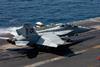
Super Hornet JSOW

Source: US Navy

A JSOW-armed Super Hornet launches from USS Abraham Lincoln

“Over the past 24 hours, the first cargo aircraft landed in Israel carrying various munitions and military equipment,” says Israel’s defence ministry.

It expects the airlift effort to “scale up” in the coming days. The programme involves Israel’s defence ministry missions in the USA and Germany.

Israel sources a range of bombs and precision guided munitions (PGMs) from the USA, including weapons like the Raytheon AIM-120 Advanced Medium Range Air-to-Air Missile and the Lockheed Martin AGM-158 Joint Air-to-Surface Standoff Missile (JASSM).

The USA is also the primary source of the Tamir interceptor, which is employed by Israel’s Iron Dome missile-defence system.

Germany and Israel also enjoy a close defence relationship with sensors, and Berlin also uses the Israeli-developed Arrow 3 missile defence system.

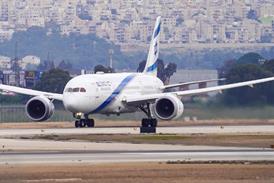
In a video clip on social media, the ministry shows two pallets of boxes being towed near the tail of a Boeing 747 freighter, hinting that commercial cargo carriers are being employed in the munition resupply effort. In the video the registration number of the aircraft has been blurred, but the tail logo indicates that the operator is Israeli-based Challenge Airlines. The carrier operates a pair of 747-400Fs and a single 767-300F. 

The urgency of the airlift is perhaps a measure of the Iranian campaign’s intensity: each interceptor expended against a drone or ballistic missile must be replaced, and even a degraded Iran may be able to launch them faster than peacetime supply chains were ever designed to replenish.

Persian Gulf states have come under attack by Iranian drones - likely the Shahed 136 - and missiles. While they boast of high interception rates, it is likely that they will be keen to top up air defence interceptors, possibly calling on air transport to make urgent deliveries.

The defence ministries of the United Arab Emirates and Qatar claim to have intercepted a total of 259 Iranian ballistic missiles out of 275 detected. As for drones, they have intercepted 669 out of 728 detected. Qatar also claims to have downed a pair of Iranian Sukhoi Su-24 fighters.

Israeli arms delivery

Source: Israel Ministry of Defense

Challenge Airlines makes a munitions delivery

The UAE, where major airports are all but entirely shut by military action, belied a degree of sensitivity around weapons stocks by taking issue with a Bloomberg report that suggested its air defences were being pushed to the brink, and that it was already pressing Washington DC for resupply.

“The UAE possesses diverse, integrated and multi-layered air defence systems capable of countering a full spectrum of aerial threats with high efficiency,” says the UAE’s foreign affairs ministry, accusing Bloomberg of “false and misleading claims.”

“These long-, medium- and short-range systems provide comprehensive protection of the nation’s airspace.” It also claims to possess “a robust strategic stockpile of munitions” that ensure its ability to intercept threats “over extended periods.”

Saudi Arabia is also under pressure, recording drone strikes against oil terminals as well as the US embassy in Riyadh.

The US military, for its part, could also confront PGM shortages during a prolonged, high-intensity conflict. The US Navy posted a video of a Boeing F/A-18E/F Super Hornets launching from the USS Abraham Lincoln with full loadouts of four AGM-154 Joint Stand-off Weapons (JSOWs) each. Another USN image shows dozens of Joint Direct Attack Munition (JADM) bombs on a carrier deck.

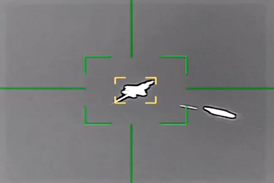
Video posted by the US Central Command show Iranian targets such as aircraft on the ground, drones, missile launchers, and vehicles being struck.

Should US weapons stocks in the Middle East dwindle, it is possible that the USA may need to draw on stockpiles in the Asia-Pacific.This could in turn hurt deterrence against China: in a conflict against Beijing, stand-off systems such as JASSM and JSOW will be at premium, not to mention air defence weapons and ship-launched cruise missiles.

Iran naval target

Source: US Central Command

An Iranian naval target meets its end

Iran, for its part, remains defiant. With its high-level leadership largely wiped out, the rump of the country’s Islamic regime has adopted a strategy of waiting out its more powerful enemies.

Military leadership and decision making appears to have been dispersed to individual units – a strategy it refers to as “Decentralized Mosaic Defence.” Such units can conduct drone and missile launches autonomously in the absence of central control.

“We’ve had two decades to study defeats of the U.S. military to our immediate east and west,” says Iranian foreign minister Seyed Aragashi in an X Post, referring to the USA’s invasions of Afghanistan and Iraq.

“We’ve incorporated lessons accordingly. Bombings in our capital have no impact on our ability to conduct war. Decentralized Mosaic Defence enables us to decide when—and how—war will end.”