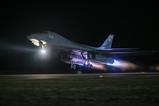




















Hermeus, the US start-up seeking to develop a reusable hypersonic vehicle, has flown its first supersonic-capable aircraft.
The company on 2 March announced the maiden flight of its Quarterhorse Mk 2.1, the first of three planned iterations in the Mk 2 series.
The unmanned Quarterhorse Mk 2 is intended to achieve supersonic flight, as Hermeus builds toward breaking the Mach 5 hypersonic barrier with the forthcoming Quarterhorse Mk 3 vehicle.
“Today’s flight kicks off a critical flight test campaign that will ultimately get us to supersonic speeds, bringing the United States closer to having the high-speed capability it needs now, not decades from now,” says Hermeus founder and chief executive AJ Piplica.
Within the Mk 2 series, Hermeus plans to build three variants that will each push further toward the M5 (3,307kt) threshold. The Mk 2.1 will break the supersonic barrier, while the successor Mk 2.2 will push into higher Mach speeds.
“Subsequent phases like 2.3 will continue to push toward Hermeus’ end goal of unlocking sustained ramjet-powered flight and delivering operational hypersonic capability for the United States this decade,” the company says.
Hermeus has previously said its goal for the Mk 2 iteration is to reach flight speeds of M2.5.
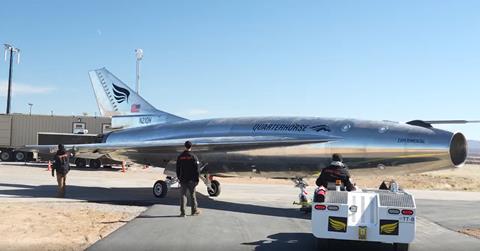
The Mk 2 is roughly the size of a Lockheed Martin F-16 fighter and powered by the same engine featured on that manned fighter – the Pratt & Whitney F100.
Other notable features on the experimental jet are a delta wing, variable air intake situated in the nose cone and a single vertical stabiliser.
Hermeus shared video of the initial, subsonic Mk 2.1 flight, including point-of-view footage during flight and landing. The sortie took place at the Spaceport America test site in southwestern state of New Mexico.
Notably, the Mk 2.1 flew less than one year after its predecessor – the Quarterhorse Mk 1 – first took off in May 2025. That subsonic vehicle was used to validate critical systems within the Quarterhorse concept, including high-speed take-off and landing, aerodynamics, stability and control.
Aircraft subsystems, including propulsion, fuel delivery, hydraulics, power and thermal management, and flight software, were successfully evaluated during the Mk 1 test campaign – which fed into the Mk 2 design.
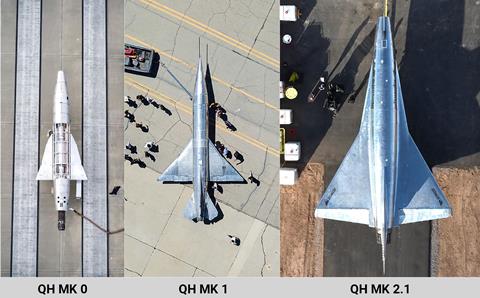
Quarterhorse Mk 2.1 is roughly three times larger and four times heavier than the Mk 1 vehicle. A smaller Mk 0 vehicle was used only for ground testing.
CEO Piplica has repeatedly said that rapid iteration within the aircraft design and fabrication process is a key element of Hermeus’ business strategy.
“Speed is the fundamental requirement for our flight systems and for our company,” he notes. “We’re building and flying aircraft on timelines that match the urgency of the world we’re in.”
Hermeus says it current development timeline will see the delivery of an operational, reusable hypersonic capability before 2030.
The company is competing against other start-ups like Stratolaunch, which logged the first hypersonic flight of its reusable Talon-A vehicle in late 2024.
The two firms are pursuing significantly different technical approaches to hypersonic flight. The rocket-powered Talon-A does not take-off under its own power, instead being ferried aloft in a captive carry configuration by Stratolaunch’s ultra-large Roc mothership.
The Talon-A then ignites its single Ursa Major Hadley rocket engine after being air-dropped. The unmanned vehicle is capable of landing under its own power.
By contrast, the Quarterhorse will take-off under its own power, accelerating into subsonic flight using a traditional turbofan engine. To achieve high-Mach and hypersonic flight, Hermeus is developing its own turbine-based combined cycle (TBCC) propulsion system called Chimera.
The Chimera will incorporate a proprietary pre-cooling system to integrate the onboard turbofan with a separate ramjet engine.
Pre-cooling refers to the chilling of engine intake air before compression and combustion. Colder intake air allows standard jet engines to operate at higher speeds, with greater efficiency and reduced performance degradation.
The physics of current high-speed ramjet designs require airspeeds of around M3.5 to achieve compression significant enough to produce ignition and generate thrust – a velocity beyond the capability of conventional jet aircraft.
Incorporating a pre-cooler could allow a turbofan engine to reach speeds sufficient to engage the ramjet, which will be needed to achieve hypersonic flight.
Propulsion supplier GE Aerospace has taken a different approach to that engineering problem: developing a more efficient ramjet.
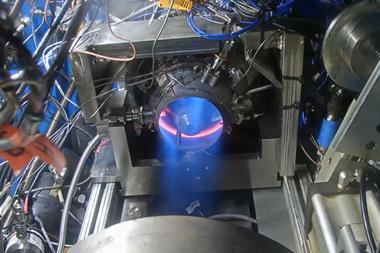
Using a technique called rotating detonation combustion (RDC) to improve performance, GE aims to lower the airspeed needed to achieve combustion with a hypersonic-capable ramjet.
In September 2025, GE said it had successfully tested two RDC engine designs, including a dual-mode ramjet configuration meant for high-speed aircraft and a missile-scale ramjet that could be used to power hypersonic munitions.