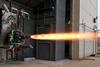















Colorado-based engine maker Ursa Major has secured an order for its developmental Draper rocket powerplant.
The propulsion start-up on 17 September said it had received a $35 million contract from an undisclosed US defence and aerospace company to deliver an unspecified number of Draper engines.
Ursa Major says the funding will help accelerate development, testing and production of the Draper engine design, which is being targeted for national security applications including hypersonic flight and space vehicles.
The order follows an earlier $28 million contract from the US Air Force Research Laboratory to demonstrate the Draper in flight for the first time before the end of 2025. That programme aims to develop propulsion solutions for hypersonic, responsive space and on-orbit applications.

“As adversaries increase their activity in space and missile defence becomes more multi-domain, Draper provides the responsiveness, control, and flexibility required for the US to defend against emerging threats,” says Ursa Major chief executive Dan Jablonsky.
To date, Ursa Major has successfully test-fired Draper engines more than 250 times.
The new powerplant aims to establish a unique niche in the propulsion space, straddling the existing categories of solid rocket motor and liquid rocket engine.
Based off Ursa Major’s hypersonic-capable Hadley engine, the Draper aims to combine the long-term storable attributes of solid rocket motors with the active throttle control and extended ranges of liquid fuelled systems like the Hadley.
To accomplish this, the Draper operates without using the volatile cryogenic propellants that traditionally are use in liquid rockets – which must be carefully fuelled shortly before use.
Instead, the Draper’s closed catalyst cycle design will allow for the engine to be stored for up to 10 years, according to its manufacturer.
“It offers the same launch readiness and storability of a solid rocket motor, with the added benefits of restart capability, throttle control and precise manoeuvrability with the flexibility to support new mission profiles,” Ursa Major says of the Draper.
The engine will also be reusable, unlike solid rocket motors featured on guided missiles.
Ursa Major has focused its development effort around maintaining affordability, with some two-thirds of Draper components being produced via additive manufacturing, otherwise known as 3D printing.

The company notched a major win in May, when the Pentagon revealed that hypersonic flight start-up Stratolaunch had earlier in the year successfully broken the Mach 5 hypersonic barrier with its uncrewed Talon A vehicle.
The air-dropped Talon A is powered by a single Ursa Major Hadley engine.
In 2023, the Ursa Major unveiled a flexible, high-rate approach to solid rocket motor production, saying it aimed to upright a market “plagued by a broken supply chain and an overextended industrial base”.
At the time, the US domestic market for solid rocket motors had shrunk to just two suppliers: Northrop Grumman and Aerojet Rocketdyne, with the latter having just been acquired by L3Harris that year.
Fellow US defence start-up Anduril has also entered into the solid rocket motor space with a production facility in Mississippi that aims to deliver 6,000 units annually by the end of 2026.
Lockheed Martin and General Dynamics have also partnered to produce solid rocket motors for Lockheed’s HIMARS rocket artillery system, with the potential to support other product lines.