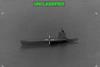














The Trump Administration has begun military operations against Iran, the culmination of a multi-week build-up in the region that has seen an armada of fighters, bombers, tankers and two aircraft carriers flow into the Middle East.
US President Donald Trump announced the start of operations in the early hours of 28 February, Washington, DC time.
“A short time ago the United States military began major combat operations in Iran,” Trump said, clad in a white “USA” cap.
“Our objective is to defend the American people by eliminating imminent threats by the Iranian regime,” Trump added.
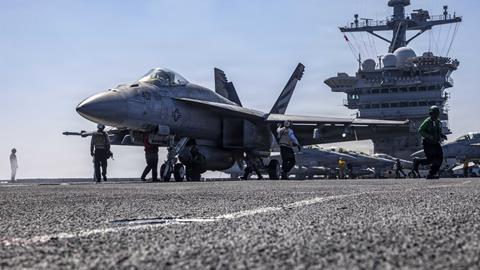
The latest campaign, dubbed Operation Epic Fury by the Pentagon, was notably launched during daytime hours in the Middle East. Previous bombing campaigns began with night-time sorties.
Israel has joined the US in the offensive, although it was not immediately clear in what capacity.
Iranian foreign minister Abbas Araghchi called the US and Israeli action “wholly unprovoked, illegal and illegitimate”, in a social media post.
Iran’s state-run news agency has reported strikes in cities around the country, including Tehran, Qom, Isfahan and Minab on the Strait of Hormuz.
Qom and Isfahan are respectively home to the Fordow and Natanz nuclear enrichment sites.
Satellite imagery analysed by the New York Times indicates there have been airstrikes at the official Tehran residence of Iran’s supreme leader Ayatollah Ali Khamenei. The images show what appears to be heavy damage, including multiple collapsed structures.
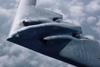
Unlike 2025’s Operation Midnight Hammer airstrike against Iran’s nuclear production facilities, which was the largest sortie of Northrop Grumman B-2 stealth bombers in history, the latest operation is more sweeping in nature and features less-concrete goals.
Trump has repeatedly said he will not accept Iran possessing a nuclear weapon. More recently he has called for a change of government in Tehran.
During his remarks announcing the start of combat operations, Trump called upon Iranian citizens to overthrow the theocratic government that has ruled the country since 1979.
Representatives from the US and Iran had been in talks for several weeks pursuing a settlement that could avoid conflict and end Iran’s nuclear weapons programme. Those talks appeared to have reached an impasse earlier this week after the latest round ended on 26 February without a breakthrough.
Although Iran has responded to previous bouts of hostilities with missile strikes targeting US bases and Israel, this time Tehran appears to be launching a more forceful counter-attack.
Video footage has emerged showing a missile impact on the what is reportedly the US naval base in Bahrain, home to the US Navy’s Middle East headquarters known as Fifth Fleet.
Qatar, which hosts the largest US base in the region, has also been targeted by Iranian strikes. The Qatari defence ministry says it has absorbed three rounds of attacks targeting several areas of the country.
Doha described the strikes as having been “thwarted”.
Saudi Arabia expressed solidarity with its fellow Arab states that were attacked by Iran, warning of “grave consequences” for continued violations of their sovereignty.
“The Kingdom affirms its full solidarity with and unwavering support for the brotherly countries, and its readiness to place all its capabilities at their disposal in support of any measures they may undertake,” the Saudi foreign ministry said on 28 February.
The statement from Riyadh indicates that Jordan, Kuwait and the United Arab Emirates were also struck by Iranian missiles.
The UAE’s defence ministry says the Gulf country was targeted by Iranian ballistic missiles and that local air defence systems responded. Falling debris from an interception killed at least one civilian.
The Washington-based Center for Strategic and International Studies has described the current US military presence as the largest build-up of naval forces in the Middle East since the 2003 US-led invasion of Iraq.
Combined, the two US aircraft carriers in the region are carrying more than 90 strike fighters, plus an arsenal of Tomahawk cruise missiles carried by escort ships.
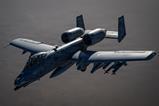
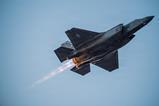
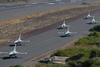
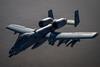
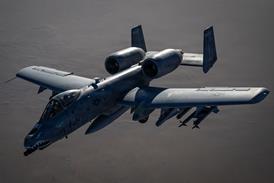
From the US Air Force (USAF), more than 110 fighters have flowed into the region from bases in North America and Europe, including Lockheed Martin F-16s and F-35As, Boeing F-15Es, and Fairchild Republic A-10 attack jets.
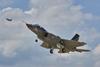
Notably, at least 10 Lockheed F-22 air superiority stealth fighters have also been sent to the Middle East – an indicator that the Pentagon may expect some kind of resistance.
Iran’s paltry fighter force has been all but destroyed by years of economic sanctions restricting the supply of spare parts. The US and Israel also targeted Iranian aircraft on the ground in previous bouts of hostilities in recent years.
A public deployment of F-22s could also be viewed as a deterrent against intervention by other potential belligerents, such as Iran’s presumptive ally Russia.
In 2023, the Pentagon deployed a flight of Raptors to the Middle East, with the stated goal of blunting aggressive and unsafe behaviour by Russian fighter pilots over Syria.
F-22s were also deployed to the Middle East during the 2025 build-up to Operation Midnight Hammer.
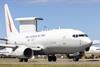
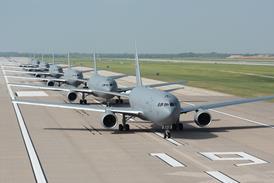
The USAF has also logged dozens of flights by Boeing C-17 strategic transports in and out of the Middle East during recent weeks, along with more than 20 aerial refuellers and five of the service’s critical Boeing E-3 Sentry airborne early warning and control jets – 30% of that entire fleet.
Notably, there has been no discernible movement of bomber forces like the Northrop Grumman B-2, which played a central role in the Midnight Hammer strikes on Iran.
In that instance, B-2s flew nonstop from their home base in the continental US to Iran, conducted strikes, and returned to North America without any stops for fuel or maintenance.
The operation was made possible by a significant aerial refuelling effort that featured dozens of tanker aircraft, according to the USAF.