













Anduril Industries is eyeing significant further growth in the UK, as the company’s in-country presence passes 100 employees and multiple opportunities emerge for its autonomy technology.
The US company’s UK arm has undergone solid but managed growth to date, with its payroll having risen from around 20 personnel two years ago, Anduril Industries UK chief executive Rich Drake tells FlightGlobal.
Along with a cadre of engineering staff working at its headquarters in the City of London, the company also has mission autonomy developers and a flight-testing presence in Llanbedr, west Wales.
The company’s goal is to perfect “one-to-many” autonomy, by which a single operator can oversee the operation of multiple uncrewed aerial vehicles (UAVs) simultaneously.
Drake says the key to achieving such operational capability is Anduril’s Lattice mission control software, which can be incorporated with its own vehicles or those manufactured by other airframers.
“That is really where we think we are a force-multiplier,” he says. “We talk about bringing affordable mass to the battlefield.”
To support its activities, Anduril also is to establish a new systems integration laboratory – which Drake likens to an ‘Iron Bird’ capability – elsewhere in London.
“We have created ourselves to be an R&D centre for Anduril worldwide, which is a pretty exciting place to be,” he says of the autonomy-focused work performed in the UK. “We are exporting our skills out to the rest of Anduril.”
Opportunities to supply the UK armed forces include via London’s interest in fielding autonomous collaborative platforms (ACPs).
COMPETITIVE OFFERS
“We have a number of irons in a number of competitive fires,” Drake notes.
While he declines to discuss the opportunity due to an ongoing bid process, that total includes its interest in the Ministry of Defence’s (MoD’s) Nyx demonstration effort.
Anduril was among seven companies shortlisted earlier this year to advance to an invitation to tender phase, with responses having been due for delivery in mid-March.
To assess the ability of a UAV with a payload capacity of over 250kg (551lb) to operate in concert with the British Army’s Boeing AH-64E Apache attack helicopters, the Nyx project has an expected budget of £100 million ($133 million). Flight-testing is due to commence in the first half of 2027.
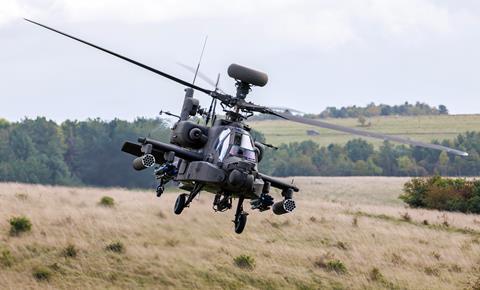
Operational tasks envisioned for such a “commanded not controlled” adjunct include “reconnaissance, target acquisition, strike, countermeasure defeat, and integration with launched effects”, the MoD says.
“Larger [uncrewed] systems are important in that attritable bracket,” Drake says, noting: “the bigger they are, the more payload they can carry.”
With many nations having only limited numbers of tactical transport aircraft, he believes such ACPs will eventually be able to self-deploy to a theatre of operations. “If we are talking about pairing them with an Apache, then they could easily be paired with an [Airbus Defence & Space] A400M as they deploy – or via a ground control station,” he says.
Anduril late last year named GKN Aerospace as its manufacturing partner in support of the Nyx effort and other future projects.
“We like GKN, because they are willing to try new things, and they are willing to move at a speed that we move,” Drake says. “We invest a lot, and GKN have been happy to keep up with us on that score.”
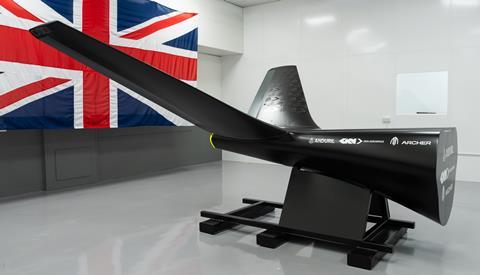
It also is working with multiple innovative small and medium-sized enterprises, including ISS Aerospace, which produces the lightweight, tube-launched Wasp UAV – suitable for potential deployment from an ACP – and distributed manufacturing company Isembard, alongside larger firms such as safety assurance and certification support specialist AtkinsRealis.
Another clear target for Anduril’s technology is the Royal Air Force’s (RAF’s) interest in also fielding an ACP capability alongside crewed fighters.
In its 2025 Strategic Defence Review, the MoD states: “To assure the future of UK combat air, investment in autonomous collaborative platforms should be considered alongside investment in FCAS [Future Combat Air Systems] and the Global Combat Air Programme [GCAP].
“The ACPs must be designed to operate in collaboration with the fourth-, fifth- and future generations of combat aircraft and to operate from UK [Royal Navy] aircraft carriers.”
The MoD’s significantly delayed Defence Investment Plan – originally scheduled for publication before the end of 2025 but still without a confirmed release date – should provide greater clarity over its funding for ACP activities and the GCAP venture being jointly advanced by the UK, Italy and Japan.
FURY PROPOSAL
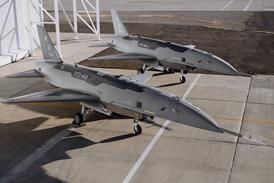
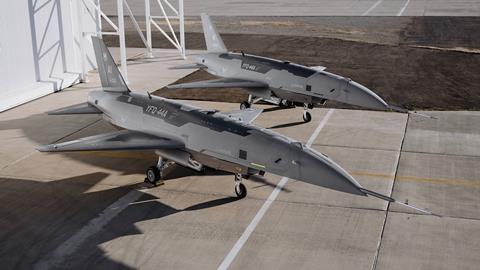
Anduril is promoting its Fury platform – which has been developed into the YFQ-44A model for assessment during the US Air Force’s (USAF’s) first-increment collaborative combat aircraft (CCA) contest – for any such RAF need.
“In the timeframe of us being able to field a Fury into the UK, we don’t really see any credible local suppliers, which is why you can see all the big US primes coming over,” Drake says.
He notes that unlike the USAF-optimised YFQ-44A, “Fury as a base model is not encumbered by ITAR [restrictions]. So whatever we would design for the UK would have UK sensors and payloads in it.”
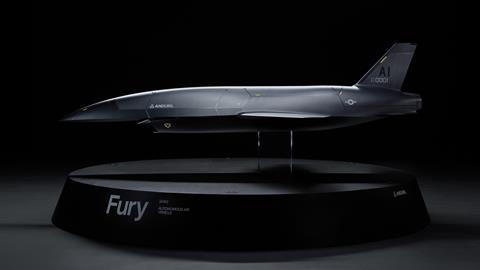
However, “We have got to get away from caring about the outside mould line – the platform – and start thinking about the brain,” he argues.
“The important bit for the customer is that they should be thinking about how they are going to use them. From Lightnings to Phantoms to Tornados to Eurofighters the concept of operation has been pretty similar – now we are turning up with loyal wing-people.
“The only way to win the next war is through open, mesh-networked hardware and software,” he says. Noting that Anduril has already flown the YFQ-44A using both its own Lattice system and Shield AI’s artificial intelligence-driven Hivemind technology, he adds: “We’re not naive enough to think that that’s all going to be ours. We are looking at modular open systems as much as we can.”
Indeed, an uncrewed asset should be thought of as a “truck for capability delivery”, he says.
And while Anduril makes its own products, he stresses: “We are a software business that makes hardware, and that really makes a difference when we start talking about CCAs.”
Regarding the company’s business strategy, he says: “To be successful when the competition is run for a CCA or an ACP for the UK I can’t buy a shed [industrial unit]. Our ambition here is bigger than that, so we are looking for places with runways.
“We are planning a nice factory,” he says. While stopping short of identifying potential locations, he adds: “We have a favourite site, and it has that runway that we are after.”
While such a facility will be on a scale far smaller than Anduril’s Arsenal-1 site in Columbus, Ohio, Drake says the UK arm would benefit from its parent’s almost $1 billion investment there.
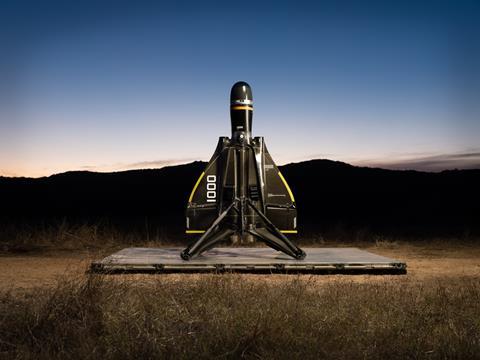
“Any of the existing designs we could build here,” he says, with examples also including the counter-drone Roadrunner interceptor and low-cost Barracuda cruise missile.
“But the thing that makes me really excited as an engineer is to design and make in the UK. All work that we win in the UK we will do in the UK – it is not a sales front [for the US business].
“We want to grow through winning.”
Meanwhile, Anduril Industries UK is now in the delivery phase in support of a programme to provide Altius-600M and -700M loitering munitions to Kyiv’s armed forces. Worth almost £30 million, the equipment was ordered in March 2025 via the International Fund for Ukraine mechanism.