













Pratt & Whitney Canada parent RTX has provided more details on the advanced hybrid-electric PW127 turboprop engine it is developing under an EU Clean Aviation project that could eventually go on to power ATR’s planned Evo aircraft.
Launched at the start of 2026, PHARES – the first Clean Aviation project to be led by a Canadian company – is a €101 million ($117 million) effort to hybridise the popular turboprop engine that equips ATR 42 and 72-series aircraft.
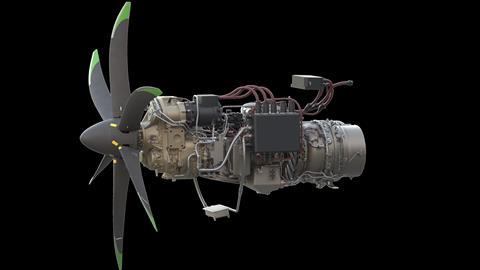
Its goal is to demonstrate a fuel-burn reduction of 20% against a 2020 baseline and will later be flight tested by the airframer through a separate Clean Aviation project.
Speaking at the EU-funded body’s annual forum in Brussels on 18 March, Hany Sarhan, vice-president sales and marketing – regional & APU at P&WC, said the powerplant would be based on an “advanced derivative” of the 2,750shp (2,050kW)-rated PW127.
While “leveraging a familiar architecture” will help to “reduce overall execution risk” for PHARES, P&WC has also identified a “clear pathway towards pushing the thermal efficiency of this engine even further”.
Improvements through the application of “advanced aerodynamics” and new materials will help “deliver a significant improvement in fuel efficiency” from the baseline gas turbine, he says.
But further fuel-burn savings will be driven by the integration of a 250kW Collins Aerospace electric motor onto the propeller gearbox.
This will provide around 12% of the overall power requirement on the demonstrator engine, says Todd Spierling, principal technical fellow – electrification, Collins Aerospace.
However, he notes that this level may not be maintained as technology advances and the engine switches to any development programme: “Will it be 12%? Probably not. Will it be more? Will it be less? Time will tell.”
Factors including the electrical power required and its duration will be important factors, he says. “The view is still pretty fluid and it will vary as we go through the course of the programme.”
Additionally, P&WC has yet to determine how much of the overall 20% fuel saving will come from improvements to the thermal engine rather than the hybridisation: “That is not yet defined. It is part of the work we have to go and do,” says Sarhan.
However, cost must also be a consideration: “You could have a great idea but if it’s not economically viable, it’s not viable.”
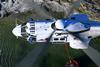
Spierling says the electrical motor it will use on the PHARES project will be an evolution of the two 250kW units that will make their debut later this year on the Airbus Helicopters PioneerLab. Motor controllers developed for that testbed will also find their way onto the hybridised PW127.
PioneerLab, he says, “is giving us the foundational work for some of the engineering challenges” P&WC will face in PHARES.
Advances to the propeller will also contribute to the fuel-burn improvement, says Sarhan, while delivering additional benefits.
To be developed by Collins Aerospace subsidiary Ratier Figeac – another partner in the PHARES consortium – it will be “a lighter weight, more aerodynamic and acoustically efficient propeller”, says Sarhan.
Pratt & Whitney’s Polish arm will, meanwhile, develop the critical propeller gearbox for the hybridisation, allowing inputs from both the gas turbine and the electric motor.
The overall package – including the thermal management system – should fit within the existing nacelle structure, says Sarhan. “Although to what extent that will be is part of the work we are doing over the next few years.”
ATR also forms a key part of the project, addressing the “significant complexities of integrating a hybrid-electric system onto the aircraft, both for the purposes of demonstration and for future product applications”, he says.
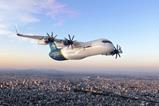
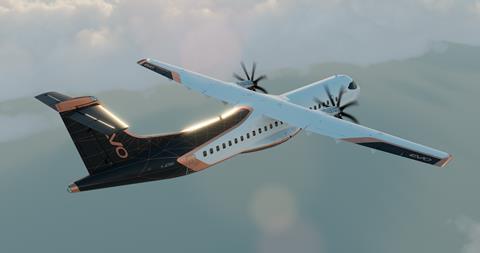
Flight tests of the hybridised engine will be undertaken through the ATR-led DEMETRA project in 2029 and ultimately shape the manufacturer’s decision on the scope of its proposed Evo upgrade for service entry in 2035. ATR is seeking a 20% fuel-burn reduction at aircraft level.
Daniel Cuchet, senior vice-president head of engineering and head of design organisation at ATR says it will seek enhancements across the entire aircraft – the airframe, wing, aerodynamics, the propeller, the engine and electrical motor.
“All these together, plus the batteries, makes something which should be viable. [And] 2035, if we start now, we will be on time.”