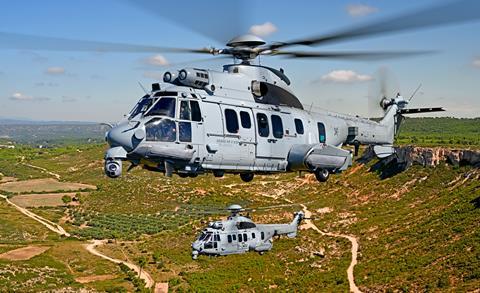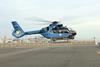














Back in 2016, it was not inconceivable that the future of the Airbus Helicopters Super Puma family – the H225 and smaller H215 – was going to be both challenging and short, defined chiefly by modest order volumes.
The root cause of that uncertainty was the fatal crash in April that year of an H225 (LN-OJF) off the coast of Norway which killed all 13 occupants.
Norwegian investigators subsequently pinned the tragedy on a main gearbox failure which caused the main rotor to separate.
Faced with the subsequent grounding and reputational damage – plus the exit, in the short-term at least, from the H225’s mainstay oil and gas market – it seemed like the Super Puma would struggle from there on, even after the airframer developed a fix for the underlying issue.
Since then, however, the Super Puma has confounded expectations, over the last decade racking up 243 gross orders. In fact, there have only been two years over the last 10 – 2020 and 2023 – in which the heavy-twin registered fewer than 10 orders, netting four and zero commitments, respectively.
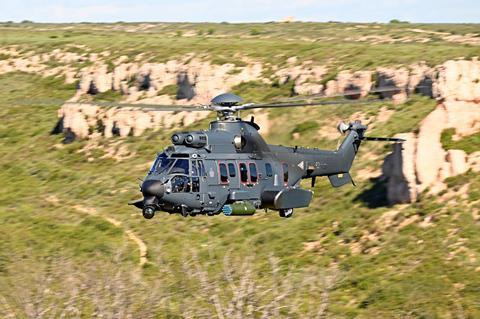
Although many have been for the M-model military variant of the H225 – gaining customers including France, Hungary, Iraq, Kuwait, Morocco, the Netherlands and Singapore – the split has been about 50-50 with civil sales, for instance, Germany’s 2024 commitment for 38 units for its Federal Police.
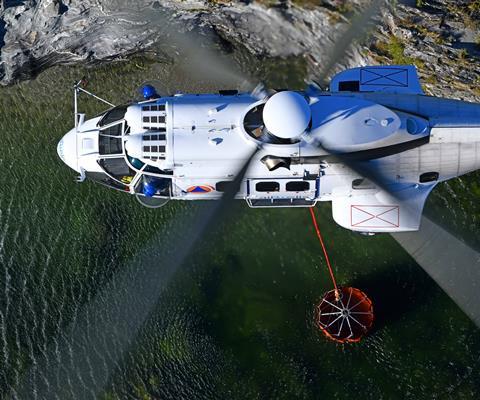
Last year saw expansion into a new segment too, with the Greek government’s order for eight H215s for firefighting. But while there remain a handful of H225s operated for oil and gas support in Brazil, China and Namibia, a new order from that segment has remained stubbornly elusive.
But that may be about to change, thinks programme manager Michel Macia. “This year I hope we will have oil and gas sales in the market, which will be the first in 10 years,” he told FlightGlobal at the recent Verticon show in Atlanta.
He says Shell’s greenlighting last year of the H225 as suitable for offshore operations will be key. “Shell approving the Super Puma means there is the possibility to come back in any country, anywhere in the world.
“We are still working with Shell and some other oil and gas companies,” – Petrobras in Brazil, TotalEnergies in Namibia – “so everything is open now. The question for us is not can we, it is what is the requirement, and this is what will drive the market.”
Macia points out that since the 2016 crash, Airbus Helicopters has strived to make improvements to the type that exceed the regulatory standards, emphasising the company’s commitment to safety.
“When we went above the certification requirement for the main gearbox it’s because we wanted to show the market that this accident has been a tragedy, including for the company and for the Super Puma, and we do not want to let it happen again.”
However, even if there is an offshore order this year, Macia believes there will be no deliveries before 2030, based on the Sikorsky S-92’s stranglehold on the market for long-range oil and gas operations. But as those assets begin to retire from that role – forecast to begin in earnest from around 2030 – Macia thinks the H225 will be there to fill the gap.
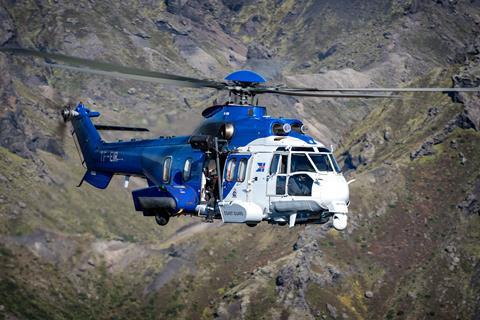
“Step by step we are getting back the credibility of this aircraft, with the operation in Africa, with the operation in Brazil, the approval of Shell. So, once we have an opportunity of introducing the H225 back into long-range we will do so.
“We don’t think it will happen quickly, only with people who extend or renew their fleet.”
Macia sees little performance difference between the H225 and the S-92, arguing that what separates them is the cost and availability of support provided by the two airframers.
And while he declines to disclose the H225’s list price, having a busy final assembly line clearly helps to reduce unit costs. In contrast to Airbus Helicopters, Sikorsky has in recent years been building the S-92 in low volumes solely for the VIP market and has only in the last few weeks announced the reestablishment of a dedicated production facility.
“For us, it’s not a relaunch of production – it’s just going on. It’s easier for us than reinvesting in manufacturing again,” says Macia.
The target, he says, is to build 20-25 Super Pumas per year – a mix of civil and military models. “This is where we think the quantity is good [although] some forecasts say [we could go] above 30.”
Macia thinks the programme “is flexible enough in terms of the industrial set-up” to achieve those levels, noting that in the not too recent past, it was delivering 35-40 aircraft annually.
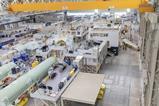
Further flexibility has been introduced into the system in recent years by tweaks to the manufacturing process. This includes a revised industrial set-up, in common with the airframer’s other programmes, that sees major component assemblies – the main fuselage, tail boom, and transmission, for instance – built across its network of factories and shipped to Marignane in southern France ready for final assembly.
Additionally, says Macia, Airbus Helicopters two years ago introduced what he calls the “Gen Flex” – generic but flexible – configuration “where we try to pre-equip the aircraft so the time to market is reduced drastically”, typically down to as little as 24 months.
Under its previous system, customisation was introduced “very early in the production line”, he says. “Now we have a completion centre at the end, which means that we can build the aircraft [in a standard way] until we customise it.
“So, it is easier for us because we can launch [production] by anticipation, and it is much better for the customer because they are delivered quickly.”
But further production capacity could also come from an entirely new final assembly line.
Last decade, Airbus Helicopters had plans to build H215s at a new facility in Brasov, Romania, contingent on Bucharest ordering the type for its armed forces.
While that never came to pass, Romania is back on the hunt for new helicopters and has identified the H225M as its platform of choice, securing EU funding via the SAFE mechanism to bankroll the purchase.
Macia says it is “in discussions” for an initial batch of a dozen helicopters but points out that the eventual requirement could top 40 aircraft.
Based on this, Airbus Helicopters is attempting to formulate an “industrial package which makes sense in Romania based on the number of aircraft and the technology we are able to share.
“There are different things we can propose – we have ideas; here’s a large spectrum of capabilities from the support and the industry and maybe even for the design,” he adds.
Back in 2014, Airbus Helicopters announced plans to replace the Super Puma with a new helicopter it referred to as the X6. That programme never made it off the drawing board – scuppered by a downturn in the oil and gas industry – and, it seems, the company is in no rush to contemplate its revival.
Considering the capabilities and performance offered by the H225 “there is no reason why we would think about a new aircraft for the future”, he says. In the meantime, any obsolescence issues are being dealt with through avionics upgrades and improvements to the human-machine interface.
Indeed, Macia thinks the Super Puma will be “being built for the next 40 years at least”, a remarkable turnaround for a programme that appeared to be nearing the end of the road.
For Macia, though, there is a certain pleasing symmetry with his tenure on the Super Puma: “I jumped into this programme in 2016 when it was a difficult time but I’m enjoying the moment right now,” he says.