












Airbus is continuing to progress work on its ZEROe 100-seat aircraft concept and related hydrogen fuel cell powertrain, confirming the feasibility of the concept at the turn of the year.
Glenn Llewellyn, vice-president zero-emission aircraft at Airbus, says the project team carried out extensive component-, system- and aircraft-level reviews of the design at the end of last year, verifying it was at technology readiness level (TRL) 3.
“We confirmed the feasibility of a pretty large fuel cell-powered aircraft – something that gives us confidence to move to the next stage,” he told FlightGlobal at the Clean Aviation annual forum in Brussels on 18 March.
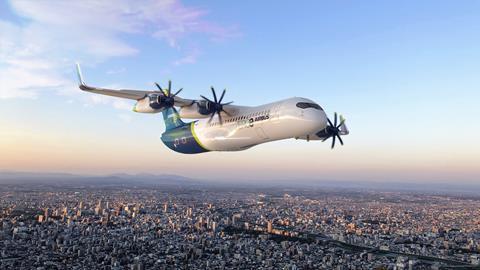
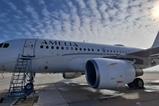
Airbus at its Summit event in March 2025 presented the latest iteration of its ZEROe design: a fuel cell-powered aircraft with four 2.4MW electric motors capable of flying 100 passengers on routes of up to 1,000nm (1,850km).
The aircraft showcased at the Summit was “a very representative image of the concept we took to TRL3”, he adds.
Additionally, the late-2025 review process identified “some opportunities” to improve the performance of the system.
Airbus will over the next two years further develop those enhancements to “cash in on those opportunities”, he says, “to incorporate them into the [system] baseline” by the end of 2027.
Potential enhancements include “further improving” the performance of the fuel cell stacks “so we increase the amount of kilowatts we get out of every kilogram”.
“We are achieving the targets that we set ourselves in 2020 but on top of that we have identified that we can go beyond those in the next few years,” he says.
Airbus developed the fuel cells through its AeroStack joint venture with automotive supplier ElringKlinger.
Additionally, the manufacturer is considering switching to a pumped hydrogen supply rather than having to rely on a pressurised storage system for delivery to the fuel cells.
If the liquid hydrogen could then be stored at a lower pressure, the mass of the tank could be cut, says Llewellyn, and while incorporating a pump would add weight, there is likely to an overall net benefit.
Airbus is also analysing the potential of using carbonfibre reinforced polymer material in the tank construction as a further weight-saving change.
“We have developed some really interesting carbonfibre materials that are compatible with cryogenic temperatures and very, very small hydrogen molecules,” he says.
Meanwhile, the airframer is in the process of building up its latest powertrain demonstrator at its test facility in Ottobrunn in southern Germany.
Sized to deliver output of 1.2MW, the end-to-end system, including a liquid hydrogen tank, will feature so-called “S1”-standard components – those developed by Airbus and its partners – rather than the commercial-off-the-shelf parts used on the S0 configuration.
Llewellyn says it will begin the test campaign on the powertrain before year-end “but progressively get to the full scope of testing”, including the liquid hydrogen tank, by the end of 2027.
Testing is also taking place in Ottobrunn and Toulouse with systems being developed under the Cryoprop programme run by Airbus’s UpNext innovation arm.
This will integrate and mature a 2MW-class superconducting electric propulsion system cooled by liquid hydrogen via a helium recirculation loop, a technological advancement that could development of a 200-seat fuel cell-powered aircraft.
While Airbus has slowed the ZEROe development, the airframer is still backing the technology. “We are convinced that this is a very close to zero-impact solution for aviation,” Llewellyn said during a panel discussion at the Clean Aviation event.
“That’s why we are investing hundreds of millions [of euros] in getting the best possible technology for fuel cell stacks and the systems around that to make a fully hydrogen-electric propulsion chain,” he says.
“It’s a massive opportunity for airlines, for passengers, for society at large and of course for Airbus – because here we are talking about, potentially, a propulsion system built by Airbus.”