












Thales is eyeing a large-scale trial of a new contrail-avoidance system to validate the solution ahead of a possible commercial roll-out by 2030 after a 12-month trial with French carrier Amelia demonstrated the viability of the technology.
An adaption of its existing FlytOptim route-optimisation software, Thales believes the contrail-avoidance system can help airlines cut their non-CO2 impacts without incurring any significant fuel-burn penalties.
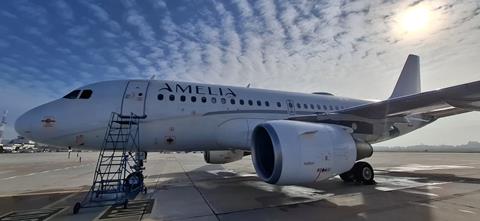
The latest trial with Amelia builds on a limited 2024 experiment that evaluated the technology on scheduled flights using Embraer ERJ-145s between Valladolid in Spain and French capital Paris.
Based on the success of that effort, Amelia widened the scope of the tests last year to include all its eligible flights with the ERJ-145s and Airbus A319 and A320 narrowbodies.
Thales’ system, which it calls Flights Forecast, uses meteorological data to identify areas on a proposed flightplan where contrails could form and suggests an alternative routing – either higher or lower – to avoid them.
By changing the altitude of a flight rather than flying around the areas of the super ice-saturated air in which contrails are prone to forming, only small increases in fuel consumption are recorded.
Across 2025, only 59 of Amelia’s more than 6,400 flights required modification, yielding a net saving of 2,000-2,500t of CO2 equivalent, or an average 70% reduction of climate impact for each sortie.
Those results were analysed and verified by the scientific start-up Klima, with validation also including spot checks using ground-based cameras.
But the contrail-reduction was achieved with a fuel-burn increase of just 0.1%, says Adrien Chabot, Amelia’s chief sustainability officer, as the carrier carefully “controlled” that potential impact.
Chabot says the carrier set a 3% fuel-burn increase limit above which it would not accept the proposed flightplan alteration. However, in practice, “we never saw changes that were increasing fuel consumption by more than 0.5-1%”.
For the carrier, the trials were not simply a means of analysing the efficacy of the contrail-reduction system but whether it was compatible with its operations and flight-planning department and flightcrews.
A key point was to reduce the pressure on air traffic control by agreeing the changes “before getting into the air”.
“At the end of the day really in the mindset they are looking for which is fly as you file… it is much easier for everyone.”
Although Amelia is a relatively small operation, Thales is confident the system could be used by even the biggest carriers providing there is a willingness to support its recommendations, says Julien Lopez, head of Thales green operations.
However, he cautions that if “overnight all the airlines in Europe do it at the same time there’s going to be a bottleneck in terms of the traffic” with “a large number of aircraft all wanting to fly in the same place”.
Accordingly, collaboration with air navigation service providers (ANSPs) will be key, something Lopez is hopeful can be implemented through “large-scale trials”, encompassing not only multiple carriers but also across a “significant” area of airspace.
Thales has already been working towards that goal through a €9 million ($10.3 million) project called CONCERTO, also involving airlines and ANSPs, and funded through the EU’s SESAR air traffic management modernisation initiative.
This has already defined how the process would work on a much larger scale, verifying through simulation and real-world ‘shadowing’ – stopping short of actual flight changes – that “it did work and generated a significant climate impact”.
Subject to further funding agreements, Lopez is hopeful that a “comprehensive” operational trial can be agreed within the next 12 months, to then run over around two to three years.
But there are no immediate plans to launch the system as a commercial product. “We are ready, the technology is ready, we could roll it out tomorrow but there is not market yet, to be honest – the regulation is not there,” says Lopez.
Nonetheless, with non-CO2 climate impacts increasingly in regulators’ crosshairs, he thinks a commercial solution could be viable by 2030.
In the meantime, however, Amelia will continue to use the system. “It is something that is now part of the normal workflow of the dispatchers and pilots, that makes it very easy to keep going,” says Chabot.