














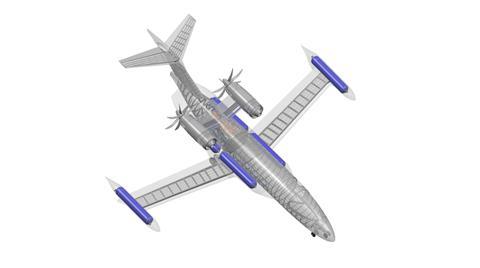
French developer Beyond Aero has dropped the electric ducted fans seen on previous iterations of its BYA-1 hydrogen fuel cell-powered business aircraft, replacing them with pusher-configured propfans, a change confirmed by its recently completed preliminary design review (PDR).
Additionally, the Toulouse-based firm has increased the maximum take-off weight (MTOW) of the BYA-1 to 9.6t, up from around 8.6t previously, pushing it into the European Union Aviation Safety Agency’s CS-25 certification category. Beyond says the aircraft will carry six passengers on routes of 800nm (1,500km).

Detailing its decision in a technical paper issued in support of the PDR, Beyond says the propfans were preferred over ducted fans for their ”ability to meet airworthiness and operational climb performance requirements in one-engine-inoperative conditions and hot-day temperatures”.
They will also “optimise” specific fuel consumption during the cruise phase of flights, the document adds.
Luiz Oliveira, chief engineer at Beyond Aero, says developing ducted fans with the required performance level would also have taken too long and been “very costly”.
Beyond’s propulsion design also incorporates within the nacelle several elements critical to the operation of the fuel cells – an electric turbo-compressor and heat exchangers for thermal management.
Powered by an independent electric motor, the compressor architecture enables “independent optimisation of compressor operating conditions across varying thrust demands, while maintaining the propeller at its optimal rotational speed”, it says.
A turbine on the same shaft also recovers energy from the cathode exhaust, “reducing the net electrical power consumed by the compression process, essential at altitude, where the compressor must work hardest”.
The heat exchanger is designed to be operated in all flight conditions – or even while stationary – and also takes advantage of the Meredith effect to deliver additional thrust, countering the drag penalty from its installation.
Beyond says it is currently evaluating “heat exchanger geometries, technologies and samples” on two dedicated test benches elsewhere in France.
It says using rear-mounted propellers – each is 2.8m (110in) in diameter – in a pusher configuration “places the propeller behind the nacelle and behind the cabin, contributing to reduced cabin noise.”
Oliveira says it opted to raise the MTOW, a decision taken at the turn of the year, as the previous design was already close to the 8,618kg (19,000lb) upper limit of the CS-23 category. “It was an unacceptable risk to keep running this project with no margin,” he says.
Although the CS-25 regulations for transport category aircraft are more stringent than those for CS-23, Oliveira says the company had already been working in alignment with the former’s standards – for example, the damage-tolerant structure and fly-by-wire control redundancy – therefore there will be little impact from the change.
And even if there is some additional engineering workload, it will result in a higher-performing aircraft for the customer, he argues.
“Above all, a CS-25 aircraft provides a better safety level for the end user in terms of single-engine performance and an innovative aircraft without this survivability would not be good for the market,” he adds.
As a result of the weight increase, the BYA-1 also moves to a twin-wheel arrangement on the main and nose landing gears.
Beyond has, however, retained the BYA-1’s distinctive hydrogen storage system using six composite fuel tanks – four at the wing-fuselage junction and two in the wing-tips – each capable of holding 32kg of gaseous hydrogen at 700bar. These feed the six fuel cell stacks located inside dedicated compartments in the aft fuselage, providing total installed power of 2.4MW.
With the PDR behind it, Beyond’s immediate focus is on derisking the adaptation for aerospace use of components sourced from the automotive sector including the fuel cells, electric motors and high-voltage system.
“It is mostly a matter of “It is mostly a matter of packaging and rearranging them and making them suitable for flight at altitude and making them lighter of course,” says Oliveira.
A critical design review is expected to follow in around 12-18 months’ time, ahead of a first flight in 2029, followed by certification in 2030 and service entry in 2031.
Supplier selection is also ongoing. While several partners have already been picked – EKPO for the fuel cells and aerostructures specialist Aernnova, for example – key systems including the 1MW-class electric motors remain up for grabs.
Beyond says it has a shortlist of three motor suppliers and will make a final decision in the coming months.