


















Next-generation business jet developer Beyond Aero has praised the performance of its prototype hydrogen-electric power-generation system in ground testing, as the French firm progresses the development of its BYA-1 aircraft.
Additionally, the programme has been boosted by Beyond Aero’s acquisition of intellectual property and assets from defunct developer Universal Hydrogen.
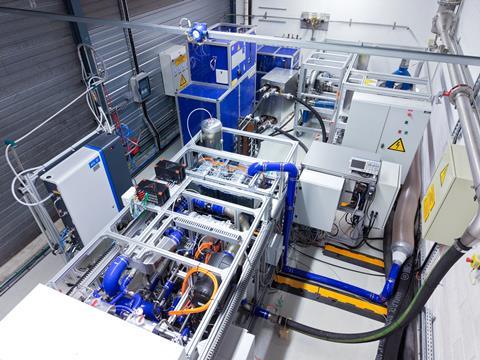
Beyond Aero says testing of the full-scale system, carried out at its new integrated powertrain laboratory in Toulouse, has proved it has attained technology readiness level (TRL) 6.

“We’ve now reached TRL6, our hydrogen-electric propulsion works at full scale, in representative conditions,” says Eloa Guillotin, chief executive of Beyond Aero.
“That’s 18 months of relentless teamwork, powered by an environment where ambition is matched by rigour and where every achievement is the result of collective determination.”
Initially tested as separate subsystems – air, gaseous hydrogen and water for cooling, plus control software – the final phase brought these together as an integrated power-generation system on a full-scale test bench.
Beyond Aero’s laboratory is capable of supporting up to 1.2MW of electrical output from three independent fuel cell channels – half of the BYA-1’s total power requirement.
“During testing, these channels were operated in conditions representative of flight profile, not only to validate individual component performance but also to assess the global integration of energy storage, hydrogen distribution, fuel cell stacks, and thermal management in a realistic environment,” it says.
Validation of the system took place in collaboration with programme partners including EKPO Fuel Cell Technologies, FEV Aerospace, BrightLoop Converters, AVL, and Dassault Systemes.
However, the developer declines to say when it will test the full powertrain, including the BYA-1’s 1.2m (4ft)-diameter electric ducted fan engines.
Beyond Aero has also now engaged with the European Union Aviation Safety Agency through its Pre-Application Services (PAC) offering, which de-risks the path to certification under the regulator’s CS-23 framework.
“Early authority dialogue is typical of novel propulsion programmes and critical to establishing a certification basis,” says the company.
Additionally, Beyond Aero has reinforced its operation through the acquisition of Universal Hydrogen’s intellectual property and assets. These include the entirety of the defunct developer’s patent portfolio, flight-test and digital data, strategic test bench components, and key talent.
Beyond Aero declines to specify the purchase price or when the acquisition took place but says the deal will “accelerate certification and de-risk integration” of the powertrain.
Universal Hydrogen folded in 2024 after running out of cash.
Beyond Aero hopes to freeze the BYA-1’s design around 2027, with service entry to follow in the early 2030s.