














German electric aviation start-up Vaeridion has officially inaugurated its new battery production plant at Oberpfaffenhofen airport – a facility previously owned by defunct aircraft developer Lilium.
In fact, Lilium’s last rites were playing out almost exactly a year ago as the firm and its successor lurched from one insolvency to the next.
As a consequence, multiple buildings at Oberpfaffenhofen were vacated, including those already earmarked and provisioned for battery production.
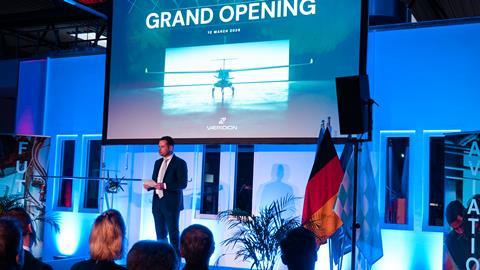
Vaeridion secured the lease on the buildings from the site’s owner in September alongside a separate deal with Lilium’s administrator for assets inside the facility, including laser welding machines and other production and testing equipment.
“It’s a fantastic expansion,” says Vaeridion founder and chief executive Ivor van Dartel. “We hope to start producing this quarter and also build out one part of the building for testing.”
Only minor modifications were required to the site to bring it up to spec, recommissioning certain assets and finalising the interior. However, the bulk of the interior fit-out – including fire-resistant walls, extraction system and battery storage containers – had been completed prior to Lilium’s insolvency.
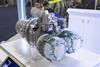
Vaeridion’s taking over the factory also sees it now moving from the first pre-series iteration of the battery packs “which were all handmade” to the second iteration “which we are industrialising”.
“In our new facility we can introduce the first steps of automation which increases both quality and output.”
Peak capacity at the new facility will be 400 packs per year, with each Microliner aircraft requiring 60 housed in its wings.
Van Dartel says the change between the first and second iterations of the battery packs has simplified their production and installation.
“We have decreased complexity, we have increased safety and maintainability and made everything a lot easier,” he adds. The cells themselves will come from Molicel, following a recent agreement between the two firms, plus other undisclosed suppliers.
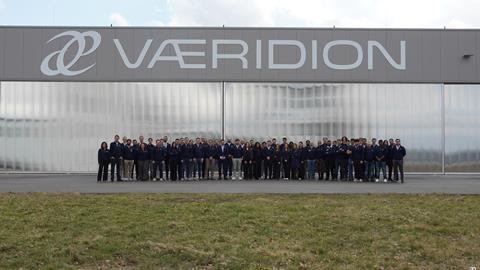
The increased production capacity offered by the Oberpfaffenhofen site “allows us to feed into the test programme” – including ground tests using Vaeridion’s ‘copper bird’ electrical system test rig and an early flight-test campaign aboard a flying testbed.
“And then finally equipping the first flying [Microliner] prototypes and ultimately even the first customer aircraft.
“It’s early but we feel that this facility will deliver what we need for the next couple of years. It’s really a step-change for us.”
There is also room for further expansion at the site, he notes, as Vaeridion eyes the requirements for full-scale production. However, the company will maintain its design office and HQ in nearby Munich.
Vaeridion is currently in the process of closing the preliminary design review on the nine-seat Microliner, with its maiden sortie targeted “within the next 100 weeks”.
Service entry is targeted for the beginning of next decade. Launch customer, Belgian operator ASL Group, is slated to receive “the first series aircraft in early 2030” adds van Dartel.