















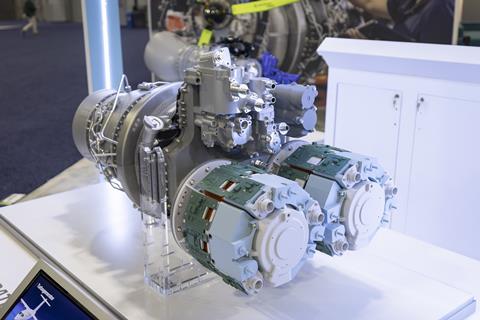
A critical part of Electra’s EL9 hybrid-electric ultra-short take-off and landing aircraft is beginning to come together, with assembly of the Safran Helicopter Engines (SHE) TG600 turbogenerator now under way, as the companies build towards a first flight in the coming years.
Based around SHE’s Aneto engine, the TG600 marries the 1,300shp (970kW)-class turboshaft with two GENeUS generators from sister business Safran Electrical & Power, delivering an output of 600kW.

The TG600’s maiden sortie will be aboard the EL9 prototype, powering eight Evolito electric motors, a milestone anticipated towards the end of 2027.
“We are very much focused on taking this to flight,” says Benjamin Balaban vice-president OEM business development. “Flight will happen very soon, probably next year, and this will lead to the certification of the product before the end of the decade.”
Electra is less specific, however: chief executive Marc Allen identifies only a date broad range – what he calls a “landing zone” – for the first flight, running from late 2027 or early 2028.
SHE’s development of the TG600 builds on an earlier research and technology phase that culminated in 2023 with ground tests of a full-scale demonstrator, providing the firm confidence in its maturity.
“It was very successful and allowed us to reach a certain [technology readiness level] that allows for the flight,” says Balaban. “The R&T phase is over; we are now entering the development and production phase.”
Assembly of the first TG600 is now under way at SHE’s facility in Bordes in southern France and “will be completed in a couple of months”, he says.
Discussions are ongoing with the European Union Aviation Safety Agency on the route for certification, which is likely to combine elements of its CS Engines and SC E-19 regulations.
Electra’s agreement with SHE covers work on the EL9, although it is understood the two parties are working to extend that partnership into the production phase.
Meanwhile, Allen says parts for the initial EL9 prototype are beginning to flow into its final assembly facility in Manassas, Virgina.
“We are still working a path through the design and development of it and putting together all the final supplier selections,” adds Allen, who expects the critical design review to be completed in late 2026.
Electra is also attempting to select a location for its final assembly line, having whittled down an initial list of 140 bidders down to a shortlist of six. Allen says the decision will be finalised in the first half of this year.
Additionally, the company was selected earlier this week by the US Department of Transportation and the Federal Aviation Administration as a participant in the inaugural Electric Vertical Takeoff and Landing and Advanced Air Mobility Integration Pilot Program – better known as eIPP – alongside state partners.
In essence, this should see the Electra’s aircraft, initially its EL2 demonstrator and later an EL9 prototype, running public demonstrations of the capability in Florida, New York, New Jersey, and Pennsylvania.
Electra is also hopeful of finalising a similar agreement with the Norwegian government to later this year trial its EL2 in the west of the country in partnership with launch customer Bristow Group.
On top of which, the company plans in 2026 to launch a Series C funding round, building on the around $200 million it has previously raised from several sources.
“We will be able to get into service with this airplane at a fraction of what it will cost the eVTOL companies,” says Allen, a Boeing veteran.
Its finances will be further reinforced by the conversion of the more than 2,200 aircraft covered by letters of intent into deposit-backed firm orders.
“This is the exact kind of contract I would have signed at Boeing – this is what it means to commercialise.”
Bristow in December became the first customer to sign such a contract and Allen says Electra has “ambitious targets” for the rest of the year.
Electra claims the EL9 will be able to carry nine passngers or 1,360kg (3,000lb) of cargo on routes of up to 1,100nm (2,040km) but critically take-off and land in as little as 45m (150ft), opening up thousands of potential landing sites. Certification is targeted in the late-2029 to early-2030 range.