












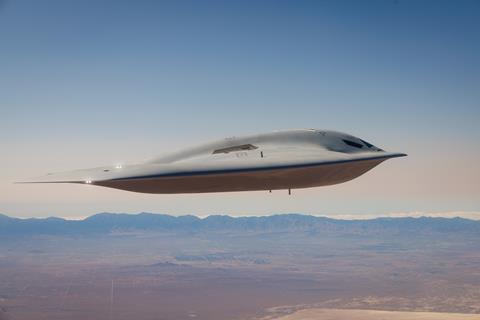
Defence manufacturer Northrop Grumman has begun in-flight refuelling tests with the US Air Force’s next-generation stealth bomber.
Unofficial images showing what appeared to be Northrop’s B-21 Raider flying prototype docking with a USAF Boeing KC-135 tanker began circulating on 10 March.
The photos were initially posted on X by California-based plane spotter and subsequently shared by a number of prominent open source intelligence accounts. Civilian enthusiasts and photographers similarly captured the inaugural B-21 flight in 2023.
Two B-21 prototypes are known to be participating in a flight test campaign at Edwards AFB in the California High Desert. Northrop is assembling B-21s at a plant in the nearby aerospace hub of Palmdale.
On 11 March, the USAF confirmed to FlightGlobal that at least one of those aircraft did log a sortie with a KC-135, although the service stopped short of acknowledging the actual transfer of fuel from one aircraft to the other.
“A B-21 Raider completed a test event involving a close proximity flight with a KC-135 Stratotanker,” the air force says. “To maintain enhanced security measures, we will not provide further details on specific test points.”
The service did not specifically comment on the veracity of the photos circulating online.
In those images, the KC-135 can be seen in position above and ahead of the B-21, with the fuel transfer boom lowered. A Lockheed Martin F-16 fighter is also visible in what appears to be an observational capacity.
Although the boom is not in contact with the flying-wing bomber in that image, another photo shows what could be an in-flight connection between the tanker and the B-21 prototype.
That image shows the fuel transfer boom positioned at the forward centreline of the B-21’s dorsal fuselage.
The Northrop Grumman B-2 Spirit stealth bomber, which is the predecessor of the newer Raider design, uses an in-flight refuelling port located along the dorsal centreline and aft of the jet’s cockpit bubble.
“This flight is part of the ongoing, rigorous test campaign to validate the B-21’s capabilities and operational readiness,” the USAF adds of the recent KC-135 sortie.
The initial B-21 first took flight in late 2023 – a short hop from Northrop’s Palmdale site to nearby Edwards AFB to start the USAF test campaign.
FlightGlobal was on hand in 2022, when Northrop and the air force first revealed that inaugural Raider airframe (number T-1) in a hangar at Palmdale. The Pentagon approved Northrop to begin low-rate production on the B-21 in early 2024.
In February of this year, the USAF and Northrop announced a $4.5 billion deal to accelerate the annual B-21 production rate by 25%
The service says it now expects to field operational B-21s in 2027, with the first aircraft going to the bomber wing at Ellsworth AFB, South Dakota.

Fielding the new stealth bomber is a top priority for the Pentagon, which has only a small fleet of 20 Northrop B-2s – the Western world’s only low-observable, nuclear-capable heavy bomber.
That fleet played a central role in 2025’s Operation Midnight Hammer – the US operation to destroy Iran’s underground nuclear enrichment sites – and is currently engaged in the more protracted air campaign Washington launched against Iran at the end of February.
“The B-21 is foundational to our long-range strike capability and to credible deterrence,” says secretary of the air force Troy Meink, the service’s top civilian official.
Current air force plans call for the fielding of 100 B-21 bombers.
Expanding the fleet beyond that amount was previously suggested as a possibility by service officials during the administration of former US President Joe Biden.
Certain industry groups have also advocated for such a move, but no firm commitment from the Pentagon has as of yet been made.