
















“We have a virtually unlimited supply of these weapons. Wars can be fought ‘forever’.”
That was the claim made by US President Donald Trump on 2 March, roughly 48h into the joint US-Israeli air war against Iran.
It’s unclear who Trump was quoting in that Truth Social post, which was referencing the availability “medium- and upper-medium grade” weapons. The only clue offered by the president as to the source of that reality is that it “was stated to me today”, Trump said in the same post.
That messaging on munitions suppliles contradicts years of warnings from military officers, congressional lawmakers, and defence industry executives.
Since Russia’s 2022 full-scale invasion of Ukraine, experts have warned that the rate of expenditure for precision munitions in a peer-on-peer industrial war will vastly outstrip the production capacity of Western defence suppliers.
As early as mid-2022, former Raytheon executive Wes Kremer flagged that US and European stockpiles were being depleted by the volume of support going to Ukraine.Northrop Grumman chief executive Kathy Warden highlighted the same challenge in an interview with the Financial Times around the same time.
“Existing weapon stockpiles were not intended to service a lengthy war,” Warden said in the July of 2022.
Although industry and the Pentagon have since made significant investments to restart shuttered munitions lines and expand existing production facilities, the Pentagon’s appetite for long-range guided missiles in combat still vastly outstrips the ability of suppliers to churn out replacement stores.
In just over a week of combat, the US and Israel have struck more than 5,000 targets in Iran, according to the White House. During the conflict’s opening days, US commanders relied heavily on long-range weapons like the Lockheed Martin AGM-158 Joint Air-to-Surface Standoff Missile.
Newer extended range and extreme range variants of jet-powered cruise missile offer a range 540-972nm (1,000-1,800km), according to the Center for Strategic and International Studies.
That allows friendly aircraft to fire JASSMs while remaining well out of range of enemy air defences.

Video release by US Central Command, which is overseeing the frontline portion of the Iran operation, show Boeing B-52H heavy bombers taking off with heavy loads of JASSM missiles.
Footage dated 2 March shows a flight of B-52H bombers taking off at night from an undisclosed location, each with three JASSMs visible on the portside underwing weapons station.
Separate video from 3 March shows a B-52H landing during the daytime at an undisclosed location with empty weapons racks, including the triple-pylon hardpoints that were carrying JASSMs in the take-off video.
Yet another B-52H video from 4 March gives a nose-on view of one of the bombers, clearly showing a loadout of six JASSMs – three on each underwing hardpoint.
In that footage, six B-52Hs are staged on the flight line ahead of take-off.
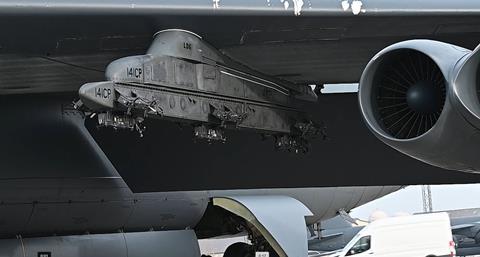
The B-52H can accomodate a total of 20 JASSMs: eight on its internal launcher, and six on each wings. In the Iran footage it was not clear if JASSMs were being carried internally.
All three of the US Air Force’s bomber types are certified to carry the JASSM, as are fighters such as the F-15E, F-16, F/A18E/F, and the F-35.
Each JASSM costs roughly $1 million, according to fiscal year 2026 Pentagon budget documents, with plans to purchase 389 missiles during that period.
Lockheed is working to expand production of both the JASSM and related Long-Range Anti-Ship Missile to 1,100 combined units annually, from a level of 720 annually in 2024. Congressional leglisation from 2022 instructed the Pentagon to start building up a stockpile of JASSMs, with a target of 3,100 missiles.
Still, if a six-ship flight of B-52Hs can salvo 120 JASSMs in a single sortie - a clear possibility in major war against a peer adversary such as China - it is clear that this is not a recipe for infinite combat.
However, JASSMs are not the “medium- to upper-medium grade” weapons that Trump appeared to be referencing.
Pentagon chief Pete Hegseth confirmed as much during a 4 March press conference.
“We used more exquisite stand-off munitions at the start, but no longer need to,” said Hegseth, who the Trump Administration has styled the secretary of war.
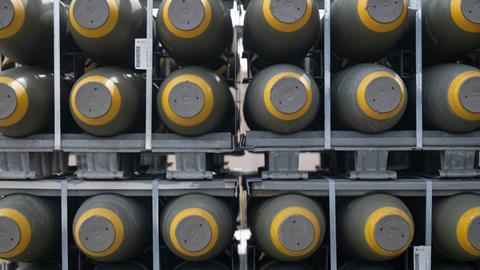
Those would seem to be the tried-and-tested gravity bombs that have been in frontline service for decades. Boeing’s Joint Direct Attack Munition (JDAM) kit was first deployed in the 1999 NATO air campaign over the Balkans.
The bolt-on kit allows a standard Mk 82 227kg (500lb) bomb to be converted into a precision munition. The Mk 82 forms the core of both the GPS-guided GBU-38 JDAM and the laser-guided GBU-12 Paveway II.
The larger, 907kg (2,000lb) Mk 84 variant can also be outfitted with a JDAM kit.
While these weapons have far less range they are more plentiful.
There are 17 facilities globally that produce the Mk 82 under license to common NATO standards, with a per unit cost of around $4,000 according to Pentagon figures. The unguided bombs are produced for the US military by General Dynamics.
A larger Mk 84 costs $16,000 apiece.
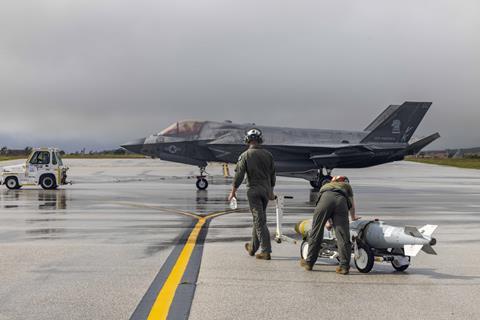
The 2026 Pentagon budget includes funds for 2,300 JDAMs for US Navy and Air Force at a cost of $187.5 million. That works out to around $80,000 per kit, although the figure has been as low as $25,000 in previous years.
In 2024, Boeing received a $7.5 billion contract to deliver an indefinite quantity of JDAMs through 2030.
After rapidly depleting its JDAM stores during the campaign to oust the Islamic State terrorist group from Iraq and Syria from 2014-2019, the Pentagon surged its purchases to more than 30,000 units in 2019 and over 24,000 in 2020.
The annual buy was gradually reduced throughout the ensuing years, indicating there is likely a sizeable stockpile of the guided bombs.
US defence secretary Pete Hegseth confirmed as much in comments made on 4 March.
“We will be using 500lb, 1,000lb and 2,000lb GPS- and laser-guided precision gravity bombs of which we have a nearly unlimited stockpile,” Hegseth said.
A day later he affirmed the message that Trump had issued earlier in the week.
“We’ve got no shortage of munitions. Our stockpiles of defensive and offensive weapons allow us to sustain this campaign as long as we need to,” the Pentagon chief said.
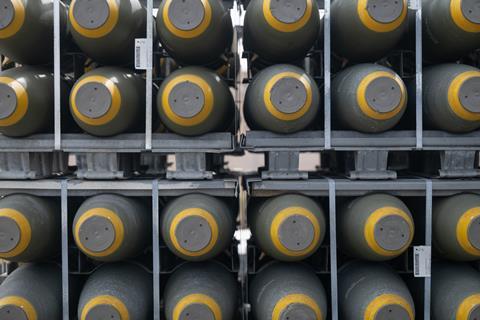
While Washington may have found a solution for its offensive weapon problem, the numbers on defensive systems still appear challenging.
Although Lockheed Martin reached a deal with the Pentagon in January to expand production of the PAC-3 interceptor to 2,000 units per year by 2030, currently only around 600 are delivered annually.
The missiles are key to the functioning of Raytheon’s popular Patriot ground based air defence system, which has seen heavy combat use in Ukraine and now across the Middle East.
Fending off mass waves of low-cost attack drones with expensive Patriot interceptors is a strategy whose folly has been proven in Ukraine. Kyiv has instead shifted to cheaper and less restricted options for air defence, like shooting the slow moving drones with helicopter-mounted machine guns.
Hegseth downplayed concerns about running low on air defence systems.
“Our stockpiles of… Patriots remains extremely strong,” he said at the 4 March briefing.
Both Hegseth and General Dan Caine, the chairman of the joint chiefs of staff, suggest that demand for air defences will slacken as US and Israeli forces attrit Iran’s ballistic missile launchers and support infrastructure.
They claimed ballistic missile shots from Iran are already down by 86%, while the firing of one-way attack drones has been reduced by 73%.
“Their missile capability is down to about 10%,” Trump said in a a 9 March press event in Florida.
During that appearance, the president also suggested that his war with Iran could end “very soon”. However, he also threatened further violence should Tehran continue to disrupt the flow of oil and liquefied natural gas through the Strait of Hormuz.,
Iran has vowed to continue fighting and says it will not give into Washington’s previously stated demand for unconditional capitulation – a condition that Trump already appears to be walking back.
It is as of yet unclear if the Trump Administration’s bravado regarding the munitions supply turns out to be sound military planning or simply bluster. History has shown that opponents, and their industrial capacity, often prove far more resilient than expected, even in the face of prolonged aerial bombardment.