
















Experimental aircraft developer Aurora Flight Sciences has completed fabrication of the fuselage for a new jet meant to operate without traditional mechanical control surfaces.
Known as the X-65, the design replaces moving parts like rudders, flaps and ailerons with an array of effectors embedded in the fuselage that project jets of air to control pitch, roll, and yaw. The concept is called “active flow control”, or AFC.
Aurora has suggested an AFC design approach could reduce weight, lower complexity and improve the aerodynamic efficiency of an aircraft.
The Boeing subsidiary revealed in early January that it started fabricating the X-65 fuselage after three years of design work and subscale wind tunnel testing under a Pentagon research programme.
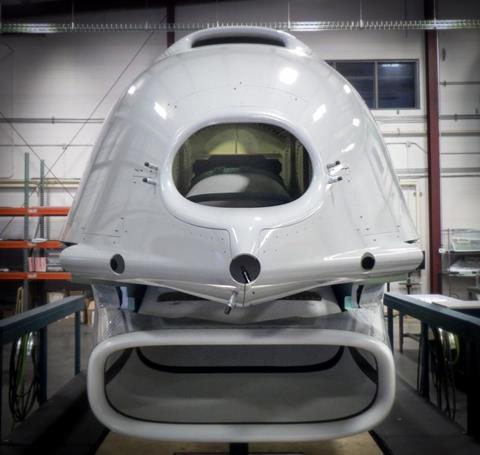
In late February, Aurora said it completed the fuselage at a company facility in West Virginia. Other critical components for X-65, including the wing assemblies and engine diffuser, are also being fabricated at that site.
The company previously said an unspecified propulsion system and the all-important AFC control system components are already on-site and ready for integration.
First flight of the novel aircraft is planned for 2027.
A photo of the newly completed fuselage is largely consistent with earlier renderings released by Aurora. The aerostructure features a large centreline air intake mounted on the ventral fuselage and two smaller air intakes situated on the X-65’s nose and dorsal fuselage sections.
These may be related to the AFC system at the heart of the X-65, which Aurora says will supply pressurised air to 14 effectors embedded across all flying surfaces of the aircraft.
Aurora has previously said the X-plane will have a 9.1m (30ft) wingspan and 3,175kg (7,000lb) gross weight, with ability to reach speeds up to 463kt (857km/h) – equivalent to Mach 0.7.
Renderings and sub-scale models show an aircraft with a radical triangular wing and centre cutouts, although photos of X-59’s actual wings have not been made public.
“The triangular wing design enables testing across multiple wing sweeps and is modular, with replaceable outboard wings and swappable AFC effectors to allow for future testing of additional AFC designs,” Aurora has said.
Although not specified, the design profile of the X-65 indicates it will be uncrewed.
The X-65 project is being funded by the Pentagon’s famous technology incubator – the Defense Advanced Research Projects Agency – under the Control of Revolutionary Aircraft with Novel Effectors (CRANE) programme.
Aurora was awarded an initial $42 million CRANE contract from DARPA in December 2022 to fund development of what has become the X-65. The company advanced to the second phase shortly after in January 2023.
In August 2025, the company reached an agreement with DARPA to “co-invest” in the completion of an X-65 demonstrator and first flight.
DARPA has said the CRANE programme will help advance AFC technology and explore the concept’s potential for future use in commercial and military aircraft.