
















The US Army has begun training rotary-wing pilots to fly the Bell-Boeing MV-22B Osprey ahead of the service receiving its first MV-75 tiltrotor prototype.
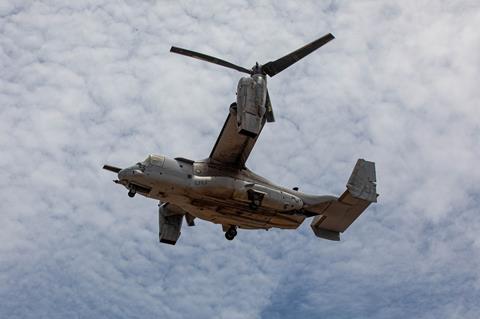
Six experimental test pilots from the army have completed a three-month familiarisation course on the Osprey with the US Marine Corps, which is the largest global operator of tiltrotor with more than 320 in service.
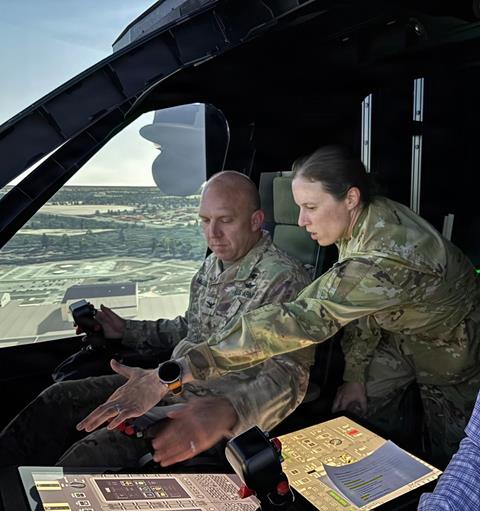
Army aviators received 60h of simulator time and 20h of flight time in MV-22Bs, which the service says will provide test pilots with skills and knowledge to operate Bell’s forthcoming MV-75.
The US Army is the only branch of the US military that does not operate tiltrotors.
“This training gives us hands-on familiarisation with the only other militarised tiltrotor aircraft… in hopes of making the MV-75 the best possible airframe,” says Major Katherine Houle, a test pilot who completed the Osprey qualification course.
Three more army aviators have attended the USMC’s Weapons Tactics Instructor course, an academic programme focusing on tactics and operational practises for employing the MV-22.
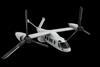
Bell has delivered two MV-75 virtual prototypes to the US Army, as the company works toward launching a flight-test campaign and delivering the first prototype.
The V-280 Valor – the experimental tiltrotor upon which the MV-75 is based – logged a substantial amount of flight time during the competitive assessment for the army’s Future Long-Range Assault Aircraft programme.
The army says its two virtual prototypes replicate key MV-75 features, including the cockpit design, mission software and flight dynamics. This has allowing test pilots to gain familiarity with the tiltrotor ahead of the first delivery.
That initial aircraft could be turned over to the army for testing and evaluation as soon as the end of this year, according to the service’s top officer.
That marks a significant acceleration of the army’s timeline for fielding the new tiltrotor, which had already been moved forward from the original 2032 goal.
Last year, the army told FlightGlobal it was working with Bell to move up delivery of the first MV-75 prototype to 2027, with frontline units receiving their first tiltrotors by 2030 or sooner.
Bell says it has begun assembling the first six MV-75 test aircraft in Wichita, Kansas, with eight examples under contract.
Originally conceived as a replacement for the venerable Sikorsky UH-60 Black Hawk, the army now expects to operate MV-75s alongside its workhorse utility helicopter.
“Plans are in place to continue flying the Black Hawk for the next several years as the army fast-tracks the rollout of a new MV-75 tiltrotor fleet,” the service says.
The MV-75 programme will ultimately cover some portion of the army’s 2,300-strong UH-60 fleet, although a final figure has not been set, according to the officer managing development and procurement of the tiltrotor.
“It doesn’t replace the entire Black Hawk fleet, but a strong majority,” Colonel Jeffrey Poquette told FlightGlobal in May 2025. “We’re talking over 1,000.”
Just as army pilots are getting a feel for the Osprey, the service’s frontline ground troops are also easing into tiltrotor operations.
Over the past year, Ospreys from the USMC completed readiness exercises with conventional US Army soldiers in Djibouti and flew Green Beret special forces troops during free-fall parachute training in Hawaii and Colorado.