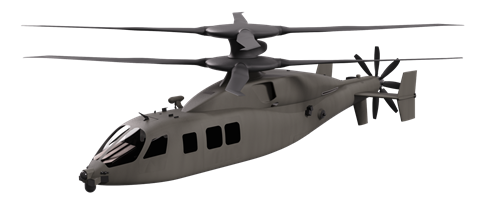
















A project involving six NATO members aiming to develop a next-generation military helicopter has agreed around 90% of the requirements ahead of the release of a request for proposals (RFP) to industry this summer.
And while three manufacturers – Airbus, Leonardo and Sikorsky – participated in the Next Generation Rotorcraft Capability (NGRC) programme’s concept phase which ended last year, they will now be joined by Boeing for the project’s next step.
Presenting at IQPC’s International Military Helicopter conference on 24 February, Cyril Heckel, NGRC programme manager, said Boeing and the three other airframers had been pre-qualified as bidders following the submission of selection questionnaires late last year.
This process assessed a bidder’s size, financial strength, management capability and “track record of delivering military platforms”, says Richard Thorpe, NGRC senior technical officer at the NATO Support and Procurement Agency (NSPA) which is managing the project on behalf of the six nations.
“It was designed to give us solid OEMs that could build a consortium to answer NGRC’s challenges and I think we were pretty successful,” says Heckel.
The selection means the RFP will be distributed to only those four pre-qualified companies when it is released in July “and they will decide if they want to go to the bidding stage”, says Heckel.
“It is a new starting line – this way it remains a fair process. Let’s see what Boeing does if they decide to bid.”
In the background, the NSPA is working to obtain agreement from the nations – Canada, France, Germany, Italy, the Netherlands and the UK – on the precise requirements for the NGRC.
While a long list of platform attributes was released in 2021 and lightly refined since, many of these are incompatible with one another, for instance balancing speed, range and payload, where if one is prioritised, the others are impacted.
“What we are saying to the nations is that they can’t have everything so will have to make some kind of compromises,” says Thorpe.
“We are getting to the fun part of trying to get a harmonised viewpoint, but we have come together on a lot of things.”
Around 90% of the requirements have been agreed, he says, “with just a few outliers” remaining.
Critical points so far hammered out include the need for an aircraft that can perform both maritime and land missions, says Thorpe: “They want that sort of ability – even the land version needs to be able to deploy off the back of a carrier or frigate.”
Additionally, capacity will be between 12 to 16 fully equipped troops.
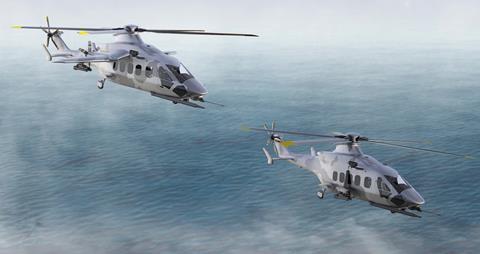
However, outstanding items included several fundamental criteria: “We are still deciding where the sweet-spot is for speed,” he says.
“If you are in a contested battlespace you will need to get down low and then agility starts to come into it.”
The 2021 attributes specified an optimal cruise speed of 220kt (407km/h) but not less than 180kt (333km/h).
Maximum take-off weight is also “not fully agreed”, he adds, although that figure is “governed by safe deck landing limits which we won’t exceed”.
The size of naval landing decks and onboard hangars are further constraints, Thorpe notes.
“With all these attributes and requirements, it’s about getting that sweet-spot while still leaving open a little bit of design space,” he adds.
Heckel concedes “it is a challenging path” to meet “all the national expectations”, but he remains confident that a resolution can be reached. “We cross our fingers that by the summer this will be ready.”
Once bidders receive the RFP they will have until September 2027 to respond, allowing the NSPA to evaluate the concept design solutions and propose a winning platform or platforms to the six nations in early 2028.
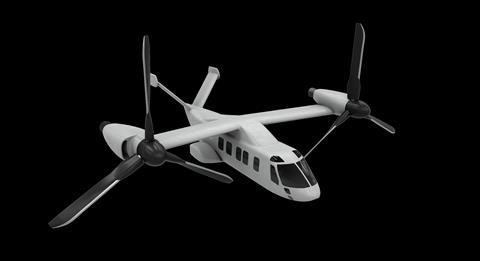
The NSPA is also considering whether, as with the preceding concept study phase, it will allow bidders to propose more than one solution – for example both conventional and high-speed rotorcraft.
“We want to give flexibility to propose the smartest architecture for the concept design,” says Heckel.
Ultimately, the NSPA may recommend several qualifying solutions “and then it is up to the nations to decide” which to pursue.
Should consensus emerge, development and production contracts should be signed in the 2028-2029 timeframe, working towards a service-entry target of 2035.
“2028 is an important milestone for the programme, and we envisage it as an appropriate time for interested parties to express their interest in joining,” Heckel adds.