


















Rolls-Royce has shown off a full-scale mock-up of its proposed UltraFan 30 engine aimed at next-generation narrowbody aircraft, featuring characteristics including a short inlet and ripple-edged outlet guide vanes.
UltraFan 30, which takes its name from its proposed 30,000lb (133kN)-thrust category, is Rolls-Royce’s candidate to re-enter the narrowbody sector it abandoned when it exited International Aero Engines in 2012 in favour of the widebody market.
Group director of engineering, technology and safety Simon Burr tells FlightGlobal that the model of the engine, displayed during a financial briefing in central London, is intended to “bring it to life”.
“You need various stakeholders to be able to take on the challenge of re-entering this market,” he says, and the mock-up is designed to show investors that “we’re serious… about investing in the technology”.
Rolls-Royce is intending to run a demonstrator for the geared-fan powerplant in 2028. The model displayed has a 90in (229cm) fan, although the demonstrator will have a slightly smaller one and feature a core based on the Pearl 10X business jet engine.
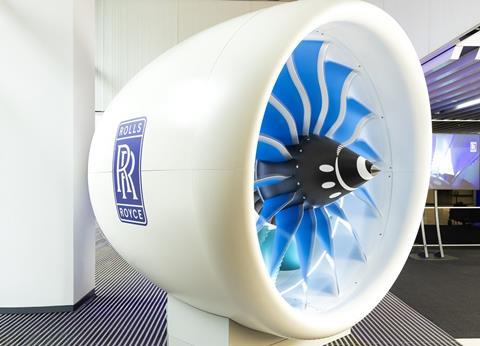
Burr points out that the UltraFan 30 inlet is short, to reduce weight and drag, a result of previous testing. The outlet guide vanes are ripple-edged, inspired by bird biomimicry, to break up airflow into smaller higher-frequency streams to reduce noise.
The engine will have a high bypass ratio, up to 15:1, and take advantage of technologies developed for the large high-thrust UltraFan 80, as well as the Trent XWB and other powerplants.
Burr says the demonstrator will not be a prototype but rather a platform to combine current “technology bricks”.
“We don’t, right now, know exactly what the airframes will be,” he says, but Airbus and Boeing are likely to design a future narrowbody to be light in weight, with higher aspect ratio wings and a composite fuselage.
Rolls-Royce research and technology director Alan Newby says the UltraFan 30 “represents the embodiment [of UltraFan 80] for the narrowbody scale”, adding: “It looks very much like the big one, but this one is optimised for the narrowbody market.”
Although scalability is fundamental to the UltraFan philosophy, Newby says the decision whether to scale within the narrowbody thrust range will depend on the airframers’ design strategies.
“Whether that means one core with two different fan diameters or a separate core will very much depend on where the families or aircraft end up sitting when we get down to the final details of what Boeing or Airbus decide to do,” he says.
“But we’re clearly going with that in mind, about how we might cover a family approach.”

The narrowbody sector, with its high-cycle nature, also brings other specific priorities and considerations, says Burr.
“For a long-range aircraft, that last tenth of fuel-burn is really important,” he says. “For this [narrowbody engine] it’s about durability, it’s about reliability and it’s about on-wing life.”
The issue of durability – or rather the lack of it – has been prominent in the narrowbody engine sector, a market dominated by CFM International and Pratt & Whitney, but Rolls-Royce has also had a rough period in the widebody arena, notably with its Trent 1000.
“We’re conscious of a desire for a much higher cyclic life than today’s engines are actually achieving,” says Burr. “Some of that is enabled by the material technology. The new disc super-alloy we’ve developed, which is going into production now for some of the Trent engines, came from the UltraFan programme.”
He adds that maintenance considerations are also crucial – including transportation, particularly with the larger fan. “You don’t want to end up with everything being main-deck cargo,” he says. “Can I just… service the core and leave the fan and power module, [leave] the fan module with the gearbox on the aircraft and just swap out cores?
“There’s lots of different thinking that’s gone into the concept. It’s not just about our ambition to enable the next generation of narrowbody aircraft with better fuel consumption.”
Newby also highlights the importance of production considerations, given the speed at which single-aisle aircraft are built.
“If you think about the volume of these, as we go through the design process, we’ve got an eye on how we will manufacture these at the rate that we need in the narrowbody market,” he says.
“That’s a different trade from that which we see in the widebody market. So the way you design the turbine blade, the fan blade, producibility is one of the key considerations that goes into account.”
Airbus has indicated that it wants to take the crucial engine decision for its next-generation narrowbody around 2030. Rolls-Royce is betting, with the ducted UltraFan 30, that it can either deter Airbus from pursuing an open-rotor concept or oust CFM from its exclusive position at Boeing.
Newby believes the 2030 timeframe is sufficient for a 2028 demonstrator to instil confidence in both the physical size of the engine and the maturity of its technology, and enable selection of the powerplant followed by a standard five- to seven-year development window to service entry.
“We think we’ve got time between then and now to do that,” he says. “And obviously, we are working closely with [the airframers] to align timescales.”

Burr says the company has to find the balance between the most advanced technology and the need for maturity.
“Of course, everyone wants maturity at day one,” he states. “But if your entry-into-service is mid-2030s, no-one wants 10-year-old technology. They want the best that’s available.”
Rolls-Royce has been out of the narrowbody market for close to 15 years but neither Newby nor Burr believe the company is disadvantaged compared with its rivals.
“If you think about which sector of the market drives the technology, that’s probably the widebody market,” says Newby. “If you think about where we’ve been with the XWB, where [GE Aerospace] has been with the [GEnx and GE9X], that really sets the technology threshold.
“So then it’s about what’s appropriate in this marketplace, and what are the appropriate trades between absolute performance and durability.”
He says Rolls-Royce is “not concerned” about its ability to compete effectively, but acknowledges: “We’ve got to do the work. We’ve got to make sure that we understand the durability challenges and that we have an engine that’s suitable for short cyclic operation, which is different to some of the things we’re used to in the widebody market. So we’re going in with our eyes open.”
Burr points out that Rolls-Royce can draw on underlying principles from the business-jet sector. The UltraFan 30 core is “not a lot bigger” than that for the Pearl 10X, he says, and the company can “carry through” relevant experience.
He also says that Rolls-Royce has a “large chest” of technologies which have come through from its work on the powerplant for the tri-national military Global Combat Air Programme.
“What gives you power density on a combat engine gives you fuel efficiency on a commercial engine,” says Burr. “And some of it’s about manufacturing techniques that enable interesting geometries from an airflow perspective, cooling geometry perspective, and so on.
“There’s a sort of synthesis of different things that comes together in that space. So no, we’re not fearful about competition, but we’re certainly not arrogant…it’s a very substantial challenge and we respect those who already operate in the market.”
Concept freeze is planned for the end of this year, and some long-lead material for the demonstrator is already on order. Part of the supplier base is already in place – Rolls-Royce is working with Liebherr on the gearbox, and Burr says there is a supply chain for the core.
“There’s a couple of choices to be made on structural elements, about whether we go for a casting or we fabricate,” he adds. “The fan is our system.”
Rolls-Royce has faith in the predictive capabilities of its performance models, proven through demonstrators of previous engine designs. “I mean, they were within 0.6%. They were a fantastic correlation,” says Burr.
“What you have to pay attention to is small things – like a valve that might have an acoustic resonance, or something.”
Rolls-Royce is having to develop UltraFan 30 in an industrial arena of supply-chain constraint, and Burr wants to avoid “joining the back of a queue” as the company refines the design and assesses the manufacturing processes required.
“When you do a [demonstrator] you can stretch your mind and do things that – when you come to the production system – you might say, ‘Well, it’s really cool to do, it helps you, but it may not be as manufacturable as you think’,” he states.
“But manufacturing technology has actually changed quite rapidly. So some things that were a dream become quite tangible.”