












New Norse Atlantic Airways chief executive Eivind Roald believes the revamped carrier reached a turning point in December as it predicts posting a profit for the coming year.
Norse outlined its profit hopes as it on 26 February reported a narrowing of its losses for 2025. The carrier cut its full-year operating loss to $20 million from $97 million, while it more than halved its net loss for 2025 to $62 million from $135 million the previous year.
The improvements come after a shift in strategy to develop a dual ACMI and network model in a bid for profitably, notably under which it is wet-leasing six of its 12 Boeing 787s to Indian carrier IndiGo.
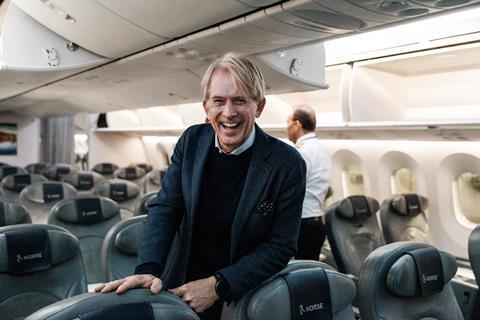
Former SAS commercial chief Roald took the helm of Norse at the end of November and says his mandate is to accelerate development of the new strategy.
“When I accepted this position… I could see that this company has a very good foundation for becoming a very profitable company in future,” Roald said, speaking during his first earnings call since the taking the role. He highlights the attractive long-term leases Norse has for its 787s, high load factors for its network services and the balanced deployment of its fleet between network and wet-leasing operations which helps counter seasonality issues.
”They took strategic measures and they have now implemented the measures and we now see the results,” he says.
While Norse’s net losses were broadly unchanged in the fourth quarter at $33 million, he highlights a 27% jump in revenues to $156 million and a 19% reduction in its unit costs during the three months to December.
”Q4 is a quarter with two months where we struggled a little bit in October and November and then we saw the turning point in December,” Roald adds, pointing to the addition of more Asia-based destinations to its network as a factor alongside the IndiGo wet-lease work which helped drive its improved cost performance.
Norse passenger numbers were up 22% in December on 14% higher capacity and unit revenues across its own network improved 6%. “December was a profitable month for Norse – even though we had some one-time costs,” he says.
Roald sees this momentum continuing into this year, pointing to a 20% year-on-year increase in January unit revenues on its network. ”This shows the turnaround that started in December accelerated in January and now continues. On the revenue side we are quite confident,” he says.
”I do also see some need for improvements when I look into the company,” he adds. ”I think we need an even more clear business idea of what we should focus on. We need to optimise the network to make sure that we reach the right destinations and also the utilisation of our aircraft. We need to accelerate the commercial initiatives and ensure we have flexible crew agreements to make sure we can meet the different needs in the market.”
To this end Norse has launched a cost and revenue savings programme, Project Falcon. Roald says: ”The Falcon project is focusing on a number of measures to secure that we are a company that is profitable and where the investors can have trust in us. We think we are now in a good position to deliver a company that will now be profitable in the coming months.”
It is against this backdrop that Norse is projecting it can deliver a profitable 2026. It is guiding for an EBITDAR in the range of $130-150 million and a pre-tax profit of between $20-40 million.
”As far as we can see into the future, we have a super-interesting product that the response from the market is very high and we are very confident that we will deliver these numbers for 2026,” Roald says.