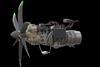


















Rolls-Royce has emphasised its scepticism over the open-rotor concept, as it unveils its ducted UltraFan 30 candidate for future narrowbody programmes.
Although Airbus is encouraged by the potential of CFM International’s open-rotor RISE project – particularly its high fuel-efficiency – it has not committed to adopting the technology to power its proposed next-generation single-aisle aircraft.
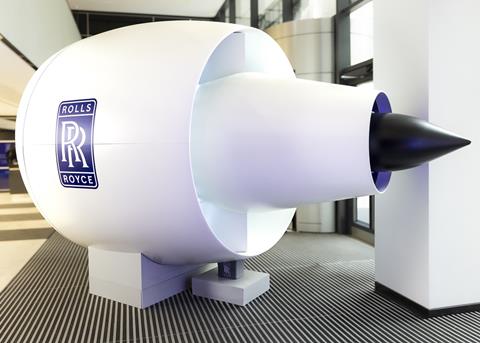
Rolls-Royce showed off a mock-up of the UltraFan 30, a more conventional ducted design, on 26 February.
Director of research and technology Alan Newby tells FlightGlobal that Rolls-Royce, having reviewed the open-rotor argument after looking into the possibilities a decade ago, remains unconvinced.
“We had [in our previous project] two high-speed, two low-speed windtunnel entries looking at noise and high-speed performance,” he says. “And we learned a lot about that, about how to design unducted propulsion systems.
“So we’re speaking from a position of knowledge. But, equally, that was 10 years ago – we’ve been back, we’ve validated our understanding with externals to make sure we’re not drinking our own bath water.”
Newby says Rolls-Royce has recruited outside institutes and universities to “check our logic”. He accepts that the high bypass ratio offered by open-rotor designs is “fundamentally good” for improving fuel-burn. But airframe integration is a serious concern.
“So yes, I’ve got this propulsion efficiency. But when I install it on an aircraft I’ve got to do a number of things.”
Newby says noise would have to be absorbed before reaching the cabin, which would require additional weight for attenuation.
“Another thing, for example, is how do I accommodate fan-blade off? So I do need to armour it,” he adds. “And then the final one is about how the propulsion system interacts with the wing and what it does to the overall aerodynamics.”
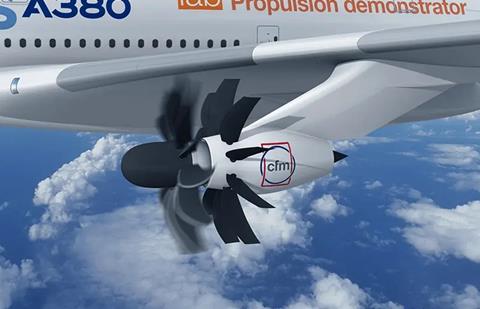
Airbus and CFM are to test the RISE open-rotor system on a modified A380, in order to examine engine-wing integration as well as validate performance.
Newby remains doubtful. “I can do windtunnel work. I can do simulations, if you like, and I can go and fly on an A380,” he says.
“But the time you realise whether it works or not is when you run that first engine on your production aircraft. That’s a long way down the road. That discovery of risk is a long time in the process.”
He says Rolls-Royce favours the ducted configuration after weighting performance against risk.
“We’ve gone into it with our eyes open. We’ve looked at the previous data. And, on balance, we’re sticking with what we’ve got. We think it’s the right solution,” he says.
Rolls-Royce group director of engineering Simon Burr adds that ducted fans are still a competitive alternative to open rotor designs.
Burr points out that the UltraFan 30 is intended for flights in which a “significant time” is spent in descent. “If you look at the operational curve for the engine, we think it’s a decision of a balance of attributes,” he says.
“No one’s questioning that, theoretically, open architectures can offer more. But overall, once you’ve taken all the factors into account, you can close the gap to within a few percentage points.”