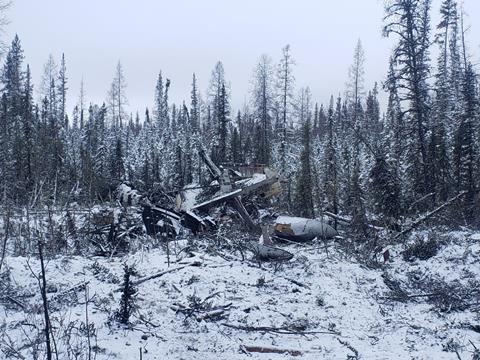














Pilots of a British Aerospace Jetstream 32 that crashed in Canada two years ago likely failed to notice the aircraft started descending prior to crashing because they were distracted by a recurring landing gear issue.
That is according to the Transportation Safety Board of Canada (TSB), which attributes the crash, which killed six of seven people aboard the aircraft, to the pilots’ actions and to broader company issues.
“As they likely focused on the landing gear issue and airspeed, the crew did not detect the loss of altitude until immediately before impact. The aircraft struck trees and terrain approximately 10 seconds after the descent began,” the TSB says in a final accident report released on 5 March.
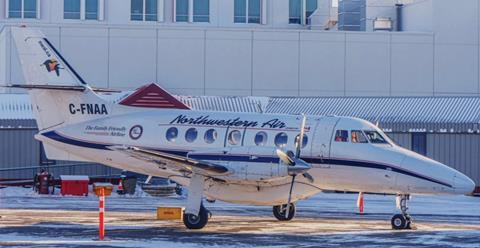
The accident involved a Northwestern Air Lease flight on 23 January 2024 from Fort Smith airport in Canada’s Northwest Territories to Diavik Aerodrome, also in the Northwest Territories.
The Jetstream (registration C-FNAA) had a recurring problem: the main landing gear sometimes failed to lock in the retracted position. The issue occurred at temperatures colder than -20°C (-4°F) and at speeds exceeding 140kt (259km/h), the TSB says.
Northwestern’s pilots and mechanics knew of the problem, but mechanics were unable to replicate it. And, being sporadic, “the consensus” within the airline was that the issue presented no safety concerns and did not warrant being entered into the aircraft’s log book.
The TSB’s report notes that the Jetstream operating manual includes an abnormal checklist calling for pilots to land if the gear fails to lock when retracted. But Northwestern’s pilots used “a simple and informal… workaround”: they would slow the aircraft and increase pitch, which caused the gear to lock.
The company could not be reached for comment. The TSB says Northwestern halted scheduled flights and stopped operating Jetstreams in January 2025.
The accident occurred shortly after the Jetstream got airborne from Fort Smith. The captain had “intentionally kept a low pitch attitude and a high airspeed” to remove snow that might have accumulated on the aircraft. As a result, the Jetstream was flying lower than standard, the report says.
The pilots attempted to raise the landing gear, but the cold temperature and fast speed caused one of the main gears – likely the left – not to fully retract.
In response, the captain reduced engine power to slow the aircraft, causing the turboprop to “enter an inadvertent descent at 140ft above ground”, the report says.
It slammed into the ground, killing the two pilots and four of five passengers. One passenger was ejected from the aircraft and survived.
“The captain and first officer were likely preoccupied with the abnormal main landing gear indication and the aircraft’s airspeed and did not notice the aircraft’s loss of altitude until immediately before impact,” the TSB says.
“Adaptations to standard operating procedures that are normalised but not formally implemented can lead to inconsistent practices,” it adds.