













UK investigators are recommending that ATR examines possible causes of electrical failures on its -500 models in which both pilots lose primary flight displays, after an unresolved inquiry involving a Loganair aircraft.
The aircraft, an ATR 42-500, had been climbing out of Aberdeen when it experienced a loss of multiple cockpit displays at about 10,000ft, just as the first officer turned off the landing lights.
Both pilots’ attitude directors and horizontal situation indicators went blank, along with two other displays, while the autopilot disengaged and the air-conditioning packs shut down.
Engine torque indications rolled back to zero and the crew felt a momentary deceleration. The multifunction control display unit and advisory display unit also blanked.
The displays and systems returned when the first officer quickly turned the landing lights back on – which meant the failure lasted only about 3s – but a similar failure occurred once the aircraft had returned to Aberdeen and the landing lights were again turned off.
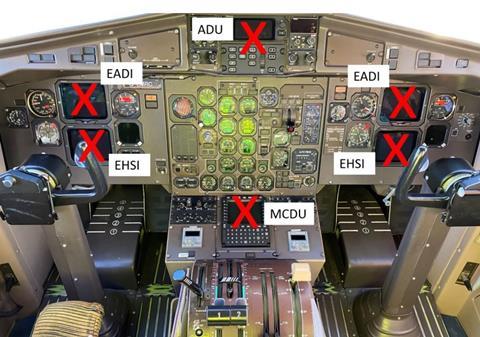
Fortunately the aircraft had been flying in daylight and visual conditions, which meant the captain could maintain control without referencing the instruments.
“Had the failure not rectified itself, and the aircraft been [flying at night or in instrument conditions], the crew would have had an increase in their workload as they would have been flying the aircraft with reference to only the standby instruments,” says the Air Accidents Investigation Branch.
It adds that the captain had not trained for such a scenario in a simulator.
Although the probe – which has run for three-and-a-half years – revealed a stuck-contactor fault, leaving it unable to supply back-up power to the emergency electrical network, this was not the cause of the power loss.
The inquiry says the initial cause “could not be determined” despite “extensive testing and examinations”.
Recorded data showed clear evidence of power loss from the various DC busses – including the essential, standby and emergency busses – but the inquiry considered whether one of the busses, designated DC BUS 2, was suffering from an undervoltage rather than a complete loss of power.
Analysis suggested a single failure involving the battery switch, or associated wiring, could explain loss of the emergency electrical network. But the probe says “no such faults were found”.
No link between the activation of the landing-light switches and a loss of DC BUS 2 power could be identified, and no faults were found in the lights or their relays.
The battery switch, landing-light relays, and the faulty contactor were replaced and the aircraft (G-LMRC) did not experience a recurrence of the 27 August 2022 incident.
“This suggests that the battery switch [or] landing-light relays may have had a part to play,” says the inquiry. “However, a functioning [contactor] could have masked a reoccurrence of the underlying fault by supplying back-up power.”
Investigators have recommended that ATR continues investigating possible causes of the failure “given the potential seriousness of a repeat” in differing circumstances. The inquiry turned up three similar electrical-failure events, in 2018 and 2019, involving -500 variants – the later -600 models have different avionics – but none was subject to a formal safety investigation.