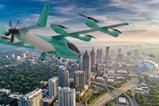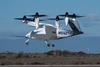














Toulouse-based hybrid-electric start-up Ascendance Flight Technologies has begun final assembly of its Atea vertical take-off and landing (VTOL) aircraft as it targets a piloted first flight in the coming months.
Equipped with the company’s own Sterna hybrid powertrain, the Atea combines a fan-in-wing configuration for vertical flight with pusher and puller propellers for cruise flight. According to the company, it will be capable of carrying four passengers on routes of up to 215nm (400km).
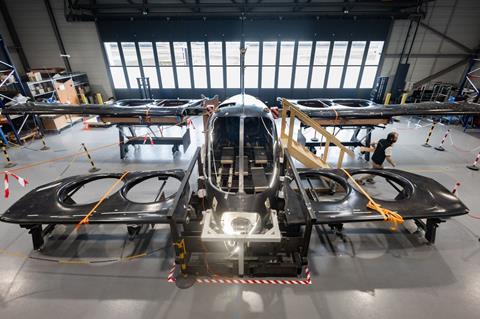
Chief commercial officer Thibault Baldivia says the company is now finalising assembly of the airframe which should be “complete in the next couple of weeks”, prior to the installation of the powertrain and other systems.
Although wary of specifying a precise first flight date, Baldivia says it will “definitely be this year, a few months from now”.
“It’s really looking good – we are excited to have it up in the air,” he says.
Ascendance has previously flown three sub-scale demonstrators, but for the past four years has concentrated its energies on development of the full-scale prototype, including extensive windtunnel and simulator testing.
Additionally, the developer has evaluated the propulsion system using its ‘iron bird’ test rig, accumulating over 500h of ground runs over the last four years.
“We have achieved the results we wanted to see – we have finalised the design and it’s time to put everything in the aircraft and flight test it,” says Baldivia.
It plans a flight-test campaign lasting 18-24 months, but in parallel will begin work on the first serial aircraft. Service entry is in 2029-2030 timeframe, he says.
Baldivia believes that flying the prototype with a pilot on board will provide a smoother path to certification due to “very stringent process” required to obtain an experimental permit to fly. “It opens the door for future certification,” he says.
Ascendance’s fan-in-wing configuration – four fans in the canard and four in the wing – is similar to the design adopted by Canadian developer Horizon Aircraft.
But while Horizon has opted for closing wing covers to improve the aerodynamics in forward flight, Ascendance has left its fans uncovered.
Baldivia says due to the specifics of its low-drag design, a closing mechanism would use more energy to deploy than the wing loses in forward flight.
However, should it seek a higher maximum cruise speed as a future improvement, it may revisit the concept. An alternative performance boost may instead be to grow capacity from four to six passengers, he notes.
Meanwhile, Ascendance hopes to ship the first Sterna powertrain to an external customer by year-end.
Baldivia sees a growing market for the propulsion system for civil and military applications, including fixed-wing aircraft and large uncrewed air vehicles.
While the Sterna system in the Atea uses a turbogenerator from French firm Turbotech, the powertrain is engine-agnostic and could use piston or turbine engines – or even fuel cells – depending on customer requirements.
To date, Ascendance holds more than 600 letters of intent for the Atea and “we have started to sign our first deposit-backed place-holders and we expect an acceleration after first flight.”
Funding to date has come from a variety of sources including BPI France, the country’s investment bank, the Dassault family and early stage venture capital fund Expansion Ventures.
Ascendance has raised over €60 million ($70 million) so far, with Baldivia estimating it will require “several hundred million” to bring the Atea to market.
However, revenues from Sterna sales, plus customer deposits, will help to reduce the reliance on external investors, he says.