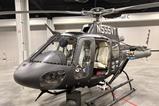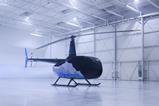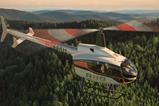














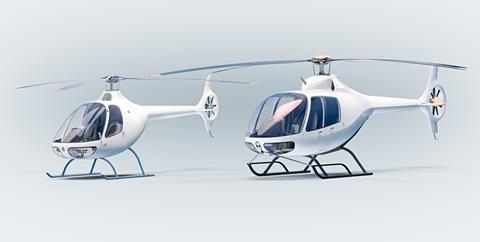
Pioneering light helicopter manufacturer Guimbal has confirmed one of the industry’s worst kept secrets, launching – in the softest way possible – a “bigger brother” of its two-seat Cabri G2.
Featuring a four-blade main rotor, shrouded anti-torque tail rotor, turbine engine and space for four passengers and one pilot, the Grand Cabri G5 is a significant upgrade on the piston-powered G2.
Bruno Guimbal, founder and chief executive of the French firm, says development of the new rotorcraft was driven by operator demand.
“When we started to deliver helicopters 15 years ago we very quickly found that whenever we met [customers] the first question they asked was nothing to do with the G2, but it was ‘how about a bigger brother, how about a four-seater?’,” he told journalists in a mid-February briefing.
But that long gestation period has given the firm “the time to refine the strategy”, he says. “We went through different options and we are now [able] to introduce what all those options became.”
Despite “making the programme official” at the Verticon show in Atlanta, Guimbal is not revealing a timeline for its development.
“I’m not very comfortable with that. I’m not ready to give you a timeline, even though I know it’s very easy to give a milestone and then change it.
“Everybody wanted [us] to be very quickly here and we are not going to jeopardise the whole company independence just to save a few years,” he stresses.
Guimbal says the G5 meets operator demands for “Cabri DNA and modern helicopter DNA”, providing “something to bridge between the Cabri and the [Airbus Helicopters] H125”.
For many years, that niche was occupied by the Airbus Helicopters H120, a five-seater powered by the Safran Helicopter Engines Arrius 2F. But after years of dwindling sales, Airbus axed the programme in 2017.
Indeed, Guimbal was deputy chief engineer for four years on what was then the Eurocopter EC120, during his stint at the Airbus Helicopters forerunner.
Of course, that means while he fond of the H120, as it later became, and acknowledges its popularity “it is no secret that the EC120 was underpowered”.
The Grand Cabri, he says “will have nothing to do with the EC120 in terms of performance”, which for its 1.7t maximum take-off weight was able to fly 383nm (710km), at a cruise speed of 122kt (226km/h).
Guimbal says the new helicopter will use a similar turbine engine as the H120 – the 450hp (335kW)-rated Arrius 2D, which is equipped with a dual-channel FADEC.
It leans on certain aspects of the G2, boasting a composite fuselage and similar high-aspect-ratio main rotor blades.
Guimbal’s goal is for the G5 to offer true “multi-mission capability”, he notes, adding: “The G2 is a very good helicopter but its missions are quite limited.” In fact, around 85% of Cabri operations are training, he says.
His vision for the G5 is as a “mini-H125”, offering the same “excellent performance and outstanding versatility”.
Additionally, despite being smaller overall than the H120, the Grand Cabri features the same size cabin, aided by a “compact” engine and gearbox installation to free up cabin space.
Meanwhile, Airbus Helicopters has taken an undisclosed minority stake in Guimbal, largely driven by a need to secure its supply chain for the G2-based VSR700 naval drone as it enters serial production.
Guimbal says the stake is “not significant… it’s only a legal and financial problem” and will not alter the company’s governance or independence.