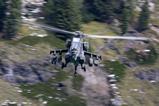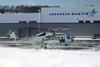

















After a development process now stretching into its 15th year, Bell appears increasingly confident that its 525 super-medium-twin is on the home straight.
But conscious of multiple missed targets in the helicopter’s recent past – it has been in development since 2012 and first flew in 2015 – Bell is not ready to say whether 2026 will be the year the 525 finally achieves Federal Aviation Administration (FAA) certification.
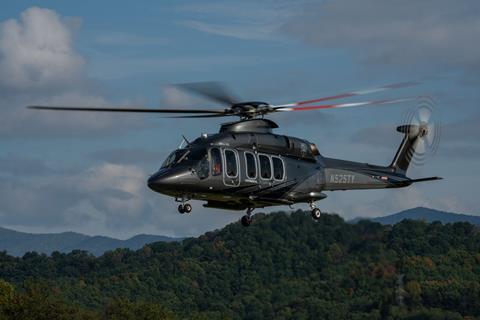
While Danny Maldonado – newly appointed as Bell’s chief executive – says one of the firm’s targets for this year is to “achieve certification” for the 525, programme chief Mike Deslatte points out that it is not in the company’s hands.
“We don’t own the timeline with the FAA, but what I can tell you is that team has never been closer.
“We have never enjoyed the amount of momentum that we have got today with the FAA. As is sits today we have no more on-aircraft testing left to do; there’s no flight testing left to do.”
Deslatte says all that remains to be completed are a pair of regression tests using its systems integration lab facility in Arlington, Texas to ensure the continued safety of its fly-by-wire control system in the event of “an unanticipated [system] failure”.
Once the test parameters are agreed with the FAA, the actual amount of test work left is around six to eight weeks, he says.
As soon as those “prerequisite tests are completed”, the airframer will embark on a 150h function and reliability test campaign using pre-production aircraft 15.
Meanwhile, one 525 (prototype 3) is wrapping up the latest phase of cold weather testing in Yellowknife, Canada, while its sister ship, aircraft 14, is performing anti-icing tests in Marquette, Michigan.
Deslatte says the transfer of those aircraft to testing for “post-type cert’ upgrades and capabilities” is a “pretty good signal that we are close to the end”.
On top of the company’s own test campaigns, oil and gas operator Omni Helicopters International will conduct its own post-certification evaluation programme in Guyana. Expected to last around six months, this will rack up around 500 flight hours using aircraft 16, the first production example, says Deslatte.
Two pilots from Omni recently completed 525 familiarisation training using Bell’s simulator, Deslatte adds.
Bell’s only publicly declared customer for the 525 is Norwegian energy company Equinor, which in 2024 unveiled an agreement for 10 examples, with deliveries of four units scheduled for 2026.
That target seems almost impossible to meet given the likely pace of European certification. Deslatte declines to speculate on how long it will take to receive validation from the European Union Aviation Safety Agency, but typically such processes take at least 12 months after the initial type certification, likely pushing delivery to Equinor into 2028 at the earliest.
Deslatte will also not say how many serial 525s have so far been built or allocated to potential buyers. “We see tremendous customer interest,” he says. “We have a lot of customers waiting on type certification [then] you’ll see a surge in momentum here.”
Featuring fly-by-wire controls and powered by twin GE Aerospace CT7 engines, Bell sees the 525 as a long-term replacement for the Sikorsky S-92 in the offshore oil and gas segment, with search and rescue and VIP missions also envisaged.