















Leonardo Helicopters has doubled down on its pursuit of a future tiltrotor aircraft, unveiling a new “optimised” design even as it ramps up flight testing of an EU-funded technology demonstrator.
In the meantime, the airframer continues pressing ahead with the slow-running certification campaign for the AW609 – a programme now well into its third decade of development.
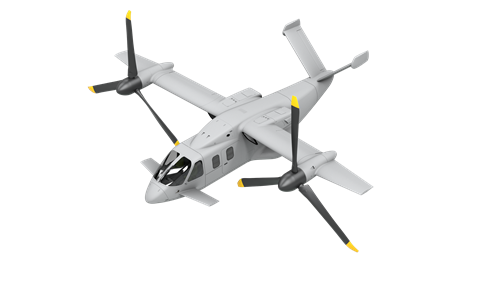
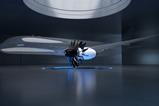
Disclosing the new concept, which it calls the Advanced Tiltrotor Aircraft – Next Generation Military (ATA-NXM), Matteo Ragazzi, director of engineering and innovation, says the design came from asking, “What is the most efficient tiltrotor?”.
While the ATA-NXM leans heavily on certain features of the Next Generation Civil Tiltrotor (NGCTR) – a technology demonstrator backed by the EU’s Clean Sky 2 programme – there are several key differences.
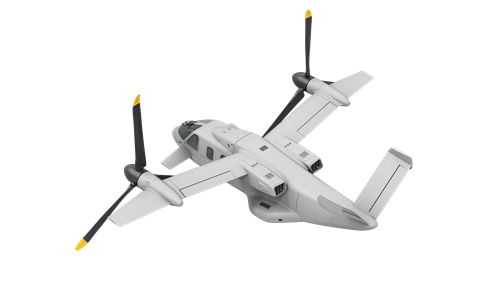
Like the NGCTR, it has straight wings rather than the forward-swept structure of the AW609, composite fuselage, a V-tail with vertical tips, and similar proprotors.
However, the ATA-NXM gains canards on its nose for better stability (also opening the path to a rear ramp), and its engines are separate from the tilting proprotors and moved inboard to the wing root, simplifying the gearbox configuration and improving aerodynamics.
Additionally, the wing now extends beyond the proprotor, further enhancing aerodynamic efficiency.
Ragazzi says the initial design was based on an aircraft with a maximum take-off weight (MTOW) of 11-13t but believes it is scalable from 8t all the way up to 18t. “We were seeing that it was still floating and possible,” he says.
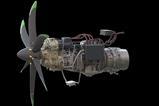
On top of which, the concept enables the use of current turboshaft engines like the GE Aerospace CT7s powering the NGCTR, a move that effectively “decouples” engine and airframe development.
“If you don’t want to develop a brand-new engine, this is the [design] with less power required,” he says.
At this stage, the ATA-NXM remains just a concept, but should it evolve into a development programme, the time required will be “much shorter” – around 50% less than for the AW609, says Ragazzi.
Although Leonardo Helicopters has one eye on the future, it continues to test in the here and now, carrying out more flights of the NGCTR.
Having performed its maiden sortie on 19 December, the NGCTR technology demonstrator returned to the skies on 25 February – showcasing the capability to stakeholders including Clean Sky 2 representatives; in total it has now accumulated around 30min of flight time.
Funding from Clean Sky 2 ran until completion of the first flight, but Ragazzi says the airframer will continue to bankroll further tests and “keep expanding the envelope and test different flight regimes”.
Indeed, flight testing will carry on for “as long as it’s needed and as long as someone gives me some money”, says Ragazzi.
In addition to its own R&D budget, Leonardo Helicopters will draw from the €100 million ($115 million) European Defence Fund-backed EU Next Generation Rotorcraft Technology programme, he says.
The second phase of the that military-focused initiative, in which it is partnered with Airbus Helicopters, recently got under way.
At its inception, the NGCTR was intended to mature five key technology bricks incorporated in its design, including:
- an advanced wing architecture featuring morphing surfaces to improve hover performance and state-of-the-art composite construction
- a thermoplastic V-tail to improve handling, cut drag and reduce interference from the wing
- a non-tilting engine installation – opening up powerplant choice – with a high-efficiency nacelle architecture like that on the Bell MV-75
- a split-gearbox drivetrain
- an advanced, modular, distributed and scalable flight-control system that cuts weight and complexity.
Ragazzi says the V-tail, a collaboration with GKN/Fokker, will test both the aerodynamic configuration – its vertical tips increase the span, much like an airliner’s winglets – and the thermoplastic material itself.
“It is a technological solution that we applied already on other aircraft but wanted to see if we could do it with such a big component,” he adds.
Its proprotors also feature blades with a slight tip anhedral, and Leonardo Helicopters is currently analysing their suitability for the AW609 programme, although that aircraft will enter service with its current blade design.
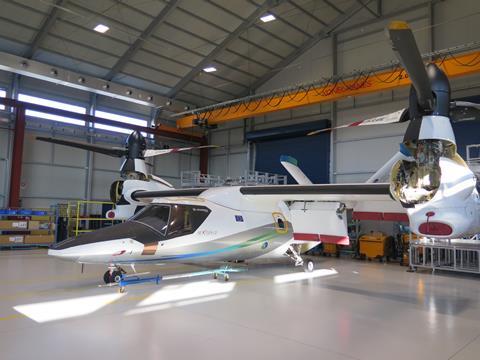
The NGCTR also has an additive-layer manufactured (ALM) proprotor gearbox support, while “the only part on the AW609 that’s ALM is the exhaust”, says Ragazzi.
Airbus Helicopters has also developed the Racer, its own Clean Sky 2-funded technology demonstrator. In addition to maturing another set of technology bricks, one Racer goal is to achieve cruise speed of 220kt (427km/h) while cutting fuel burn.
However, Ragazzi says the NGCTR has no need to chase speed goals. Airbus Helicopters had “to prove a point that we didn’t need to prove”, he says, given the established performance of the AW609. Leonardo Helicopters lists its maximum cruise speed as 270kt.
While that figure may have been established through flight testing, the AW609 has still not entered service amid the continued slow pace of Federal Aviation Administration (FAA) certification.
Testing continues with two prototypes, AC4 and AC5, while a sixth aircraft will shortly roll out from the manufacturer’s AW609 final assembly line in Philadelphia in the United States. That asset will be used for function and reliability testing.
Likely stung by previous predictions that have not panned out, Ragazzi no longer offers a forecast of when the AW609 will receive regulatory clearance.
He had hoped certification flights would wrap up this year, but given lack of clarity from the FAA he is now uncertain of timing.
Regardless, the first three customer aircraft – the manufacturer has previously declared six firm orders – are in various stages of production in Philadelphia.
And despite the uncertain timeline, the programme is still attracting operator interest, with several potential buyers having recently flown the aircraft. “There is constantly a queue of people coming in to trial their missions,” says Ragazzi. However, further commercial activity is on hold until certification.
Additionally, the company continues to work with multiple Italian governmental bodies, including the army, navy and Guardia di Finanza, and with others thought to be interested.
But with the NGCTR already demonstrating a more-advanced tiltrotor architecture than the AW609, is the latter aircraft still relevant?
Ragazzi thinks so: “We need a first generation to start building [from],” he says. Besides, it is not just about the aircraft, he argues, there is also a need for the wider ecosystem and operators to be ready.
“It is not conventional what we have in front of us – you need to have [operators] learn; it is still a new architecture.”
Support for the concept is also maintained at the top of the company. Leonardo Helicopters managing director Gian Piero Cutillo says the tiltrotor architecture ”is really overcoming the embedded limits” of traditional vertical-lift platforms and that ”we continue to believe” in its value.
Although conceding the certification process ”seems like a never-ending story”, he maintains that ”we are really making some important progress”.