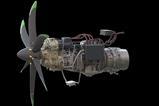
















Safran Aircraft Engines is ramping up system-level testing for a future open-fan engine as it builds towards full-scale ground tests next year of the front module – including the 4m (13ft)-diameter fan – and ultimately flight tests of a complete powerplant in 2029.
Delphine Dijoud, deputy vice-president engineering and R&T at Safran Aircraft Engines, says the company is “progressing across all the different fields” required for the open-fan development.
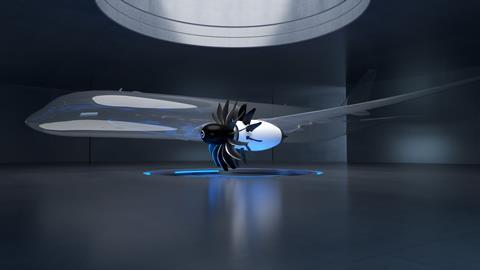
“Everything is progressing in parallel and honestly, each week there is something new,” she said, speaking to FlightGlobal at Clean Aviation’s annual forum on 18 March.
Safran’s efforts are contributing to the RISE technology demonstrator it is developing within its CFM International joint venture with GE Aerospace.
To date, the French propulsion specialist has racked up 400h of windtunnel testing, and 200-plus mechanical tests for the resin transfer moulding-produced fan blades, including ingestion and high-cycle vibration tests.
Another round of windtunnel testing also recently commenced in Austria, assessing the performance of the fan blades in icing conditions.
Evaluations of a new high-speed booster are meanwhile under way at sister company Safran Aero Boosters in Liege, Belgium, assessing the performance of low-, intermediate- and high-pressure compressors.
On top of which, testing was conducted last year on the compact gearbox for the low-pressure module that has been developed in co-operation with Italy’s GE Avio, yielding “very good results on performance and efficiency”, she says.
“We are doing everything to make sure these technologies are robust,” adds Dijoud.
“Now we are getting ready for an exciting moment where we will have a full-scale front module of the open-fan in our new test cell.”
Specially designed, the new 8m-diameter test cell is in the process of being constructed at Safran Aero Engines’ facility in Villaroche near Paris, part of a range of investments across the company to ready for the next-generation development.
Including everything from the fan to the gearbox, the assembly of the front module “will be truly emblematic because it will be the first image of what [it] will look like,” she says.
“What will be key for us is that while we had pretty promising results, component by component, now the question is really about integration at module level, or even further, at aircraft level.”
Those ground tests will start in “early spring” next year and run for around three months, says Dijoud.
Notably, tests of the front module will include bird ingestion and partial blade-out tests, the latter a critical consideration for later installation on an A380 testbed being developed by Airbus through the COMPANION project, which will also look at integration challenges.
Although some of the development work has been supported by projects funded at national level or from Safran’s own internal research and technology budget, significant chunks of the open-fan effort have been backed by the EU’s Clean Aviation body,
In fact, Safran is leading a pair of parallel Clean Aviation projects, OFELIA – which runs until mid-2027 – and its successor, TAKE OFF, work on which began in February.
Essentially, OFELIA is about maturing the underlying technologies necessary for an open-fan engine, while TAKE OFF brings an integrated powerplant to flight readiness and includes interaction with the regulator to obtain a permit to fly.
GE will be supplying a “donor core” for the flight-test phase – adapted from its Passport business jet engine – as the point of the technology demonstration is to evaluate the open-fan architecture rather than an entirely new engine. GE is separately developing a new compact core for the RISE engine and also contributing to low-pressure system development.
“What is important for this demonstration is to have the low-pressure system – the front and rear modules – representative of a new product,” says Dijoud.
“They are many virtues – to keep it simple and to avoid some risks and also to have a parallel effort. Otherwise, if you wait until you get a new core to do the demonstrator it will be late in the game.”
Assembly of the first flight-test engine, featuring a “more product-representative front module”, will begin in 2028.