















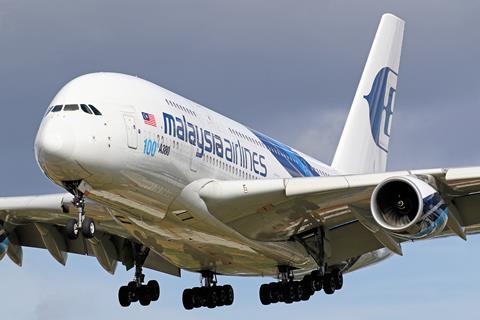
At some point in the next 12 months, a freshly-painted A380 will arrive in Toulouse ready for Airbus to begin a series of modifications that will eventually leave it looking like no other superjumbo in existence.
Acquired from former owner Malaysia Airlines as part of a buy-back deal, the quad-jet – MSN114, the 100th example built – will be transformed into a flying testbed, allowing the airframer to evaluate next generation narrowbody engines from 2029.

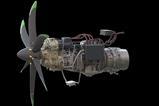
Which means that by the time 2029 rolls round, if all goes to plan, not only will it sport a smart new paint job showcasing Airbus’s FlightLab colours, it will also have a radical new powerplant – CFM International’s RISE open-fan technology demonstrator – attached in the number two engine position.
While the FlightLab aircraft is designed to serve as a testbed for any engine – and potentially other technologies – its first mission is focused on the RISE.
Airbus announced in 2022 that the open-fan demonstrator being developed by the GE Aerospace-Safran joint venture would first fly aboard an A380, although back then it appeared to have selected its earliest prototype, MSN1, to serve as the testbed aircraft.
But, explains Stephane Perrin Decroux, head of propulsion of tomorrow flight-test demonstrators at Airbus, as that example last year reached the 20th anniversary of its first flight, age ultimately weighed against it.
As the goal is to end up with a platform that supports development for the decades, “starting with an aircraft already 20 years old was deemed too risky”, he says. By way of comparison, MSN114, at just 12 years old, is a relative spring chicken.
Indeed, the aircraft is currently in Abu Dhabi, having its 12-year check and other maintenance tasks performed by Etihad Engineering.
Painting will take place later this year before MSN114 returns to Toulouse ready to be modified for its new role, work on which is due to commence in 2027.
CLEAN AVIATION
Airbus is not working in isolation: conversion of the A380 is being part-funded by the EU through its Clean Aviation initiative under a €25.7 million ($30 million) project called COMPANION.
Kicking off in January 2024, COMPANION aims to “define, design and prepare a common flight-test demonstrator platform to enable the validation of ultra-efficient propulsion systems developed in Clean Aviation… at full scale and in a wide envelope of realistic operational conditions”.
It is linked to a pair of narrowbody-orientated projects – Safran-led OFELIA and its successor TAKE OFF (both focused on open-fan engines), and SWITCH (a hybridised gas turbine).
In addition to changes required to the aircraft itself, COMPANION is developing flight-test instrumentation (FTI) required to measure multiple performance parameters, including aerodynamics, loads, noise and emissions.
The big three propulsion specialists all use dedicated flight-test assets, chiefly the Boeing 747, to test engines, though aircraft OEMs rarely get involved this early in the development process.
But because an open-fan engine is such a step into the unknown, particularly in relation to aircraft integration, Airbus is keen to gather as much data as possible ahead of a potential programme launch.
DATA COLLECTION
Broadly speaking, Airbus’s data efforts fall into two pillars: aerodynamic and structural loads the open-fan architecture imposes on the wing and airframe, and the thrust the engine produces versus the higher level of drag that will inevitably be induced.
In the case of the former, that will include measuring in-plane or 1P loads, a unique characteristic of unducted engines, particularly at high angles of attack, which stresses components in different ways and can affect the controllability of the aircraft.
“It’s really key for us to characterise this so that we can size the future aircraft components correctly,” says Perrin Decroux.
The thrust-versus-drag calculation is important too, due to differences between ducted and unducted engines.
“When you consider a ducted engine on an aircraft it’s pretty easy to say the airframer is responsible for the drag and the engine maker the thrust,” says Perrin Decroux.
“But with an open-fan, due to the fact that there is high interaction between the engine and wing, that notion is becoming a bit fragile, so we need to measure properly what is thrust and what is drag.”
Notably, the project will not evaluate performance of the engine core.
“The purpose for us is really to see, what does it mean getting something unducted – so such a [different] low-pressure module – on the aircraft. We are very interested, but the engine demonstrator definition, as proposed today, does not respond to this need.”
It remains unclear what the demonstrator powerplant that flies in 2029 will be composed of. Ducroux describes it as having a “legacy core” married to an all-new low-pressure system: the fan, outlet guide vanes and mid-fan booster.
It is a fair characterisation, but CFM is staying tight-lipped on the exact composition of the engine.
Although the narrowbody engine joint venture confirms the core will be based and sized after the hot section of the 19,000lb (85kN)-thrust Passport business jet engine produced by CFM shareholder GE, it is implementing numerous technological enhancements to the baseline core specifically for the RISE programme.
Additionally, Ducroux says CFM will introduce upgrades to the low-pressure system “to be closer to the eventual product”.
CFM does not say what those changes are, but adds: “As technologies mature, demonstrator plans are regularly updated to incorporate the latest learnings”.
Originally due to finish in June this year, the updates proposed by CFM, and accepted by Airbus, have caused COMPANION to be extended by 12 months until the middle of 2027.
AIRCRAFT CONCEPT
Airbus has frozen the overall aircraft concept and is “converging on the design [freeze]”, a milestone targeted for the second half of this year. In parallel, it has participated in a concept-review phase for the engine demonstrator, ahead of a preliminary design review this year.
Based on analysis to date, changes required to the A380 are “not so complicated”, says Perrin Decroux, and include modifications to the aircraft’s controls and other systems, such as fuel, plus the location of and routing for the FTI.
The demonstrator will be attached to a bespoke pylon, “so far there is no need to change anything on the wing itself”, he adds.
Airbus is also analysing whether to apply additional shielding to the fuselage and wing to protect against debris from fan-blade releases. Such events pose particular risks to unducted engines due to their lacking nacelles and containment rings.
Perrin Decroux says the team has developed a “robust shielding concept” – additional aluminium panels to be installed on top of the fuselage – implementation of which will depend on future vulnerability studies analysing the potential size of debris and likely trajectories.
Although the first engine tested on the A380 is to be the RISE demonstrator, the open rotor is not its sole focus: around 12 months later the aircraft is to serve as a testbed for a hybridised version of Pratt & Whitney’s PW1100G.
Currently being developed as part of the MTU Aero Engines-led SWITCH effort, this is expected to be taken to flight test as part of Clean Aviation’s second phase (a request for proposals is expected next month).
“We have only one platform – that’s why COMPANION is there to develop a flight-test platform capable of supporting the two campaigns, but one after another: open-fan first and then hybrid second,” Perrin Decroux adds.
HYBRID READINESS
Changes to the aircraft for compatibility with the hybrid PW1100G are expected to be less dramatic – after all, that engine is a known quantity – and include integrating the propulsion system and its high-voltage electrical system.
Flights of this engine are expected around 2030; each campaign is expected to be performed over 6 months.
In both cases, flight clearance is not predicated on the thrust provided by the test engine, although engine behaviour and potential failure cases will still need to be considered.
The A380 will effectively be flying on three engines during these tests – limiting its take-off weight and the length of runways it can operate from. Which means, of course, that should the superjumbo be forced into making an emergency landing at an airfield with a shorter runway, it would run the risk of becoming stuck.
To prevent such a scenario, changes to the engine interface for the test powerplants are designed to permit re-installation of a Trent 900, Perrin Decroux points out.
The superjumbo will also make its first flight post-modification with four Trent 900s installed as Airbus seeks to capture baseline performance data prior to embarking on the RISE tests.
“Then we will be able to compare, back to back, the demonstrator configuration versus the reference,” says Perrin Decroux.