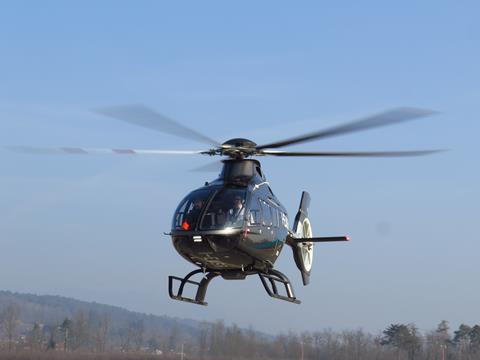















After years of missed deadlines, Leonardo Helicopters believes its AW09 light-single is finally on the home straight, with certification and service entry promised this year.
Of course, the airframer has been here before – as recently as March 2025 pledging that the 2.8t AW09 was on course for European approval later that year – but executives are confident that this time will be different.
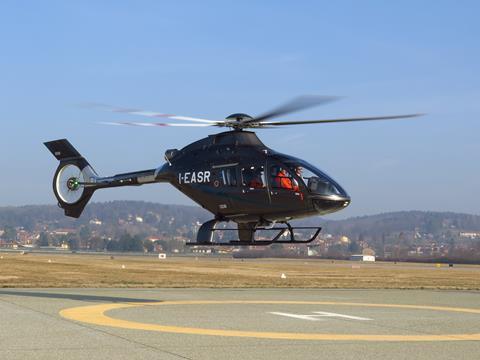
Guglielmo Monguzzi, head of the AW09 programme, says “we expect certification this year”, a promise built “on solid ground” given test campaign progress to date.
The big difference over previous promises, he says, is that “we have scored, we have brought home, all the critical tests that can be passed in a defined way. It is either a pass or not pass – there is no in-between.”
Indeed, the three-strong test fleet has rapidly achieved multiple certification points over the past year since returning to flight last March following a five-month lay-up after non-conforming parts were found to have been installed on aircraft.
“We have three workhorses that are serving the certification campaign – they have already carried out around 500 flight hours that are valid for certification,” he says.
Including several now retired prototypes, the programme has accumulated around 1,000h of flight time, he adds.
Based on current performance, Monguzzi is hopeful AW09 flight testing will wrap up in early in the second quarter, including the crucial 150h function and reliability (FAR) campaign being flown by aircraft S6 – the first production example that arrived in August last year – which is around halfway through that effort.
Flight-test activities are being supported by two pre-serial helicopters – aircraft PS4 and PS5 – all flown from their base in Mollis, Switzerland.
Aircraft PS4 is presently “in the last stages” of its certification programme, carrying out performance assessment and handling qualities testing. PS5, meanwhile, is engaged in load survey activities, with its work culminating in the coming weeks with autorotation tests.
Elsewhere, ground testing is also wrapping up. So far, the airframer has successfully completed multiple points covering the fuel system and drivetrain – including a 15min run-dry test of the main gearbox.
Tie-down endurance testing has also been completed, during which a non-flying prototype was run for around 100h at Leonardo Helicopters’ Cascina Costa base in northern Italy. “This one was an important achievement,” says Monguzzi.
Still to be completed are fatigue tests of the AW09’s composite structure, what he calls the “last chapter of major tests”; this activity is under way and will “proceed for the next couple of weeks”.
While acknowledging there are still certification points still to be addressed, Monguzzi notes that much of the process “is just paperwork to some extent”.
Pilots from the European Union Aviation Safety Agency (EASA) have also been flying the AW09 on a regular basis.
In the meantime, Leonardo Helicopters has already begun building the first customer aircraft at its final assembly plant in Vergiate, Italy.
Its “innovative” production system for the AW09 sees major component assemblies – the transmission, tail, and main fuselage – built at other Leonardo Helicopters’ factories and then shipped, pre-equipped with cabling and other systems, to Vergiate for final assembly.
Customer configuration options are also predefined, simplifying the build process.
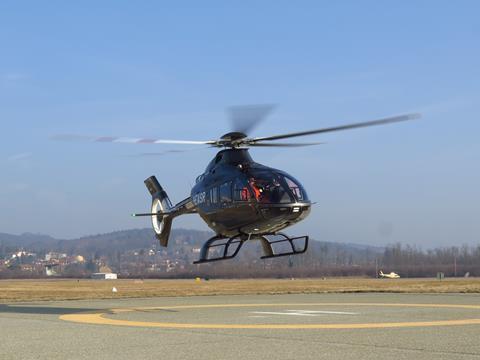
Combined, these initiatives allow a “streamlined approach” that cuts flow time on the line, achieving “quick throughput”.
Monguzzi declines to say how fast Leonardo will be able to build an AW09 at full rate but says the time for final assembly will be “weeks” rather than months.
The AW09’s complete structure is currently made in Brindisi, Italy but will be progressively shifted to Leonardo Helicopters’ Polish subsidiary PZL Swidnik as production ramps up.
Although he will not say how many AW09s will be built this year, “in terms of production demand we are already in a good state” and multiple deliveries are expected in 2026.
First to receive an AW09 will be an undisclosed French operator, which will take more than one helicopter this year, all configured for corporate transport missions. In all, Leonardo holds more than 120 agreements for the Safran Helicopter Engines Arriel-2K-powered AW09.
Familiarisation training with customer pilots is already ongoing, he says, and the company continues to develop the training syllabus in parallel with the certification process.
Monguzzi is hopeful Federal Aviation Administration validation will come “as soon as possible” after EASA type certification – likely around 12 months later – opening the way to deliveries to its large emergency medical services (EMS) customer base in the United States.
Future developments include an expanded hot and high envelope – testing is due later this year and in 2027 – plus the approval, via supplemental type certificates, of multiple kits for the AW09, including aeromedical equipment and a cargo hook for utility operators.
First to be advanced will be an air conditioning system, followed by floats, says Michele Riccobono, director of engineering at Kopter, the Swiss firm whose 2020 acquisition by Leonardo brought the AW09 into its portfolio.
Also in the roadmap is the addition of an autopilot that will permit instrument flight rules certification, a key functionality for EMS operators. Integration should be “a fairly simple process”, replacing existing control rods with actuators.
For AW09 chief test pilot Russ Grant – with the programme since before Leonardo’s purchase – the difference in performance between the early prototypes and aircraft S6 is “chalk and cheese”.
“I remember taking my hands off the controls for about five seconds and that was momentous for the time.
“I would never have flown it at maximum power and not concentrated completely: in high-speed flight it felt like it wanted to go backwards and we weren’t able to turn terribly well – but that’s the joy of development.
“We have just sorted everything out. It’s quite refined now,” he says. “We have loads of manoeuvrability; it’s basically a van with the agility of a sports car.”
“Having been with this programme since 2017 and nursed it through all the modifications and comparing the first flight of PS3 in November 2018… it’s not just a rebranding – it’s a completely different helicopter,” adds Riccobono.
Monguzzi maintains that the original Kopter concept – the large cabin, full composite structure and shrouded tail rotor – has been retained but has been “enriched and strengthened by the experience of a top player like Leonardo.
“We have transformed this idea into a product… something that can be certificated and built,” he says.