















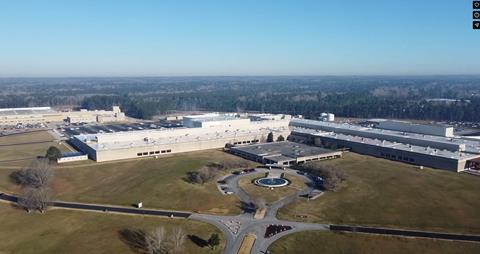
Pratt & Whitney (P&W) will open another engine-manufacturing forging press at its facility near Columbus in Georgia as part of a broader site expansion intended to support the company’s commercial and military engine manufacturing programmes.
The Connecticut-based engine maker revealed the project on 24 February, saying it will invest $200 million on the effort and that the additional “isothermal forging press” will bring the number of such presses at the site to seven.
P&W, like prime competitor CFM International, has for several years been working to ramp production of engines and engine components. Production has been hampered particularly by shortages of cast and forged metallic parts, which tend to be time- and labour-intensive to produce.
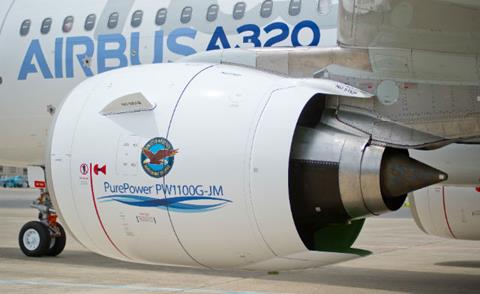
Shortages of such components have kept the engine makers from meeting production goals for their narrowbody aircraft engines – specifically P&W’s PW1000G geared turbofan (GTF) and CFM’s Leap.
P&W has been particularly strained by its global recall of GTFs due to production quality problems; that recall has driven a wave of demand for spare GTFs and for replacement parts.
“This addition is expected to increase output of critical parts, such as rotating compressor and turbine disks, by 30% to support GTF, F135 and other engine programmes. The isothermal forging press is expected to become operational in 2028,” says P&W.
F135s power Lockheed Martin F-35 fighters.
P&W had already been expanding its presence in the Columbus region, where it operates both its Columbus Forge Facility and its Columbus Engine Center. The company performs GTF maintenance at the Engine Center and recently completed a project that added 7,525sq m (81,000sq ft) of space of maintenance space to that site.
P&W now employs more than 2,600 workers in the Columbus region and since 2008 has invested more than $1 billion in those facilities.
“This latest investment will increase output of critical parts for our growing military and commercial engine programmes and underscores our ongoing commitment to ramp industrial capacity to support our customers,” says P&W president Shane Eddy.
P&W badly needs more engine capacity, with prime customer Airbus having to recently pair back 2026 aircraft-delivery targets owing partly to not having enough GTFs.
Several days ago, Airbus chief executive Guillaume Faury said the airframer is “managing” its production ramp-up ”while facing significant Pratt & Whitney engine shortages”.