















Looks can be deceiving. Take as an example Leonardo’s choice of venue for the launch of its new five-year industrial plan by chief executive Roberto Cingolani.
Rather than a plush hotel or conference venue, its showpiece financial gathering was staged in Rome’s Pratibus district, within the shell of a 1920s-era bus depot which has been partially revitalised as a site for corporate events, festivals and art exhibitions.
But from the outside, it looked like an abandoned and neglected shell – a perception only heightened by the torrential rain, thunder and lightning which accompanied the proceedings on 12 March.
Since Cingolani took the wheel at Italy’s aeronautics and defence champion in mid-2023, Leonardo has undergone its own transformation, having previously fallen into something of a rut, with what he describes as “siloed and fragmented” business units.
That situation has changed, with the charismatic CEO now targeting a new era of growth through the company’s recently signed-off 2026-2030 industrial plan.
“After three years, the portfolio is maybe the most completely defined among our peers – this is a competitive advantage that we have now,” Cingolani says. “We can make both manned and unmanned systems in any domain.”

Within the same time, it has increased its payroll from almost 51,400 people working at 105 sites worldwide to nearly 62,800 employees at 131 locations. Its home presence in Italy accounts for roughly 38,000 of its headcount, with 9,300 in the UK, 7,800 in the US and 3,300 in Poland.
In the defence sector, the completed transformation – which includes major advances in the digital arena – “made us credible when we started talking about multi-domain solutions and technologies”, he says.
This year’s presentation centred on the Michelangelo Dome concept launched by Leonardo late last year. An open-architecture integrated air and missile defence capability, this will combine in-service equipment ranging from anti-aircraft guns to long-range interceptors to guard nations – or even Europe as a whole – against attacks ranging in scale from swarms of small drones to ballistic missiles.
After its launch last October, Cingolani says: “Now we have 20 countries that are in contact with us, to see how we can make this.”
Rather than simply selling its own equipment, Leonardo sees the model as enabling it to deliver continually updated services, including cyber-security. “The threats are evolving on a monthly basis, and we are going to evolve on a monthly basis,” he says.
“The first component of the Michelangelo Dome is now under construction for our friends in Ukraine. The first steps will be there, in a real environment, delivered before the end of the year.”
Leonardo is by no means alone in eyeing demand for such a defensive ‘dome’ – indeed, French company Thales on 12 March launched to the market a new command and control capability named Sky Defender.
Achieving success with initiatives like its proposed defensive shield will be key to Leonardo meeting Cingolani’s ambitious growth plans.
“We could survive in a comfort zone with the strong portfolio we have now, but I don’t think this is the target for Leonardo. We really have to develop something which is great.
“Without innovation, Leonardo would go back to where it was before,” he argues.
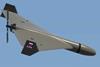
Another example is the LBA Systems joint venture with Turkish developer Baykar Technologies, through which Leonardo will manufacture systems including the Kizilelma uncrewed fighter and medium-altitude, long-endurance Akinci in Italy.
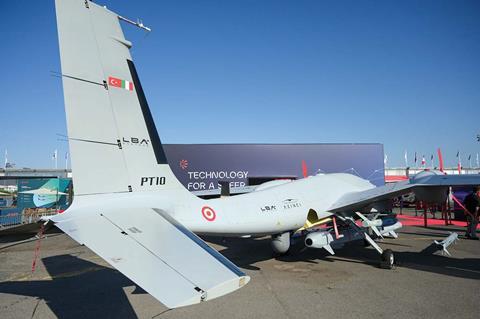
Cingolani sees a strong need for nations to field “adjunct fighters” – a new capability also referred to as collaborative combat aircraft, or autonomous collaborative platforms – noting: “I have very big expectations for drones. This really could be a breakthrough – if you have an unmanned fighter jet you get a really interesting tool… state of the art, but with a cheaper and more flexible approach” versus crewed sixth-generation assets unlikely to be available for a decade or more.
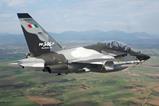
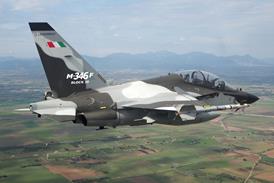
May should see the first demonstration flight of a Leonardo M-346 light-attack aircraft commanding two adjunct fighters; expected to be Kilzilelma vehicles.
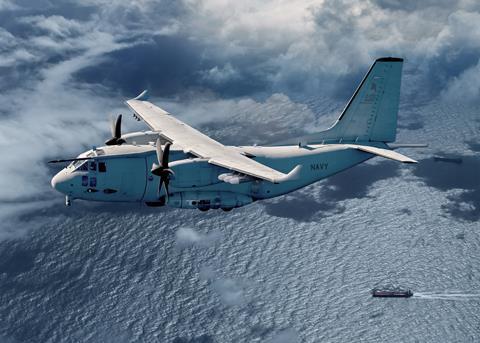
Underscoring such new ways of addressing operational challenges, he made only passing references to what he refers to as “hardware” – the company’s nuts and bolts products like the C-27J tactical transport and M-346 advanced jet trainer, which have respectively landed significant contracts from Saudi Arabia and Austria within the last few months.
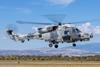
Its highly successful range of military and civilian helicopters only received a passing mention, and the ATR joint venture with Airbus was not referred to at all.
Meanwhile, a long-running effort to establish a new joint venture with an undisclosed potential partner to turn around the company’s aerostructures unit appears to finally be within months of conclusion.
“The business plan and industrial discussion with our partner is concluded, so we know the level of investment necessary,” he says. “Our partner is now waiting for a political response, primarily to do with the possibility of incentives from their government to close the deal. We have agreed to exclusivity until 30 June to let there be a yes or no.”
He notes: “We will do the new joint venture, but in any case, the numbers are improving within aerostructures, so we can say that by ’28 we will have the break-even point. But it’s a technology and industrial policy issue – we have to fix this in a very definite way.”
Leonardo’s business forecast sees orders rising from €23.8 billion ($27.5 billion) last year to a projected €32 billion in 2030 – if achieved, that would represent a rise of 85% against 2022’s figures. The company’s backlog, meanwhile, should increase from €46.6 billion to €62.5 billion during the same period, and its global workforce will climb above 75,000.
“For sure, the company is fully committed. The numbers show that there was an impact from our actions [so far], and now the best should come.”
While there could well be more bumps ahead in the road, Cingolani’s revitalised Leonardo now has a clear route planned, and the technologies to deliver.