














Start-up electric air taxi developer Eve Air Mobility’s research and development expenses ramped up last year as flight testing commenced, with the company now predicting it has sufficient financing to fund its operation through 2028.
Eve is seen as a frontrunner among several electric vertical take-off and landing (eVTOL) developers working to keep their coffers flush as they progress through the incredibly expensive process of aircraft development and certification. FlightGlobal last week reported Eve had completed 28 test flights to date.
Based in Melbourne, Florida, Eve reported on 16 March having lost $224 million in 2025 – 62% more than the $138 million it lost in 2024, a jump Eve attributes to ramping up development.
The company spent $195 million on research and development last year – in line with its expectations but 50% more than spent in 2024. Its fourth quarter 2025 R&D expenses nearly doubled year on year to $59 million.
“The higher accumulated costs and expenses are primarily driven by increased developmental activities necessary to advance our programme,” Eve says, noting, “To date, our business has not generated any revenue”. Competitors are mostly in the same boat.
It ended 2025 with $392 million in cash, cash equivalents and financial investments, up from $303 million at the end of 2024.
Last year, Eve raised $230 million through a stock offering and secured R200 million ($38 million) in loan commitments from the Brazilian Development Bank. Already this year, in January, Eve closed another $150 million loan from a syndicate of lenders.
“We believe the funding is sufficient to support our operations and programme investments through 2028,” Eve says.
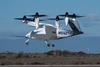
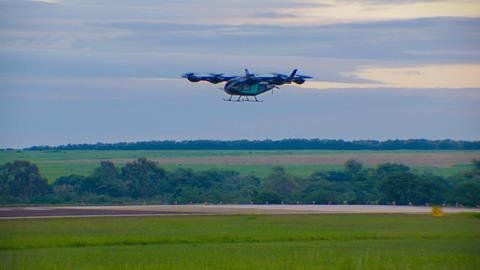
The company has indeed made development progress, completing first flight of its eVTOL engineering prototype on 19 December from its facility in Gaviao Peixoto in Brazil.
The maiden sortie started “what has now become a full-fledged and intense flight campaign” – one so far involving 28 flights and “accumulating more than 1h of flight time”.
“The campaign has been progressing as planned, with initial hover and on-air manoeuvres being performed,” Eve says. “We expect to fly around 300 times with this prototype in 2026; at the current pace, we are well on our way to hitting this milestone.”
The company expects Brazil’s aviation regulator will “soon” set the air taxi’s “means of compliance”, meaning to specify “rigorous tests that our aircraft must successfully perform to receive type certification”.
“We expect to initiate our certification campaign shortly thereafter,” it adds.
Eve plans to produce six production-conforming prototypes of its final air taxi design, dubbed the E100. Those are to be flying next year.
Eve’s air taxi has eight lifting propellers mounted on booms extending from fixed wings, and a “dual-electric-motor” pusher prop.