















The Federal Aviation Administration (FAA) is set to require airlines to inspect 787s for fatigue cracks created by manufacturing errors involving too-large “shim gaps” between structural components.
A proposed airworthiness directive released on 12 March by the FAA is the latest step taken by the regulator to address gap-related structural issues affecting 787s.
Excessively large gaps between fuselage sections required Boeing in recent years to perform rework on dozens of 787s prior to delivery.
The FAA’s new proposed rule responds to an investigation by Boeing into “manufacturing errors and excessive pre-load forces” involving components on the 787’s “lower side-of-body splice plates”.
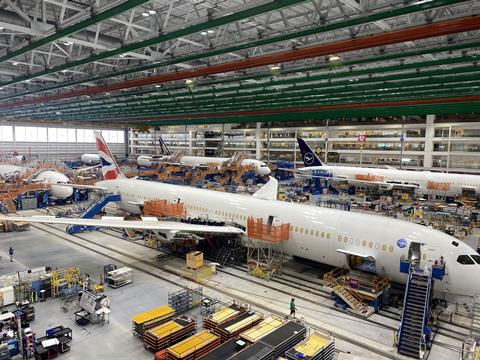
Those splice plates are “common to the lower outboard wing skins”, where they are used to marry structural components.
Boeing’s investigation determined that “shim gaps may have exceeded engineering allowances, and high pull-up forces on the components may cause fatigue cracks to form at the fastener holes”, the proposed rule says.
Those cracks could “weaken primary wing structure until it cannot sustain limit load”.
Boeing in August 2025 took action to address this specific problem by issuing an Alert Bulletin instructing operators to inspect 787s for cracks in components including splice plates, spar terminal fittings, chords and jack pads.
The FAA’s proposed order would mandate those inspections and any required fixes. But it applies to only 17 US-registered 787s, rather than the full US inventory, likely relating to their date of manufacture. The agency is accepting public comments for 45 days.
The proposed rule says Boeing’s “existing structural inspection programme… is not adequate to detect cracking in principal structural elements with sufficient probability” prior to failure.
Boeing says, “We support the FAA making that guidance mandatory. The 787 global fleet can continue normal operations. We identified the root cause of this issue and corrected it in production.”
The company several years ago was scrambling to address issues with oversized gaps between some sections of the 787’s composite fuselage. In 2024, news broke that the FAA was investigating the issue after it had been flagged by a whistleblowing Boeing engineer.
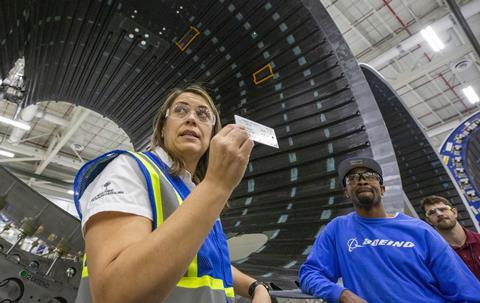
That led Boeing to host reporters at its 787 manufacturing site in North Charleston, South Carolina to explain the issue and to emphasise that Dreamliners are safe.
Boeing functional chief engineer Steve Chisholm said full-scale 787 fatigue testing, involving 165,000 simulated flights, resulted in “zero findings in fatigue in our composite structure”.
While the excessive gaps did not jeopardise flight safety, Boeing said, it needed to fix undelivered jets because the gaps exceeded FAA-approved specifications.
Chisholm reviewed the role pull-up forces, splice straps and shims play in joining the 787’s massive fuselage sections.
Workers initially bring sections together using what they call “fit-up force”. Then, if gaps between sections are too large, they are supposed to fill those gaps with shims.
Workers then add more force – this time called “pull-up force” – to align the sections a final time for the permanent join. They marry the sections using splice straps (which overlap the inside of the structures being joined) and fasteners.